
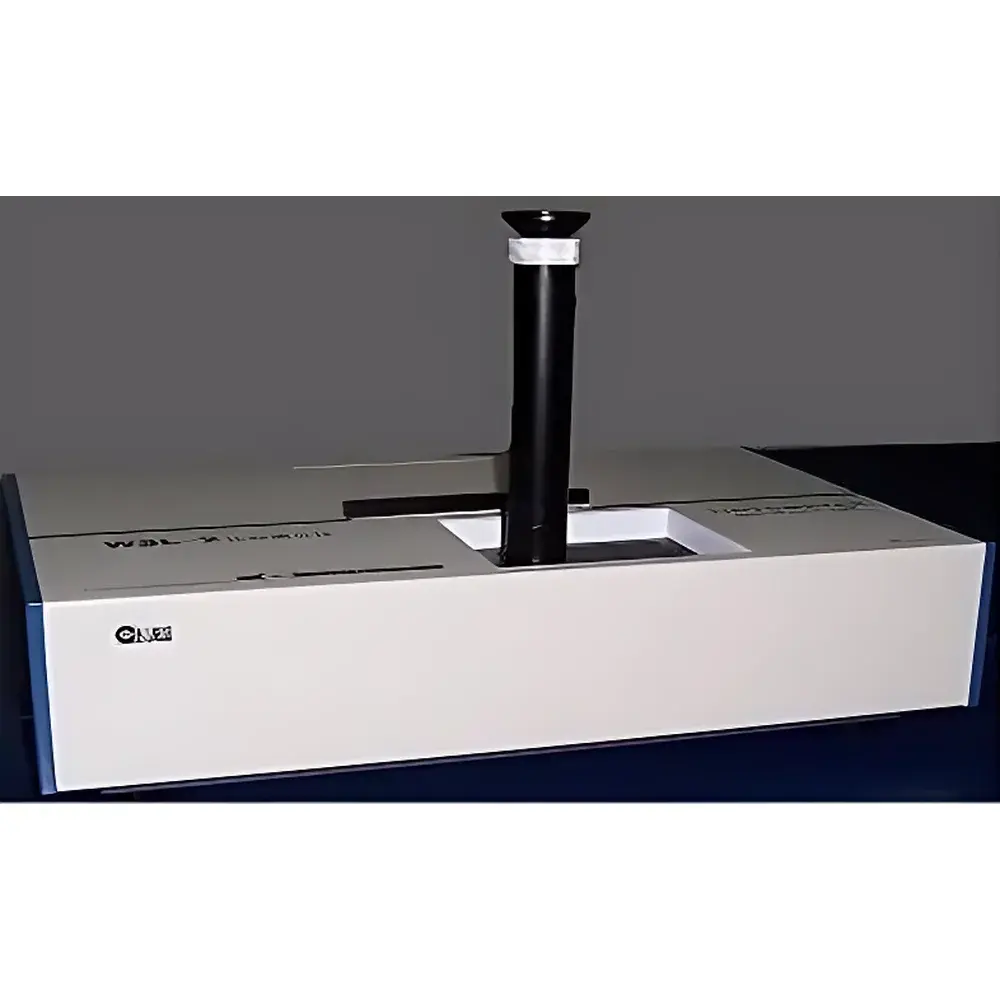
Weissmann WSL-2 Lovibond Tintometer
| Brand | Weissmann |
|---|---|
| Origin | Shanghai, China |
| Manufacturer Type | Authorized Distributor |
| Country of Origin | China |
| Model | WSL-2 |
| Pricing | Available Upon Request |
| Red Scale | R0.1–R79.9 Lovibond Units |
| Yellow Scale | Y0.1–Y79.9 Lovibond Units |
| Blue Scale | B0.1–B49.9 Lovibond Units |
| Neutral (Grey) Scale | N0.1–N3.9 Lovibond Units |
| Minimum Resolution | 0.1 Lovibond Unit |
| Net Weight | 12.5 kg |
Overview
The Weissmann WSL-2 Lovibond Tintometer is a precision visual color comparison instrument engineered for objective, repeatable color assessment in food quality control laboratories and production environments. Based on the internationally standardized Lovibond® color scale system—first established by Joseph Lovibond in 1865 and subsequently codified in ASTM D1209, ISO 2761, and AOAC Official Method 952.05—the WSL-2 enables quantitative evaluation of color in liquid, semi-solid, and translucent food matrices via direct visual match against calibrated glass color standards. Unlike spectrophotometric systems, the WSL-2 operates on the principle of subtractive color mixing using fixed-tint glass filters arranged in standardized red (R), yellow (Y), blue (B), and neutral (N) scales. Its optical path is optimized for consistent illumination geometry (D65 daylight simulation), controlled viewing angle (0°/45°), and observer-independent standardization per CIE 1931 observer functions. This makes it particularly suitable for routine QC where regulatory compliance, method traceability, and operator-to-operator reproducibility are prioritized over spectral data acquisition.
Key Features
- Full compliance with the Lovibond color scale architecture: R0.1–R79.9, Y0.1–Y79.9, B0.1–B49.9, and N0.1–N3.9 units, each calibrated to NIST-traceable reference standards
- High-stability tungsten-halogen light source with integrated D65 daylight filter and thermal stabilization to minimize chromatic drift during extended operation
- Ergonomic dual-view optical design enabling simultaneous side-by-side comparison between sample and standard, reducing subjective bias
- Robust aluminum alloy chassis with vibration-damped base plate, ensuring mechanical stability during manual adjustment of filter dials
- No software dependency or calibration drift: all color values derived directly from physical glass standards, supporting audit-ready documentation under GLP/GMP frameworks
- Integrated alignment verification tool and zero-reference neutral slide for daily operational checks per internal SOPs
Sample Compatibility & Compliance
The WSL-2 accommodates a broad range of food-grade samples including edible oils (soybean, olive, palm), syrups (corn, maple, invert), beverages (beer, fruit juices, soft drinks), dairy products (butter, whey, condensed milk), and processed sauces (tomato paste, soy sauce). Sample cells are available in standard 10.0 mm, 25.4 mm, and 50.0 mm path lengths (quartz or borosilicate), compatible with ASTM D1500 and ISO 2049 specifications. All measurements adhere to the fundamental assumptions of the Lovibond method: homogeneous, non-scattering, optically clear samples at controlled temperature (20 ± 0.5 °C recommended). Instrument validation follows IQ/OQ protocols aligned with FDA 21 CFR Part 11 requirements for manual analytical instruments used in regulated food manufacturing. Certificate of Conformance includes traceability to UK National Physical Laboratory (NPL) Lovibond reference sets.
Software & Data Management
The WSL-2 is a fully manual, analog color comparator with no embedded electronics or digital interface. As such, it requires no firmware updates, cybersecurity validation, or electronic record management. Color results are recorded manually in laboratory notebooks or LIMS-integrated paper-based forms, satisfying FDA 21 CFR Part 11 §11.10(a) for “systems that do not create, modify, maintain, or transmit electronic records.” Each unit ships with a validated logbook template compliant with ISO/IEC 17025 clause 7.7 (result reporting) and includes a unique serial-numbered calibration certificate issued by the authorized distributor’s metrology lab. Audit trails rely on handwritten entries with date/time, analyst ID, and raw Lovibond unit notation (e.g., “R24.3 + Y38.7 + B12.1 + N0.9”), ensuring full traceability without digital dependency.
Applications
- Quality release testing of refined vegetable oils per AOCS Cd 13b-92 and ISO 10520
- Batch consistency verification in caramel color production (E150a–d) against EU Commission Regulation (EC) No 1333/2008 Annex II
- Monitoring Maillard reaction progression in roasted coffee extracts and malted barley
- Verification of natural pigment stability in fruit juice concentrates exposed to thermal processing
- Raw material acceptance for annatto, paprika, and turmeric extracts per USP-NF monographs
- Internal specification alignment for private-label food manufacturers supplying retailers with strict color tolerances (e.g., Walmart SFS, Tesco QMS)
FAQ
Is the WSL-2 compliant with FDA or EU food safety regulations?
Yes—the instrument implements the Lovibond scale as referenced in multiple FDA-recognized methods (e.g., AOAC 952.05) and EU food additive specifications. Its manual operation eliminates electronic record concerns under 21 CFR Part 11.
Can it measure opaque or particulate-containing samples?
No—per ASTM D1209, the WSL-2 requires optically clear, non-scattering samples. Turbid or suspended-phase materials must be pre-filtered or centrifuged prior to analysis.
How often does it require recalibration?
Glass standards are inherently stable; annual verification against NIST-traceable reference sets is recommended. Daily zero-check with the neutral slide satisfies routine operational qualification.
Does it support custom color scales beyond Lovibond?
No—it is purpose-built for the four-parameter Lovibond system. Conversion to CIELab or other color spaces requires empirical correlation studies per ISO 11664-4.
What training is required for operators?
A two-hour competency session covering illumination alignment, standard selection logic, and result notation meets ISO/IEC 17025 clause 6.2.2 requirements for personnel competence.





