
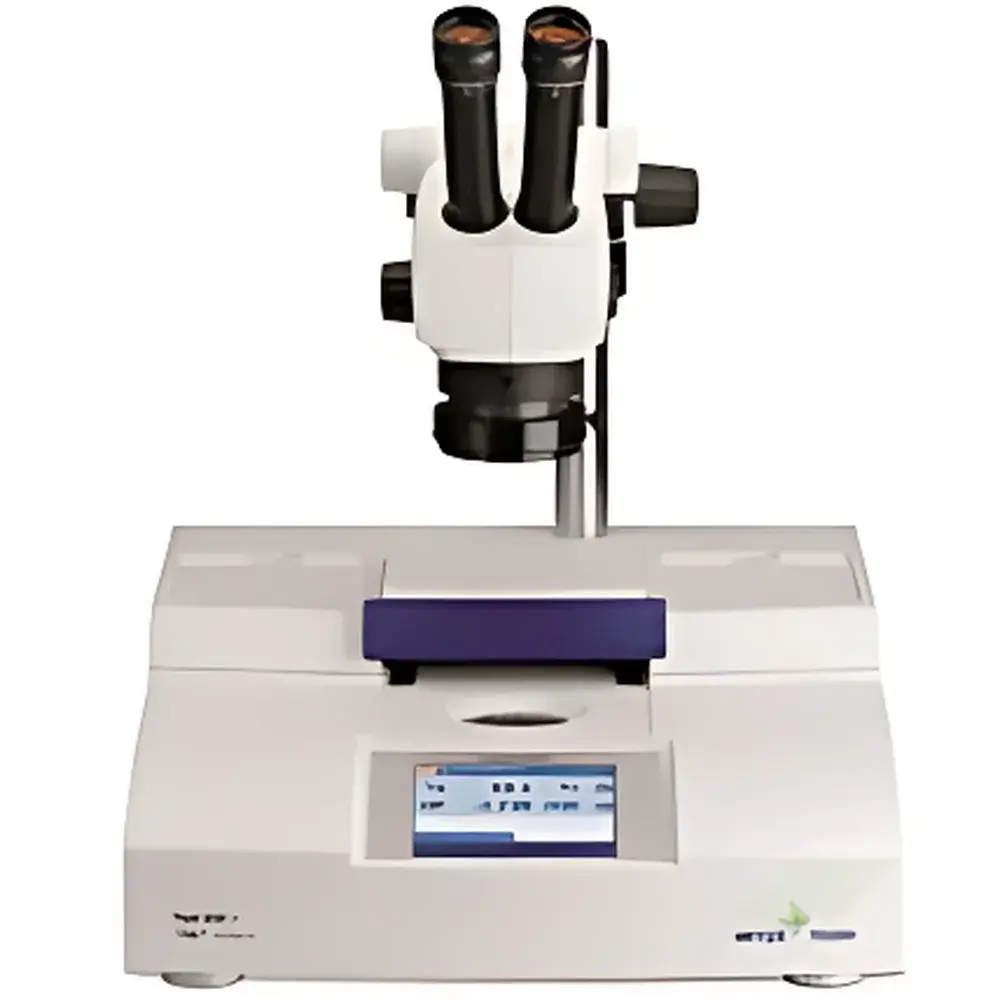
METTLER TOLEDO Flash DSC Ultra-Fast Differential Scanning Calorimeter
| Brand | METTLER TOLEDO |
|---|---|
| Origin | Switzerland |
| Model | Flash DSC |
| Temperature Range | –95 to 450 °C |
| Heating/Cooling Rates | Up to 10⁶ K/s (heating), up to 10⁵ K/s (cooling) |
| Sensor Response Time | < 1 ms |
| Sample Mass Range | 1–500 ng |
| Compliance | ISO 11357, ASTM E794, ASTM E1269, USP <1151>, FDA 21 CFR Part 11 (with optional software module) |
Overview
The METTLER TOLEDO Flash DSC is an ultra-fast differential scanning calorimeter engineered for nanoscale thermal analysis under extreme heating and cooling conditions. Unlike conventional DSC systems that operate at rates up to 100 K/min, Flash DSC employs a proprietary chip-based sensor architecture with integrated micro-fabricated heaters and thermocouples, enabling controlled heating rates from 0.1 K/s to 10⁶ K/s and cooling rates up to 10⁵ K/s. This capability allows direct observation of non-equilibrium phenomena—including vitrification, cold crystallization, solid-state polymerization, and ultrafast phase transitions—that are kinetically suppressed or unresolvable in standard DSC measurements. The instrument operates on the principle of heat-flux differential scanning calorimetry, where minute thermal events are detected via real-time comparison of heat flow between sample and reference micro-sensors on the same silicon chip. Its design targets fundamental materials research, formulation development, and process optimization where thermal history, structural metastability, and nanoscale domain evolution are critical parameters.
Key Features
- Ultra-High Scan Rates: Programmable heating rates spanning seven orders of magnitude (0.1–1,000,000 K/s) and cooling rates up to 100,000 K/s enable access to previously inaccessible kinetic regimes.
- Nanogram-Scale Sensitivity: Optimized for sample masses between 1 and 500 ng, minimizing thermal lag and maximizing signal-to-noise ratio for thin films, nanocomposites, and single-crystal fragments.
- Sub-Millisecond Sensor Dynamics: Integrated MEMS-based sensor with thermal response time < 1 ms ensures fidelity in capturing rapid enthalpic events such as flash-induced crystallization or explosive decomposition onset.
- Extended Temperature Range: Operational range from –95 °C to 450 °C supports low-T glass transitions in cryogenic polymers and high-T melt behavior in engineering thermoplastics and metallic glasses.
- Chip-Based Sample Mounting: Disposable sensor chips with pre-patterned gold electrodes simplify preparation, eliminate crucible-related artifacts, and ensure consistent thermal contact across repeated runs.
- Modular Thermal Control: Independent regulation of chip temperature, furnace base, and ambient enclosure enables precise thermal gradient management and minimizes parasitic heat loss.
Sample Compatibility & Compliance
Flash DSC accommodates a wide variety of solid-state samples—polymers, pharmaceuticals, alloys, ceramics, and organic small molecules—in powder, film, fiber, or bulk micro-fragment form. Sample preparation requires no encapsulation; direct deposition onto the sensor chip ensures minimal thermal resistance and eliminates pressure-dependent effects common in sealed crucibles. The system complies with international thermal analysis standards including ISO 11357 (plastics — determination of transition temperatures), ASTM E794 (melting and crystallization temperatures by DSC), ASTM E1269 (heat capacity measurement), and USP (thermal analysis in pharmaceutical characterization). When configured with METTLER TOLEDO’s STARe software and audit trail modules, it meets data integrity requirements per FDA 21 CFR Part 11 and supports GLP/GMP-compliant workflows through electronic signatures, user access control, and immutable raw data archiving.
Software & Data Management
Controlled via METTLER TOLEDO’s STARe (Scientific Thermal Analysis and Research) software platform, Flash DSC provides synchronized acquisition of heat flow, temperature, and time data with 10 kHz sampling resolution. The software includes dedicated modules for kinetic modeling (e.g., isoconversional analysis using Friedman and Ozawa–Flynn–Wall methods), multi-step temperature programming, and comparative overlay of ultrafast vs. conventional DSC traces. All raw data files are stored in vendor-neutral .q4 format, supporting third-party analysis in MATLAB, Python (via open-source pyDSC libraries), or OriginLab. Data export options include CSV, PDF reports with embedded metadata (operator, timestamp, calibration ID), and XML-based structured archives compliant with laboratory information management systems (LIMS).
Applications
- Characterization of amorphous drug stability and recrystallization kinetics under pharmaceutically relevant thermal stress profiles.
- Mapping of nucleation barriers and crystal growth velocities in semi-crystalline polymers subjected to quench-cooling protocols.
- Quantification of latent heat and phase transformation enthalpies in shape-memory alloys during rapid thermal cycling.
- Thermal degradation onset detection in flame-retardant composites under simulated fire exposure conditions.
- Fundamental studies of glass transition broadening and fictive temperature evolution in chalcogenide glasses.
- Validation of molecular dynamics simulations through direct experimental benchmarking of predicted relaxation timescales.
FAQ
How does Flash DSC differ fundamentally from conventional DSC instruments?
Flash DSC uses a micro-electro-mechanical sensor chip with integrated heating/temperature sensing elements, eliminating thermal mass limitations inherent in furnace-based DSC. This architecture enables true nanosecond-scale thermal transients, whereas conventional DSC is constrained by macroscopic sensor inertia and heat transfer delays.
Can Flash DSC data be directly compared with results from standard DSC systems?
Yes—through overlapping measurement windows (e.g., 10–100 K/s), Flash DSC provides continuity with legacy DSC datasets. The instrument’s calibrated heat flow scale and standardized baseline correction algorithms ensure quantitative comparability across scan rate domains.
Is specialized training required to operate Flash DSC?
Basic operation follows METTLER TOLEDO’s standardized thermal analysis workflow; however, interpretation of ultrafast kinetics requires familiarity with non-isothermal solid-state reaction models. Application support and method development workshops are available through certified METTLER TOLEDO Application Centers.
What sample preparation techniques are recommended for optimal reproducibility?
Samples must be uniformly dispersed or deposited as thin layers (< 1 µm thickness) on the sensor chip surface using spin-coating, drop-casting, or focused ion beam sectioning. Residual solvent content must be minimized to avoid spurious endothermic peaks during ultra-rapid heating.
Does Flash DSC support automated sample changers or high-throughput configurations?
No—due to the chip-based architecture and nanogram-scale sensitivity, Flash DSC is designed for method development and deep mechanistic investigation rather than routine throughput. Each measurement requires manual chip handling and calibration verification.



