
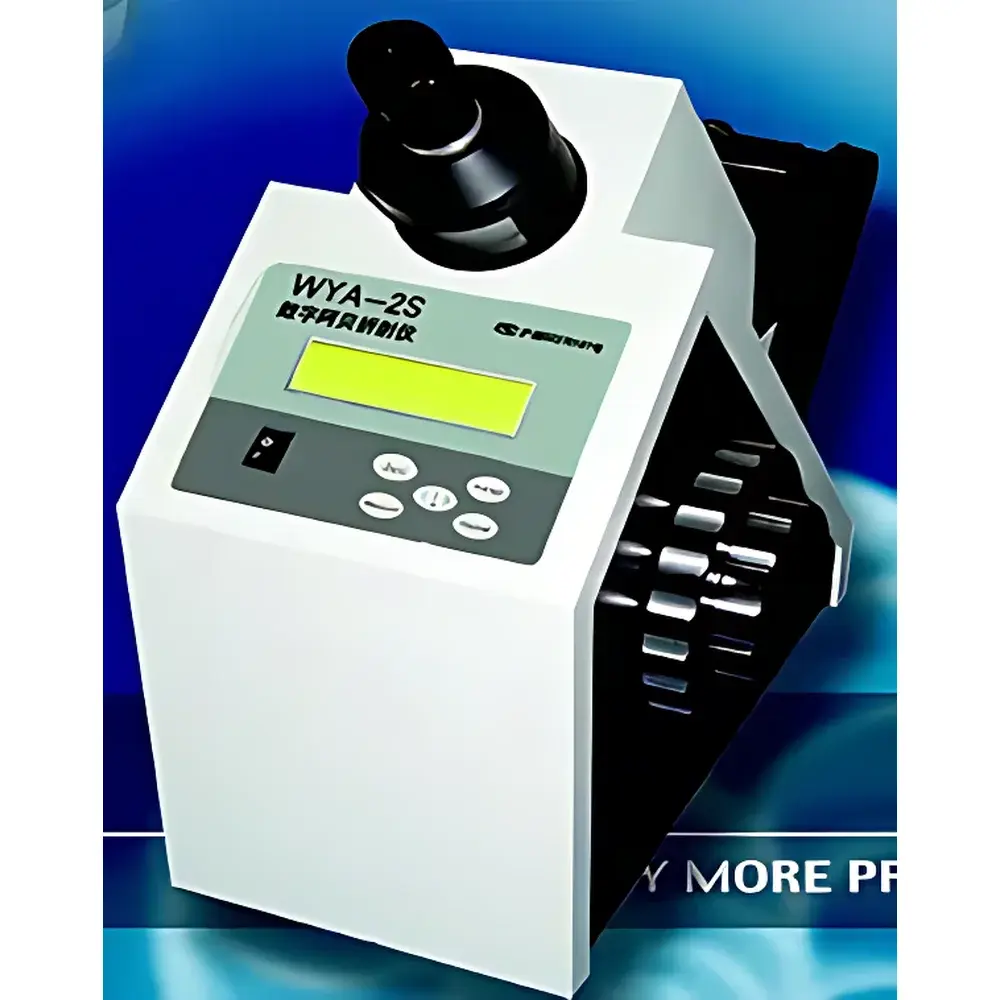
Gerber WYA-2W Digital Abbe Refractometer
| Brand | Gerber |
|---|---|
| Model | WYA-2W |
| Measurement Range | nD 1.3000–1.7000 |
| Accuracy | ±0.0002 (nD), ±0.1% (Brix) |
| Temperature Display Range | 0–50 °C (0.1 °C resolution) |
| Mass | 10 kg |
| Interface | RS-232 serial port for data output |
Overview
The Gerber WYA-2W Digital Abbe Refractometer is a precision optical instrument engineered for high-reproducibility measurement of refractive index (nD) and Brix concentration in transparent or translucent liquid and solid samples. Based on the classical Abbe principle—utilizing total internal reflection at the prism-sample interface—the instrument determines nD by locating the critical angle of refraction under monochromatic sodium D-line illumination (589.3 nm). Its dual-scale digital readout simultaneously displays refractive index and mass-based Brix values, enabling direct correlation between optical property and solute concentration. Designed for laboratory environments requiring traceable, operator-independent results, the WYA-2W integrates a thermally stabilized measuring prism and a high-resolution digital temperature sensor (0.1 °C resolution, 0–50 °C range), allowing real-time temperature compensation per ISO 21542 and AOAC Official Method 932.12. The device complies with fundamental metrological requirements for refractometric analysis in regulated industrial QA/QC workflows.
Key Features
- Abbe-type optical design with precision-ground, hardened glass measuring prism (nD calibration traceable to NIST SRM 1484)
- Dual-parameter digital display: refractive index (nD, 4-decimal resolution) and Brix (% w/w, 0.1% resolution)
- Integrated Peltier-assisted temperature sensing with automatic nD-to-Brix conversion using standard ICUMSA and AOAC temperature correction algorithms
- RS-232 serial interface compliant with EIA/TIA-232-F for direct connection to LIMS or laboratory PCs; supports ASCII data streaming with timestamp and sample ID tagging
- Robust cast-aluminum chassis (10 kg mass) minimizing vibration-induced measurement drift; ergonomic prism cover with spring-loaded clamping mechanism ensures consistent sample film thickness
- No moving optical components—eliminates alignment drift and reduces long-term calibration frequency
Sample Compatibility & Compliance
The WYA-2W accommodates homogeneous liquids (e.g., sucrose solutions, glycerol-water mixtures, pharmaceutical syrups), molten solids (e.g., resins, waxes above softening point), and polished solid plates (glass, polymers) via optional solid-sample attachment kit. It is not suitable for opaque, highly scattering, or volatile low-boiling-point samples (<60 °C boiling point). Instrument performance aligns with ASTM D1218 (refractive index of hydrocarbon liquids), ISO 21542 (optical properties of building materials), and USP (refractometry in pharmaceutical excipient testing). Data acquisition meets FDA 21 CFR Part 11 requirements when paired with validated software enabling electronic signatures, audit trails, and user access controls.
Software & Data Management
While the WYA-2W operates as a standalone instrument, its RS-232 port enables integration with third-party data acquisition platforms supporting Modbus RTU or custom ASCII protocols. Typical deployment includes connection to LabArchives ELN or Thermo Fisher SampleManager LIMS via serial-to-USB adapters. All transmitted records include instrument ID, measurement timestamp, ambient temperature, sample temperature, nD, Brix, and operator code. Firmware supports configurable data output format (CSV or fixed-field) and auto-incrementing sample IDs. No proprietary software is bundled; users retain full control over data ownership and archival compliance.
Applications
- Quality control of sugar content in fruit juices, soft drinks, and dairy concentrates per ICUMSA Method GS4/8-12
- Concentration verification of antifreeze glycol solutions (ethylene/propylene glycol) in automotive and HVAC maintenance
- Batch release testing of ophthalmic solutions and injectables where osmolality correlates with nD
- Raw material identity testing for solvents (e.g., ethanol, acetone) in chemical manufacturing per ASTM D1218
- Educational use in university physical chemistry labs for studying partial molar volumes and solvent-solute interactions
- Monitoring polymerization degree in resin synthesis via nD trend analysis
FAQ
Does the WYA-2W require external calibration standards?
Yes—routine calibration requires certified reference fluids: distilled water (nD = 1.3330 at 20 °C) and bromonaphthalene (nD = 1.6580 at 20 °C), both traceable to NIST or equivalent national metrology institutes.
Can it measure samples below 0 °C or above 50 °C?
No—the integrated temperature sensor and prism thermal mass are rated only for 0–50 °C. External thermostatted stages may extend operational range but void factory calibration unless revalidated.
Is Brix conversion valid for non-sucrose solutions?
The built-in algorithm assumes sucrose-water matrix. For fructose, glucose, or mixed-sugar systems, users must apply empirical correction factors derived from independent HPLC or densitometric validation.
What is the minimum sample volume required?
Approximately 0.5 mL is sufficient to fully cover the prism surface (25 × 15 mm active area) without overflow or air entrapment.
How often should the prism surface be cleaned?
After every sample change—using lint-free lens tissue and spectroscopic-grade ethanol or isopropanol—to prevent residue-induced refractive index hysteresis.



