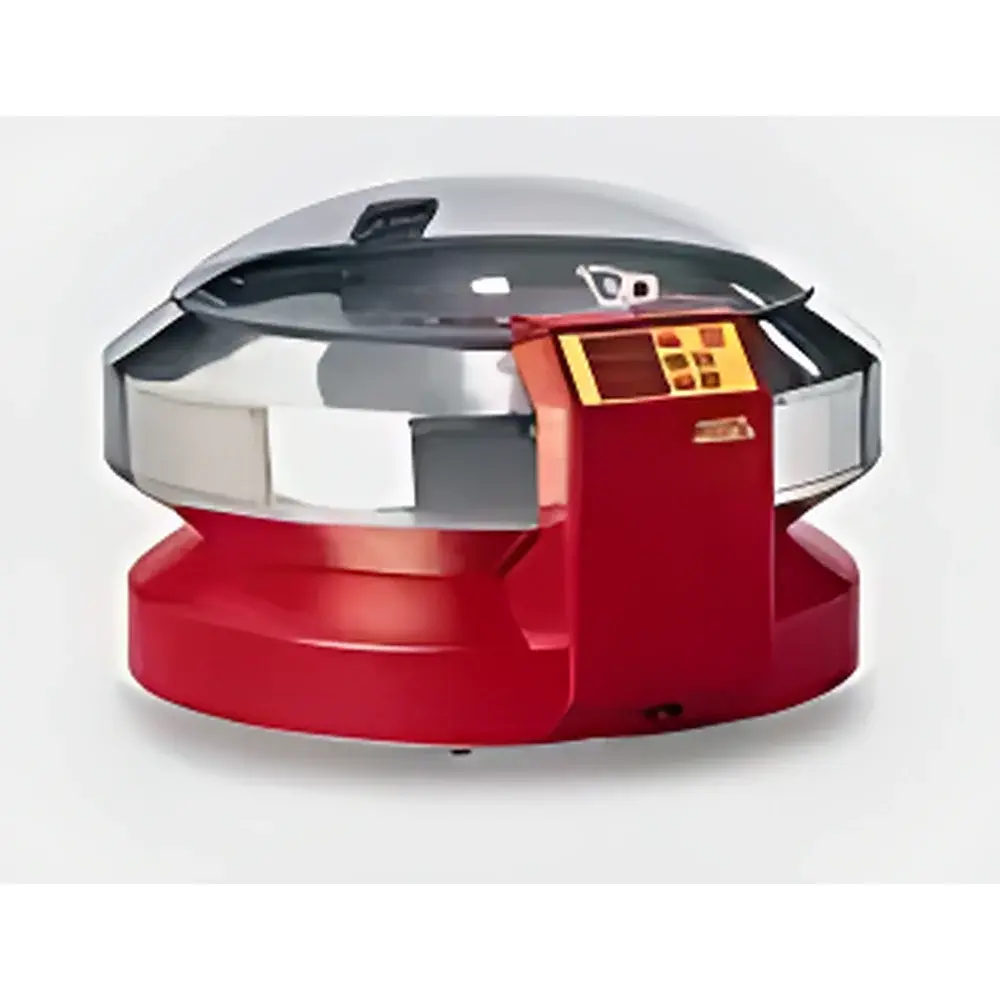
Gerber SUPER-VARIO-N Multi-Method Dairy Centrifuge
| Brand | Gerber |
|---|---|
| Origin | Germany |
| Model | SUPER-VARIO-N |
| Max Speed | 1130 rpm |
| Speed Adjustment | 10 rpm increments (600–1130 rpm) |
| Heating Range | Ambient to 68 °C (1 °C increments) |
| Timer Range | 1–99 min |
| Chamber Material | Stainless Steel |
| Safety Features | Automatic lid lock and brake system |
| Sample Capacity | 12 positions for Mojonnier and solubility methods |
| Compliance | Designed for ASTM D129, ISO 1735, IDF 14, and AOAC 923.04 dairy fat determination protocols |
Overview
The Gerber SUPER-VARIO-N Multi-Method Dairy Centrifuge is an engineered solution for standardized fat quantification in liquid dairy matrices—primarily raw milk, pasteurized milk, cream, and recombined dairy products. It operates on the principle of differential sedimentation under controlled centrifugal force and thermal conditioning, enabling precise phase separation of fat globules from aqueous and protein phases. Unlike general-purpose benchtop centrifuges, the SUPER-VARIO-N integrates method-specific rotor geometry, programmable thermal control, and timed acceleration/deceleration profiles optimized for four internationally recognized dairy fat analysis procedures: the Gerber method (ISO 1735), Mojonnier method (AOAC 923.04), Babcock method (ASTM D129), and solubility-based fat extraction (IDF 14). Its design adheres to the mechanical and thermal reproducibility requirements of official dairy testing laboratories operating under ISO/IEC 17025-accredited quality systems.
Key Features
- Stainless steel chamber construction ensures corrosion resistance against acidic reagents (e.g., sulfuric acid in Gerber method) and long-term hygiene compliance in high-throughput dairy QA environments.
- Programmable rotational speed from 600 to 1130 rpm in 10-rpm increments enables method-specific optimization—e.g., 1000 rpm for Gerber, 1130 rpm for Mojonnier extraction—without manual recalibration.
- Integrated heating module with ±0.5 °C stability across 1–68 °C (1 °C resolution) maintains consistent sample temperature during centrifugation, critical for viscosity-controlled fat layer formation per ISO 1735 Annex A.
- Digital timer with 1–99 minute range supports both rapid Gerber assays (5–10 min) and extended solubility extractions (up to 60 min), with automatic termination and audible alert.
- Electromechanical safety interlock prevents operation unless the lid is fully engaged; dynamic braking halts rotation within <8 seconds after cycle completion, minimizing carryover risk between batches.
- 12-position rotor configuration allows parallel processing of Mojonnier or solubility test samples—doubling throughput versus traditional 6-tube Gerber rotors—while maintaining individual tube balance tolerance per IEC 61000-6-3 EMC standards.
Sample Compatibility & Compliance
The SUPER-VARIO-N accepts standard Gerber, Mojonnier, and Babcock glassware (including 10-mL Gerber butyrometers, 50-mL Mojonnier flasks, and 100-mL Babcock bottles) via interchangeable adapter sleeves. All rotor assemblies are dynamically balanced to ISO 1940 G6.3 grade. The instrument meets CE marking requirements under Directive 2014/30/EU (EMC) and 2014/35/EU (LVD), and its operational parameters align with reference methods cited in Codex Alimentarius STAN 206–1999, EU Regulation (EC) No 853/2004, and national dairy standards including China GB 5009.6–2016 and US FDA Grade “A” Pasteurized Milk Ordinance (PMO) Appendix N. Routine calibration verification follows manufacturer-specified torque and temperature traceability protocols compatible with GLP audit documentation.
Software & Data Management
While the SUPER-VARIO-N operates via embedded microcontroller without external PC dependency, it supports full audit trail generation through optional RS-232 or USB-C serial output (firmware v3.2+). Logged data includes date/time stamp, method ID, speed setpoint, actual RPM (±15 rpm), chamber temperature (±0.5 °C), elapsed time, and safety event flags (e.g., lid open interrupt, overtemperature). Exported .CSV files are structured for direct ingestion into LIMS platforms compliant with 21 CFR Part 11—supporting electronic signatures, user access levels, and immutable record retention when paired with validated third-party middleware.
Applications
- Routine fat content verification in raw milk intake at dairy cooperatives and processing plants.
- Quality control of standardized milk powders, UHT creams, and flavored dairy beverages where fat stability impacts shelf-life prediction.
- Method validation studies comparing Gerber vs. Mojonnier recovery rates across seasonal milk compositions (e.g., high somatic cell count or low-fat winter milk).
- Regulatory testing laboratories performing proficiency assessments under ILAC G13 guidelines.
- Educational use in food science curricula for hands-on instruction in classical gravimetric fat analysis principles.
FAQ
Is the SUPER-VARIO-N certified for official dairy trade testing?
Yes—it is type-approved by multiple national dairy authorities for use in statutory fat testing when operated strictly per ISO 1735:2022 and accompanying Gerber GmbH application notes.
Can it be used for non-dairy emulsions such as plant-based milks?
Not recommended—its rotor geometry, thermal profile, and calibration are validated exclusively for bovine, caprine, and ovine dairy matrices per AOAC Official Method 923.04; alternative emulsions require method adaptation and independent validation.
What maintenance intervals are required for regulatory compliance?
Annual verification of speed accuracy (tachometer traceable to NIST standards), temperature uniformity mapping, and lid interlock function is mandatory under ISO/IEC 17025 Clause 6.4.1; logbook entries must be retained for minimum 5 years.
Does it support remote monitoring or IoT integration?
No native Ethernet/WiFi capability exists; however, serial output enables integration with industrial SCADA systems via protocol converters supporting Modbus RTU or ASCII framing.
How does it differ from the legacy Gerber VARIO model?
The SUPER-VARIO-N adds 12-sample Mojonnier capacity, expanded temperature range (to 68 °C), improved thermal homogeneity (<±0.3 °C radial variance), and firmware-level compliance logging absent in pre-2018 VARIO units.