
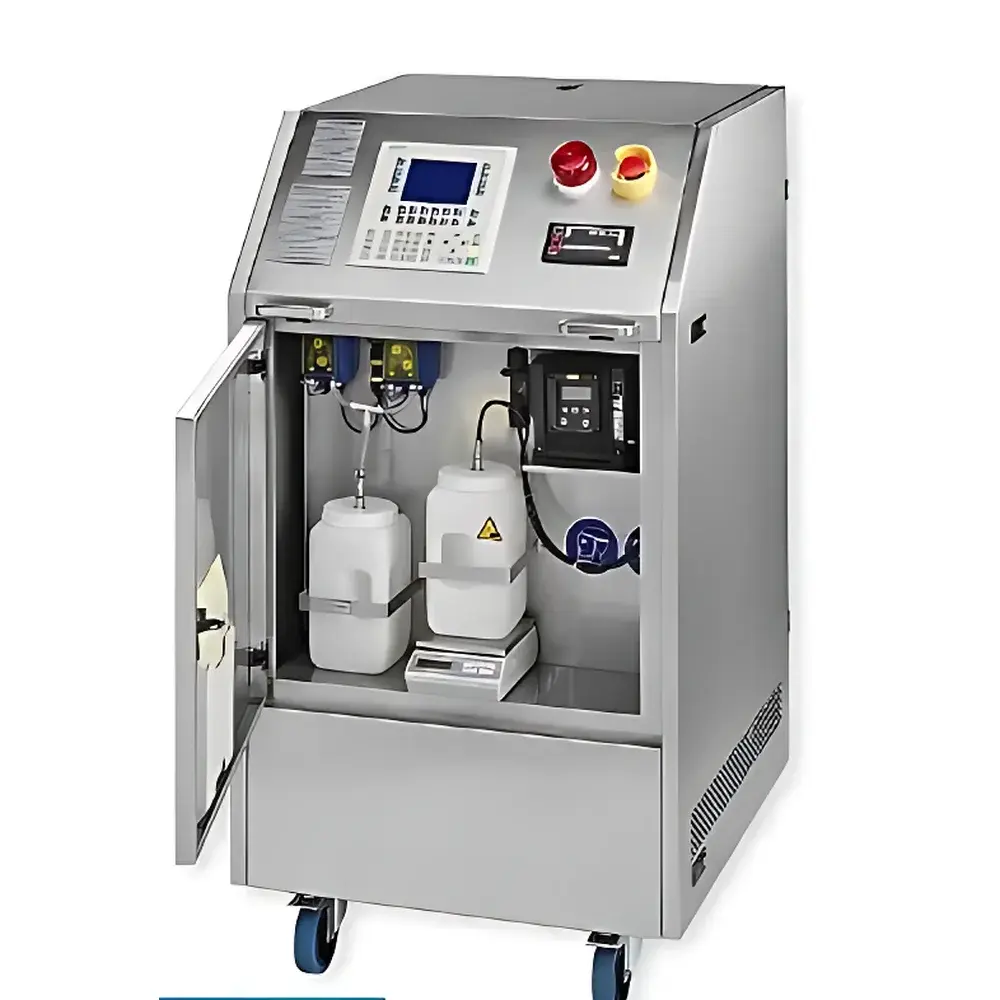
VHP Hydrogen Peroxide Vapor Generator by PEA
| Brand | PEA |
|---|---|
| Origin | Germany |
| Type | Imported Equipment |
| Hydrogen Peroxide Concentration | 35% w/w |
| Vaporization Rate | 16 g/min |
| Air Flow Rate | 120 m³/h |
| Sterilization Volume Range | 1–600 m³ |
| Vaporization Temperature | 100 °C |
| Dehumidification Setpoint | 35–40% RH |
| Final H₂O₂ Residual Level | <1 ppm |
| Filtration Efficiency | ≥99.999% at 0.2 µm (HEPA/ULPA-grade) |
| Log Reduction | ≥6-log for Geobacillus stearothermophilus spores |
| Sterility Assurance Level (SAL) | ≤10⁻⁶ |
Overview
The PEA VHP Hydrogen Peroxide Vapor Generator is an engineered solution for low-temperature, residue-free bio-decontamination of critical controlled environments—including cleanrooms (ISO Class 5–8), isolators, transfer hatches, RABS, and HVAC ductwork. Operating on the principle of flash vaporization, the system thermally converts liquid 35% hydrogen peroxide into a dry, highly diffusive vapor phase at 100 °C. Unlike conventional evaporative or nebulized methods, this rapid-phase transition minimizes condensation risk on cold surfaces—ensuring uniform distribution, high material compatibility (including polymers, elastomers, and electronics), and reproducible biocidal efficacy. The process complies with ISO 14644-3 for cleanroom qualification and supports validation under EU GMP Annex 1 (2022), FDA Guidance for Aseptic Processing, and PIC/S TR 79.
Key Features
- Flash-vaporization technology enabling consistent, sub-micron H₂O₂ vapor generation without droplet formation
- Integrated dehumidification module maintaining ambient RH at 35–40% prior to vapor injection—critical for optimal vapor saturation and sporicidal kinetics
- Real-time vapor concentration monitoring via UV photometric sensor (0–2000 ppm range) with closed-loop feedback control
- Automated four-stage cycle: (1) Environmental conditioning (dehumidification), (2) Vapor generation & distribution, (3) Exposure dwell (dose-controlled), and (4) Catalytic decomposition to <1 ppm residual H₂O₂
- ULPA-grade filtration (0.2 µm, ≥99.999% efficiency) on recirculation path to prevent particulate reintroduction
- Modular design supporting standalone operation or seamless integration into building management systems (BMS) via Modbus TCP or BACnet/IP
Sample Compatibility & Compliance
The generator demonstrates validated compatibility with stainless steel (316L), anodized aluminum, polycarbonate, silicone, EPDM, and common pharmaceutical-grade tubing materials—verified per ISO 10993-5 cytotoxicity and ASTM F1608 sporicidal compatibility testing. All cycles are fully traceable and support 21 CFR Part 11-compliant electronic records when paired with optional audit-trail-enabled software. System qualification follows IQ/OQ/PQ protocols aligned with ISO 14644-2, ISO/IEC 17025, and PDA Technical Report No. 1 (Sterilization of Isolators). Documentation packages include DQ, FAT/SAT reports, and cycle development templates for SAL ≤10⁻⁶ verification using biological indicators (BIs) per EN 17141-2.
Software & Data Management
The embedded control interface provides full-cycle parameter logging (time-stamped temperature, RH, H₂O₂ ppm, airflow, and stage status) with export capability in CSV and PDF formats. Optional PEA-SteriLog™ software enables remote monitoring, multi-unit fleet management, automated report generation (including deviation flagging), and secure user role assignment (admin/operator/auditor). All data integrity controls meet ALCOA+ principles—ensuring attributable, legible, contemporaneous, original, accurate, complete, consistent, enduring, and available records. Electronic signatures and change history tracking satisfy GMP data governance requirements for regulated manufacturing sites.
Applications
- Aseptic processing suites: Pre-use decontamination of isolators and filling lines
- Pharmaceutical manufacturing: Terminal sterilization of barrier systems and HVAC ducts
- Cell & gene therapy facilities: Rapid turnaround between batch campaigns in classified environments
- Research laboratories: Decontamination of biosafety cabinets, gloveboxes, and animal housing isolators
- Medical device packaging: Validation-supporting sterilization of Class II/III device cleanrooms
- Biotech pilot plants: Scalable decon for flexible manufacturing spaces (1–600 m³)
FAQ
What biological indicators are recommended for cycle validation?
Geobacillus stearothermophilus spores (ATCC 7953 or equivalent) on stainless steel carriers, placed at worst-case locations per ISO 14644-3 Annex B.
Can the system be integrated with existing HVAC infrastructure?
Yes—via dedicated supply/return duct interfaces and BMS communication protocols; engineering support includes airflow modeling and pressure-balancing analysis.
How is residual H₂O₂ neutralized post-cycle?
Catalytic decomposition using heated manganese dioxide (MnO₂) media reduces vapor to water vapor and oxygen—verified by real-time ppm monitoring until <1 ppm is achieved.
Does the process require post-cycle aeration?
No—unlike formaldehyde or ethylene oxide, VHP leaves no toxic residues; personnel re-entry is permitted immediately after the catalytic neutralization phase confirms <1 ppm.
What regulatory standards does the validation package address?
EU GMP Annex 1 (2022), USP , PDA TR#1 & TR#75, ISO 14644-2/3/4, and FDA Process Validation Guidance (Stage 3: Continued Process Verification).



