
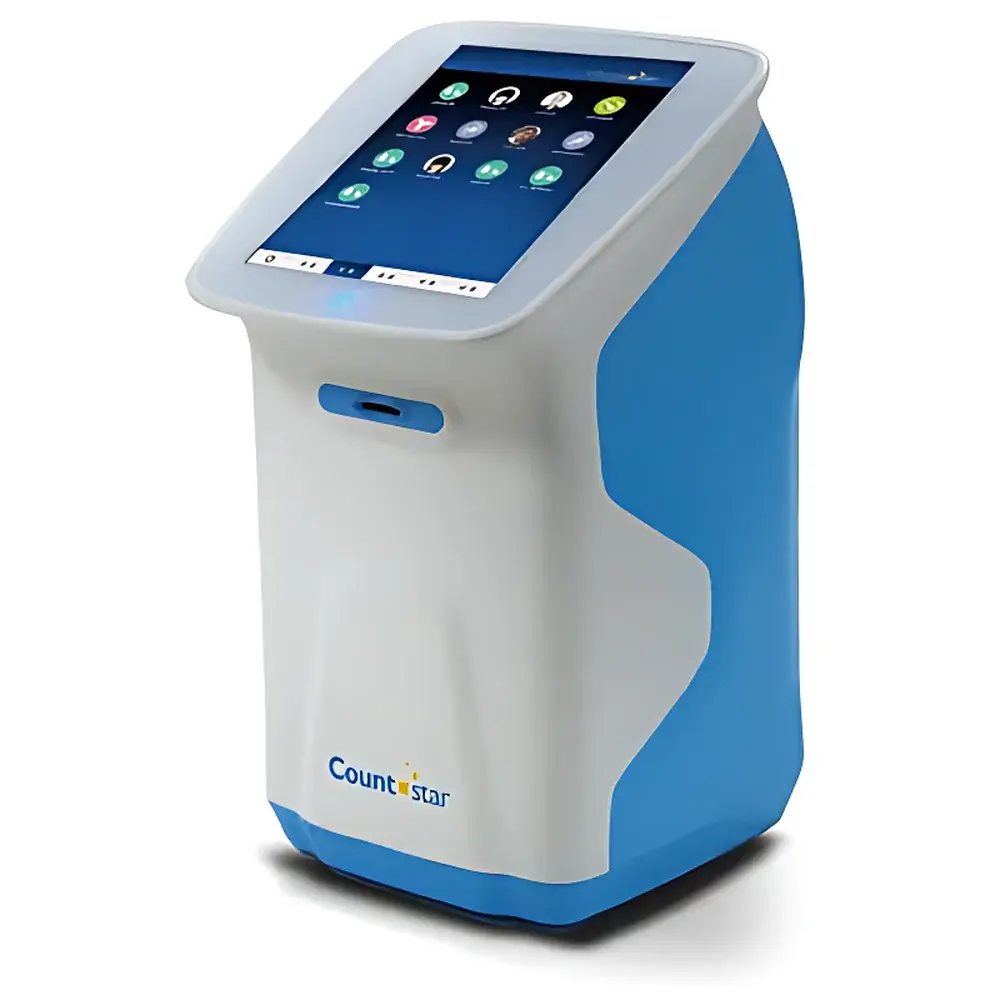
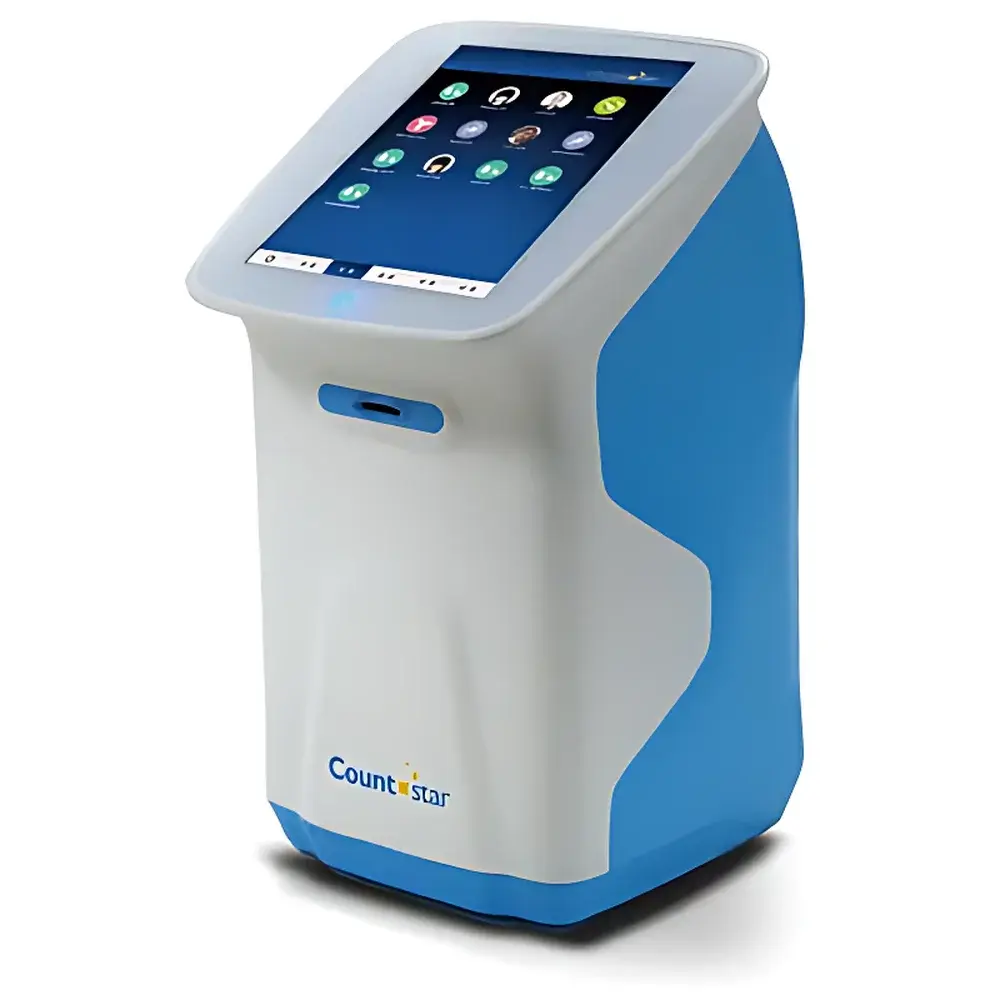
Countstar Rigel Automated Fluorescent Cell Analyzer
| Brand | Countstar |
|---|---|
| Origin | Shanghai, China |
| Model | Rigel |
| Detection Time | <20 s |
| Cell Concentration Range | 1×10⁴–3×10⁷ cells/mL |
| Sample Volume | 20 µL |
| Throughput | 5 samples per run |
| Detectable Cell Diameter | 3–180 µm |
| Fluorescence Channels | Up to 13 (4 excitation sources + 5 emission filter combinations) |
| Regulatory Compliance | CE-marked, FDA 21 CFR Part 11–compliant software architecture |
| Intended Use | Research use only (RUO), not for diagnostic purposes |
Overview
The Countstar Rigel Automated Fluorescent Cell Analyzer is a benchtop, image-based cytometry platform engineered for quantitative fluorescence and brightfield analysis of suspension cells. Unlike conventional flow cytometers that rely on hydrodynamic focusing and single-cell event stream detection, the Rigel employs high-resolution digital microscopy coupled with automated focus-locking optics to capture full-field cellular images—enabling simultaneous morphological assessment and multi-parametric fluorescence quantification at the single-cell level. Its core measurement principle integrates transmitted light imaging with four independently controllable LED excitation sources (365 nm, 470 nm, 530 nm, and 630 nm) and five configurable emission filter positions, supporting up to 13 distinct fluorescent channels in a single assay. Designed for reproducible, operator-independent operation, the system features a patented fixed-focus optical path that eliminates manual focusing variability—ensuring consistent axial plane acquisition across all samples and fluorophores. The Rigel delivers rapid, standardized cell counting, viability assessment (e.g., AO/PI dual staining), apoptosis staging (Annexin V/PI or PS exposure), cell cycle profiling (Hoechst 33342 DNA staining), transfection efficiency evaluation (GFP/RFP expression), and immunophenotyping (CD marker detection) without requiring complex compensation matrices or extensive instrument training.
Key Features
- Integrated all-in-one design with touchscreen interface and preloaded assay protocols for immediate deployment
- Patented fixed-focus optical architecture ensuring repeatable imaging plane alignment and eliminating user-induced focus drift
- Automated multi-channel fluorescence switching: seamless, software-controlled excitation/emission filter reconfiguration within a single run
- Simultaneous acquisition of brightfield + up to 4 fluorescence channels per sample—no need for sequential scanning or repositioning
- High-throughput capability: complete analysis of 5 samples in under 2.5 minutes, with total assay time per sample <20 seconds
- FDA 21 CFR Part 11–compliant software framework including electronic signatures, audit trails, role-based access control, and data integrity safeguards
- Flexible assay customization: supports development of application-specific staining protocols, reagent kits, and analysis templates
Sample Compatibility & Compliance
The Rigel accommodates standard 20 µL cell suspensions in disposable counting slides—compatible with primary cells (e.g., PBMCs), adherent cell lines (after trypsinization), stem cells, hybridomas, and immune effector cells (CAR-T, NK). Its 3–180 µm detection range enables robust analysis of small lymphocytes, large macrophages, and aggregated or clumped populations without lysis or filtration. The system meets CE marking requirements for in vitro diagnostic (IVD) research equipment and operates within ISO 13485–aligned quality management practices during manufacturing. While intended solely for research use (RUO), its software architecture conforms to regulatory expectations for data governance in GxP environments—including secure user authentication, immutable audit logs, and version-controlled protocol storage. All fluorescence assays are validated against established reference methods (e.g., trypan blue exclusion, flow cytometric Annexin V/PI staining) to ensure analytical consistency.
Software & Data Management
The Rigel Control Software provides an intuitive, app-style interface for assay selection, parameter adjustment, and real-time result visualization. Each analysis generates a structured dataset containing individual cell coordinates, morphology metrics (area, circularity, aspect ratio), integrated fluorescence intensities per channel, and population gating statistics—all exportable in CSV, PDF, and FCS 3.0 formats. Optional integration with De Novo Software’s FCS Express enables advanced single-cell event analysis, including cell cycle modeling (Dean–Jett–Fox algorithm), kinetic cytotoxicity calculations, and multi-dimensional clustering. The software enforces ALCOA+ principles (Attributable, Legible, Contemporaneous, Original, Accurate, Complete, Consistent, Enduring, Available) through timestamped audit trails, electronic signature workflows, and encrypted database backups. All user actions—including gate modifications, threshold adjustments, and report generation—are logged with operator ID, timestamp, and contextual metadata.
Applications
- Fluorescent cell counting & viability: Dual-stain quantification using AO/PI to discriminate live/dead nucleated cells while excluding platelets and debris based on size and intensity thresholds
- Apoptosis staging: Visual identification and quantification of early (PS externalization), mid-stage (membrane integrity loss), and late-stage (nuclear fragmentation) apoptotic events via multi-channel imaging
- Cytotoxicity assays: Real-time monitoring of CAR-T or NK-mediated tumor cell killing using calcein-AM/GFP labeling combined with Hoechst 33342 (total nuclei) and PI (dead cell membrane rupture)
- Cell cycle analysis: DNA content profiling using Hoechst 33342 with automated G0/G1, S, and G2/M phase classification—without requiring DNA denaturation or RNase treatment
- Immunophenotyping: CD marker expression analysis (e.g., CD4+, CD8+, CD25+, CD127) on primary T-cell subsets, with direct correlation between fluorescence intensity and morphological features
- Transfection efficiency: Quantitative GFP/RFP expression assessment across heterogeneous populations, including low-expressing subpopulations missed by bulk fluorescence readers
FAQ
Is the Countstar Rigel suitable for clinical diagnostics?
No. The Rigel is designated for research use only (RUO) and is not cleared or approved by regulatory authorities for diagnostic applications.
Does the system require daily calibration or maintenance?
The Rigel features factory-calibrated optics and auto-zeroing illumination; routine maintenance is limited to slide chamber cleaning and periodic verification using NIST-traceable microsphere standards.
Can I import custom gating strategies from other platforms?
Yes—FCS Express integration supports import of existing gating hierarchies, compensation matrices, and template-based analysis workflows.
What sample preparation steps are required prior to analysis?
Cells must be suspended in isotonic buffer (e.g., PBS + 0.1% BSA) at concentrations between 1×10⁴ and 3×10⁷ cells/mL; no centrifugation or red blood cell lysis is needed for PBMC analysis.
How does the fixed-focus design impact resolution across different cell types?
The optical path is optimized for a 50-µm depth-of-field plane aligned to the slide’s counting chamber bottom surface—ensuring consistent focus for cells sedimented within physiological suspension volumes.
Related Products




