
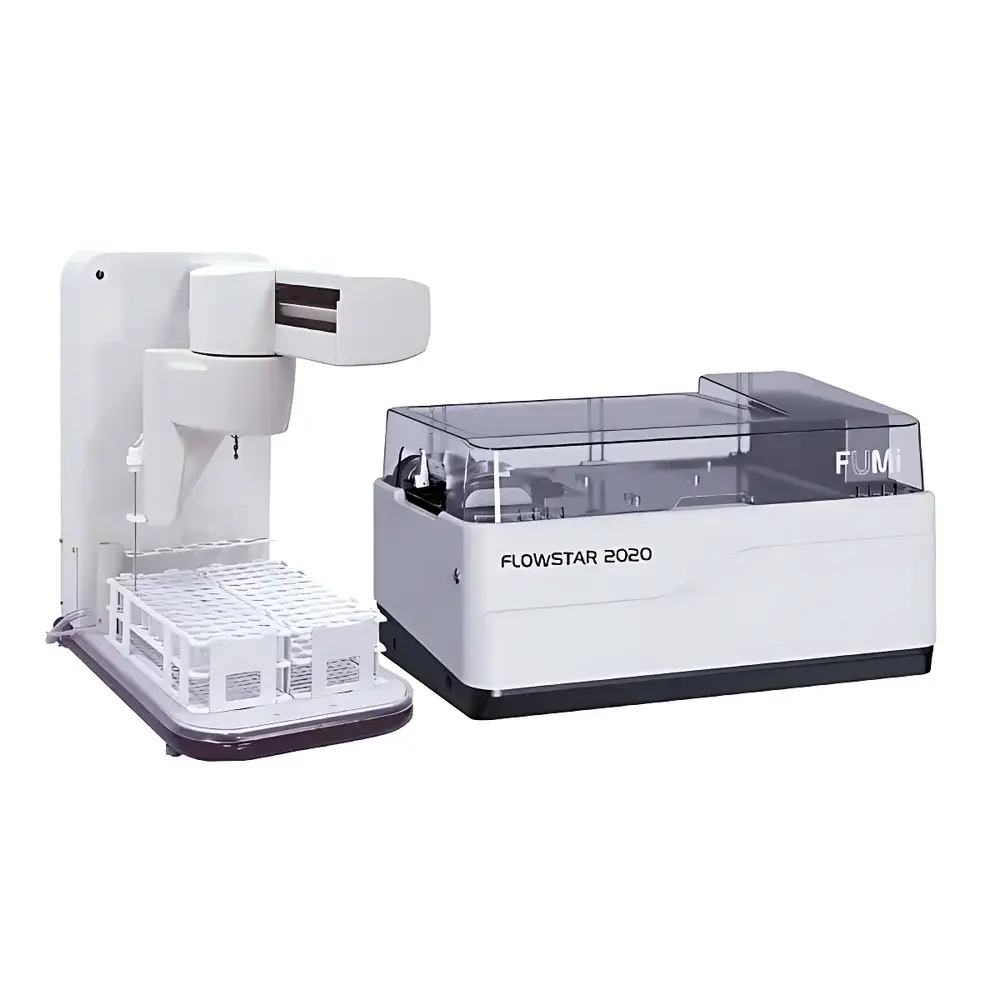
Shanghai Fumi Flowstar 2020NY Automated Continuous Flow Analyzer for Nitrogen and Phosphorus in Agricultural Samples
| Brand | Shanghai Fumi |
|---|---|
| Origin | Shanghai, China |
| Manufacturer Type | Authorized Distributor |
| Regional Category | Domestic (PRC) |
| Model | Flowstar 2020NY |
| Price Range | USD 28,000 – 70,000 (FOB Shanghai) |
| Instrument Type | Continuous Flow Analyzer (CFA) |
| Wavelength Range | 270–1100 nm |
| Sample Carrier Capacity | 100 / 180 / 270 positions (vials: 5 mL, 8 mL, or 10 mL) |
| Reagent Positions | 100 / 180 / 270 |
| Flow Cell Path Lengths | 10 mm, 30 mm, 50 mm |
| Light Source | High-Stability LED and Krypton Lamp |
Overview
The Shanghai Fumi Flowstar 2020NY is a third-generation automated continuous flow analyzer engineered for high-precision, routine quantification of total nitrogen (TN), ammonia-N, nitrate-N, nitrite-N, orthophosphate, and total phosphorus (TP) in complex agricultural and environmental matrices. It operates on the principle of segmented flow analysis (SFA), where discrete air segments separate sample and reagent zones within narrow-bore tubing (2 mm i.d.), enabling controlled reaction timing, minimized dispersion, and robust interference suppression. Unlike conventional flow injection systems, SFA supports extended reaction durations—up to 40 minutes—making it suitable for multi-step protocols including online distillation, UV digestion, dialysis membrane filtration, and cadmium reduction without manual intervention. The system complies with AOAC Official Methods of Analysis (e.g., AOAC 973.42, 982.23), ISO 11905-1 (TN), ISO 6878 (TP), EPA Method 353.2 and 365.2, APHA Standard Methods 4500-NH3, 4500-NO2−, 4500-NO3−, and over 150 validated Chinese national and industry standards (e.g., GB 5750.5–2023, HJ 665–2013, HJ 667–2013, HJ 670–2013, SL/T 788–2019). Its architecture integrates dual-beam, dual-wavelength photometry with selectable pathlength cells (10/30/50 mm) and hybrid light sources (LED + Kr lamp) to ensure optimal sensitivity across UV–Vis spectral bands.
Key Features
- True walk-away automation: Full sequence execution—including sample aspiration, reagent addition, air segmentation, thermal/UV digestion, dialysis, cadmium reduction (via integrated Cd-coil, not packed column), and detection—without operator input.
- Segmented flow architecture with 2 mm i.d. PTFE/PFA tubing: Tolerates suspended solids up to 50 mg/L; eliminates need for pre-filtration or degassing of samples or reagents.
- Modular optical detection: Dual-beam spectrophotometer with selectable wavelengths (270–1100 nm); interchangeable flow cells (10 mm, 30 mm, 50 mm pathlength) for optimized signal-to-noise ratio across concentration ranges.
- Integrated high-pressure UV digestion module: Compliant with ISO 11905-1 and HJ 670–2013 for total cyanide and total phosphorus oxidation; enables complete mineralization of refractory organic N/P species.
- Dialysis membrane interface: Removes color, turbidity, and particulate interferences prior to detection—critical for soil extracts, plant digests, fertilizer solutions, and wastewater.
- Low reagent consumption: Average < 1.2 mL per test cycle; reagent reservoirs support ≥180 tests without refill (configurable 100/180/270-position racks).
- High throughput: ≥30 samples/hour with full method execution; method-switching time < 90 seconds via software-driven valve sequencing.
Sample Compatibility & Compliance
The Flowstar 2020NY accepts liquid and semi-solid extracts from diverse agricultural and environmental sources: seawater, groundwater, surface water, municipal and industrial wastewater, tobacco leaf digests, soil leachates (e.g., Mehlich-3, Olsen), plant tissue homogenates, commercial fertilizers (NPK solutions), food processing effluents, and compost leachates. All hardware and fluidic pathways are chemically resistant to strong acids (H2SO4, HNO3), alkalis (NaOH), and oxidants (persulfate, KMnO4). System validation documentation supports GLP-compliant operation and audit readiness under FDA 21 CFR Part 11 (when paired with compliant LIMS integration). Calibration traceability follows ISO/IEC 17025 requirements; performance verification includes linearity (R² ≥ 0.999), repeatability (RSD ≤ 1.8% at mid-range), and detection limits (e.g., 0.008 mg/L NH4+-N, 0.005 mg/L PO43−-P).
Software & Data Management
Control and data acquisition are managed via FumiFlow v4.2 software—a Windows-based platform supporting method library management, real-time chromatogram visualization, peak height/area dual-integration algorithms, and automatic baseline correction. Raw absorbance data, peak metadata, and QC flags (e.g., bubble detection, pressure deviation, temperature drift) are timestamped and stored in encrypted .fdb databases. Export formats include CSV, PDF reports (with electronic signature fields), and XML for LIMS interfacing. Audit trail functionality logs all user actions, parameter changes, and calibration events with immutable timestamps—meeting requirements for regulated environments under ISO 17025 and CNAS accreditation frameworks.
Applications
- Agricultural nutrient monitoring: Routine TN/TP profiling in irrigation water, manure slurries, and foliar sprays per FAO guidelines.
- Soil testing laboratories: High-volume analysis of Mehlich-3–extractable P and Kjeldahl N in certified reference materials (CRMs) and field samples.
- Environmental compliance: EPA NPDES discharge reporting, ISO 14001 wastewater auditing, and HJ 665–2013–mandated TP monitoring in aquaculture effluent.
- Food safety labs: Nitrate/nitrite screening in vegetables (EU Regulation No. 1881/2006) and phosphate additives in processed meats.
- Research applications: Kinetic studies of nitrification/denitrification in rhizosphere microcosms using programmable reaction delay modules.
FAQ
Does the Flowstar 2020NY support both EPA and Chinese standard methods simultaneously?
Yes—method libraries include pre-validated sequences for EPA 353.2 (nitrate), EPA 365.2 (phosphate), GB 5750.5–2023 (water quality), and HJ 670–2013 (total phosphorus), with identical hardware configuration.
Can it analyze undiluted soil extracts with high turbidity?
Yes—the integrated dialysis membrane unit removes particulates and color interference; no centrifugation or filtration is required for most Mehlich-3 or CaCl2 extracts.
What maintenance intervals are recommended for the Cd-coil reduction module?
The electroplated cadmium coil requires replacement every 12 months under continuous operation (≥6 h/day); lifetime exceeds 10,000 analyses with proper acid wash cycling.
Is remote diagnostics supported?
Yes—optional Ethernet-connected service port enables secure remote firmware updates and troubleshooting via TLS-encrypted VNC session, compliant with IEC 62443-3-3.
How is calibration verification performed per ISO/IEC 17025?
Built-in calibration verification checks include CRM analysis (e.g., NIST SRM 2783), intermediate precision assessment across 3 days, and blank contamination monitoring using ultra-pure water blanks at start/end of each batch.




