
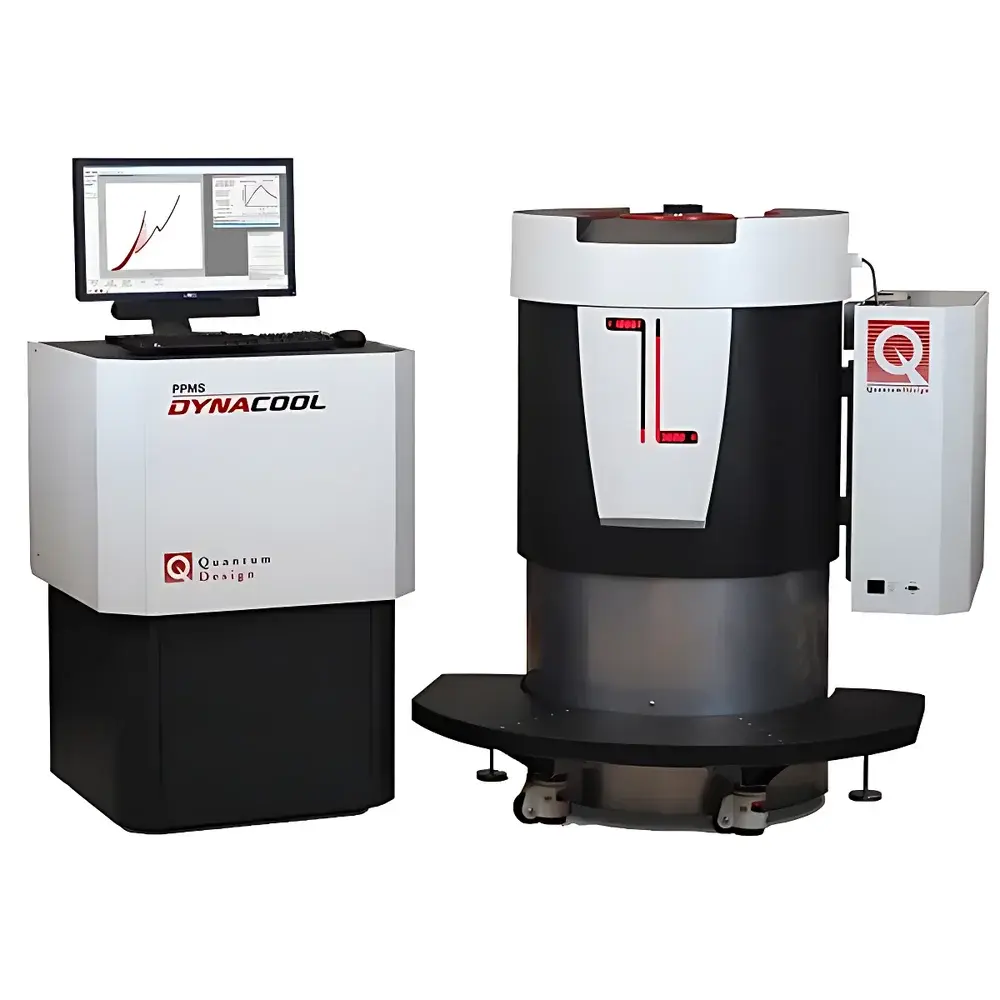
Quantum Design PPMS DynaCool Fully Cryogen-Free Physical Property Measurement System
| Brand | Quantum Design |
|---|---|
| Origin | USA |
| Manufacturer Type | Original Equipment Manufacturer (OEM) |
| Country of Origin | Imported |
| Model | PPMS DynaCool |
| Pricing | Upon Request |
Overview
The Quantum Design PPMS DynaCool is a fully cryogen-free, integrated physical property measurement system engineered for high-precision, multi-modal characterization of quantum materials under extreme conditions. Unlike conventional PPMS platforms requiring liquid helium or liquid nitrogen, the DynaCool employs a dual-stage pulse-tube cryocooler to simultaneously cool both the superconducting magnet and sample space—eliminating dependency on consumable cryogens while maintaining ultra-low vibration performance essential for sensitive measurements. Its core architecture retains full backward compatibility with the established PPMS measurement ecosystem, supporting simultaneous or sequential acquisition of magnetic, electrical, thermal, and structural response functions across a continuous temperature range from <1.9 K to 400 K and magnetic fields up to ±14 T. The system operates on a CAN bus-based control infrastructure, enabling deterministic timing, robust inter-module synchronization, and seamless integration of advanced optional modules—including AC/DC magnetometry, heat capacity, thermal transport, and high-field transport. Designed for compliance with GLP and GMP laboratory practices, the PPMS DynaCool incorporates hardware-level audit trails, electronic logbook functionality, and firmware-validated calibration protocols aligned with ISO/IEC 17025 metrological principles.
Key Features
- Fully cryogen-free operation: No liquid helium, liquid nitrogen, or other consumable refrigerants required
- Continuous temperature control from 1.85 K to 400 K; smooth, uninterrupted passage through the 4.2 K helium lambda point
- Integrated 10−4 Torr cryopump—eliminates need for external vacuum pumps and ensures stable base pressure for all add-on modules
- Dual-pulse-tube cooling architecture delivering <40 min cooldown from 300 K to 1.9 K with thermal stability of ±0.1% (T 20 K)
- Modular field options: 9 T, 12 T, and 14 T superconducting magnets with field homogeneity <0.1% over 10 mm DSV
- Standby mode reduces power consumption by >65% while preserving thermal state and enabling rapid resumption of measurements
- CAN-based distributed control system ensuring deterministic communication latency (<100 µs) between main controller and all peripheral modules
Sample Compatibility & Compliance
The PPMS DynaCool accommodates diverse sample geometries—from single crystals and thin films to polycrystalline powders and microfabricated devices—via standardized sample holders compatible with VSM, torque magnetometry, heat capacity, and thermal transport modules. All measurement modules conform to ASTM E2243 (heat capacity), ASTM F2129 (electrical transport in biomaterials), and ISO 8503-2 (surface roughness influence on thermal contact resistance). Data acquisition firmware supports 21 CFR Part 11-compliant electronic signatures, audit trail logging, and role-based user access control. System calibration certificates are traceable to NIST standards, and thermal sensor linearity is verified per IEC 60751 Class A tolerances. Vacuum integrity meets UHV-class requirements for surface-sensitive measurements, and magnetic shielding satisfies IEEE Std 299–2006 attenuation specifications for ambient field suppression.
Software & Data Management
Measurement execution, real-time visualization, and post-processing are managed through Quantum Design’s MultiVu software platform—a Windows-native application built on Qt and Python 3.9 with HDF5-based binary data storage. MultiVu implements hierarchical metadata tagging (including instrument configuration, calibration history, and environmental logs), automatic unit conversion, and export to ASCII, MATLAB .mat, and NeXus-compatible formats. Advanced analysis modules include two-tau model fitting for heat capacity data, lock-in harmonic decomposition for AC susceptibility, and self-consistent thermal gradient modeling for thermoelectric parameter extraction. Raw data streams are timestamped with GPS-synchronized precision (±100 ns), and all parameter changes are logged with operator ID, timestamp, and pre-/post-value states. Remote monitoring via secure TLS 1.3 API enables integration into institutional LIMS environments.
Applications
The PPMS DynaCool serves as a foundational platform for condensed matter physics, quantum materials discovery, and advanced functional materials development. It enables quantitative investigation of superconducting phase diagrams (Tc, Hc2, vortex pinning), magnetic anisotropy landscapes via torque magnetometry, electron-phonon coupling strength through specific heat analysis, and topological transport signatures (e.g., anomalous Hall effect, quantum oscillations) under combined low-T / high-H conditions. Its cryogen-free architecture supports long-duration experiments—such as aging studies of spin-glass dynamics or time-resolved photoinduced magnetization—without operational interruption. The system is routinely deployed in national laboratories (e.g., ORNL, NIST), university quantum institutes, and industrial R&D centers conducting DOE-, NSF-, and EU Horizon-funded research on correlated oxides, heavy fermions, skyrmion lattices, and 2D heterostructures.
FAQ
Does the PPMS DynaCool require any cryogenic liquids for initial cooldown or routine operation?
No. The system achieves base temperature using only its integrated dual-stage pulse-tube cryocoolers. No liquid helium, liquid nitrogen, or other cryogens are needed at any stage.
Can the PPMS DynaCool be upgraded to lower temperatures after purchase?
Yes. Optional He-3 refrigerator and dilution refrigerator modules extend the operational range to 0.5 K and 50 mK respectively, with full software and hardware integration validated by Quantum Design.
Is the system compatible with third-party vacuum or magnetic shielding enclosures?
Yes. Standard flange interfaces (CF-63, CF-100) and electromagnetic interference (EMI) shielding specifications are documented in the mechanical interface manual for custom integration.
How is temperature calibration performed across the full 1.85–400 K range?
Primary calibration uses NIST-traceable ruthenium oxide (RuO2) sensors below 50 K and platinum resistance thermometers (Pt-100) above 50 K, with in situ validation against fixed-point references (e.g., superconducting transitions of In, Sn, Pb).
What level of magnetic field homogeneity is achieved in the standard 9 T magnet option?
Field homogeneity is better than 0.1% over a 10 mm diameter spherical volume (DSV), verified by Hall probe mapping and maintained across the entire temperature range.



