
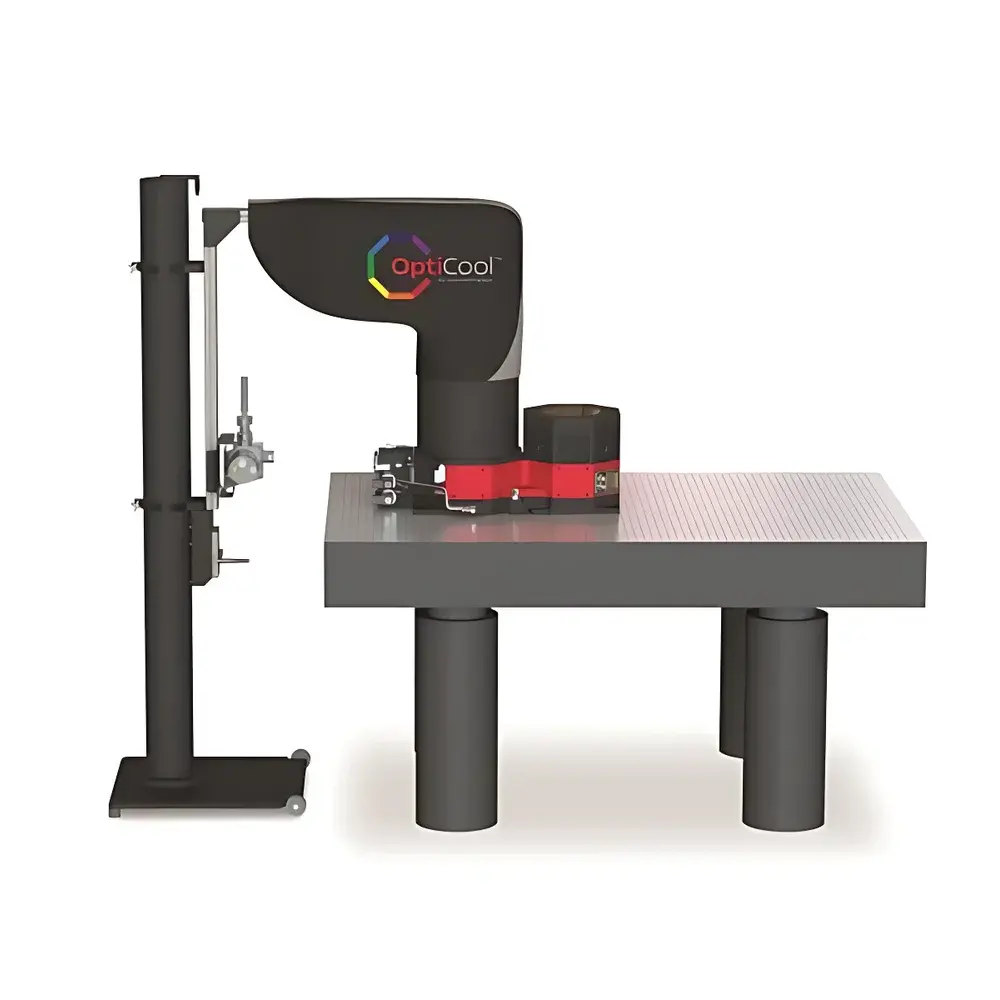
Quantum Design OptiCool Advanced Dry-Insert Cryogenic Optical Research Platform with Split-Pair Superconducting Magnet
| Brand | Quantum Design |
|---|---|
| Origin | USA |
| Manufacturer Type | Original Equipment Manufacturer (OEM) |
| Country of Origin | Imported |
| Model | OptiCool |
| Instrument Type | Vertical Cryostat |
| Temperature Stability | ±0.2% (T < 20 K) |
| Working Distance | 3 mm |
| Temperature Range | 1.7 K to 350 K |
| Vibration Stability | <10 nm peak-to-peak (horizontal) |
| Cooling Medium | Helium-free, dry-cycle pulse-tube refrigeration system |
| Optical Access | 7 side ports (NA > 0.11), 1 top port (NA > 0.7) |
| Magnetic Field | ±7 T |
| Sample Space | Ø89 mm × 84 mm |
| Electrical Feedthroughs | Standard 16 leads (expandable to 80) |
Overview
The Quantum Design OptiCool is an advanced, fully dry-insert cryogenic optical research platform engineered for high-precision magneto-optical experiments under extreme conditions. Unlike conventional liquid-helium-dependent systems, the OptiCool employs a two-stage pulse-tube cryocooler to achieve continuous, helium-free operation across a broad temperature range—from 1.7 K to 350 K—with exceptional thermal stability and mechanical quietness. Its core architecture integrates a split-pair superconducting magnet capable of delivering a homogeneous, reversible field up to ±7 T, combined with a uniquely open optical geometry. The system’s defining feature is its large-diameter (89 mm), tall (84 mm) sample chamber, coupled with eight high-numerical-aperture optical access points—including seven side ports (NA > 0.11) and one top port (NA > 0.7)—enabling multi-angle excitation and detection in reflection, transmission, and backscattering configurations. This design supports full spatial access to the sample while maintaining sub-10-nm mechanical stability—critical for interferometric, confocal, and near-field optical measurements.
Key Features
- Helium-free dry operation: Eliminates reliance on liquid cryogens; uses closed-cycle pulse-tube refrigeration with minimal helium gas consumption during cooldown and maintenance.
- Ultra-low vibration performance: Horizontal vibration <10 nm peak-to-peak; vertical vibration <4 nm peak-to-peak—validated via laser Doppler vibrometry and essential for scanning probe–optical hybrid techniques.
- Optimized magnetic–optical co-location: Dual-cone split magnet design delivers both high field homogeneity (ΔB/B < 10−4 over 10 mm DSV) and large numerical aperture, enabling simultaneous high-field magnetometry and diffraction-limited optical resolution.
- Thermal precision and repeatability: Active temperature control with stability of ±0.2% below 20 K and ±0.02% above 20 K, supported by calibrated Cernox™ and RuO2 sensors traceable to NIST standards.
- Modular electrical interface: Standard 16 pre-thermalized feedthroughs routed through multiple heat-sink stages; expandable to 80 leads with custom wiring harnesses compatible with low-noise preamplifiers and high-frequency RF/DC biasing.
- Automated operation: Unified software suite enables synchronized ramping of temperature and magnetic field with programmable profiles, real-time data logging, and hardware interlock management per IEC 61508 functional safety guidelines.
Sample Compatibility & Compliance
The OptiCool accommodates diverse sample geometries—including bulk crystals, thin-film heterostructures, 2D materials on transparent substrates, nanowires, and microfabricated devices—within its vertically oriented, thermally anchored sample stage. The 3 mm working distance from the top window to the sample plane supports integration with commercial confocal microscopes, FTIR spectrometers, and ultrafast laser systems operating at UV–MIR wavelengths. All optical windows use AR-coated fused silica or CaF2, certified for transmission >90% across 190–8000 nm. The system complies with ISO 14644-1 Class 5 cleanroom requirements when operated in controlled environments and meets electromagnetic compatibility (EMC) standards per EN 61326-1 for laboratory instrumentation. For regulated research environments, the control software supports audit-trail generation, user-level access control, and electronic signature capability aligned with FDA 21 CFR Part 11 and GLP/GMP documentation frameworks.
Software & Data Management
The OptiCool is operated via Quantum Design’s proprietary QDrive software—a cross-platform application built on Qt and Python-based backend services. QDrive provides deterministic timing synchronization between temperature setpoints, field ramps, and external trigger signals (TTL, LVDS) with sub-millisecond jitter. It natively imports and exports data in HDF5 format, supporting metadata tagging per NeXus conventions for long-term FAIR (Findable, Accessible, Interoperable, Reusable) compliance. Real-time plotting, scriptable automation (via Python API), and integration with LabVIEW, MATLAB, and EPICS IOC environments enable seamless incorporation into synchrotron beamline or quantum lab infrastructure. Firmware updates are delivered via secure HTTPS with SHA-256 signature verification, and all configuration changes are logged with timestamp, operator ID, and hash-verified parameter state.
Applications
- Low-temperature magneto-optical Kerr effect (MOKE) and rotational MOKE for domain imaging and spin dynamics quantification.
- Resonant Raman spectroscopy of quantum magnets and topological insulators under high magnetic fields.
- Photoluminescence (PL) and time-resolved PL mapping of defect centers (e.g., NV−, SiV) in diamond and hBN under tunable strain and field.
- Far- and mid-infrared reflectance/absorption spectroscopy of correlated electron systems, including cuprates and iron-based superconductors.
- Fourier-transform infrared (FTIR) microscopy with magnetic field modulation for magneto-phonon coupling studies.
- Ultrafast pump–probe spectroscopy (THz to visible) probing coherent spin and lattice dynamics on picosecond timescales.
- Magnetotransport–optics correlation using integrated Hall bar or van der Pauw devices with optical excitation.
- Spin-polarized photoluminescence and circular dichroism (RMCD) for chiral spin textures in skyrmion-hosting materials.
FAQ
Is the OptiCool compatible with ultrafast laser systems requiring sub-100 fs pulse delivery?
Yes—the top optical path supports dispersion-compensated beam delivery with <100 fs pulse broadening over 3 mm air gap; optional vacuum or purged top-port variants further reduce group delay dispersion.
Can the system be upgraded to include in situ electrical transport measurement capabilities?
Absolutely—the standard 16-lead configuration supports four-probe DC and low-frequency AC measurements; optional high-frequency feedthroughs (up to 40 GHz) and integrated lock-in amplifiers are available as factory-installed modules.
What level of magnetic field homogeneity is achieved at the sample position?
Within a 10 mm diameter spherical volume (DSV), field uniformity is better than 10−4 ΔB/B at ±7 T, verified by Hall probe mapping and required for quantitative Faraday rotation and Zeeman splitting analysis.
How does the dry-cycle cooling system impact experimental uptime and maintenance intervals?
The pulse-tube refrigerator achieves >20,000 hours MTBF; scheduled maintenance is limited to annual compressor oil replacement and cold-head inspection—no cryogen refills or vacuum-jacket servicing required.
Does the system support third-party software integration for custom experiment orchestration?
Yes—QDrive exposes a documented RESTful API and Python SDK; it has been successfully integrated with Synchrotron Control System (SCS), Bluesky, and custom LabVIEW-based quantum control stacks.



