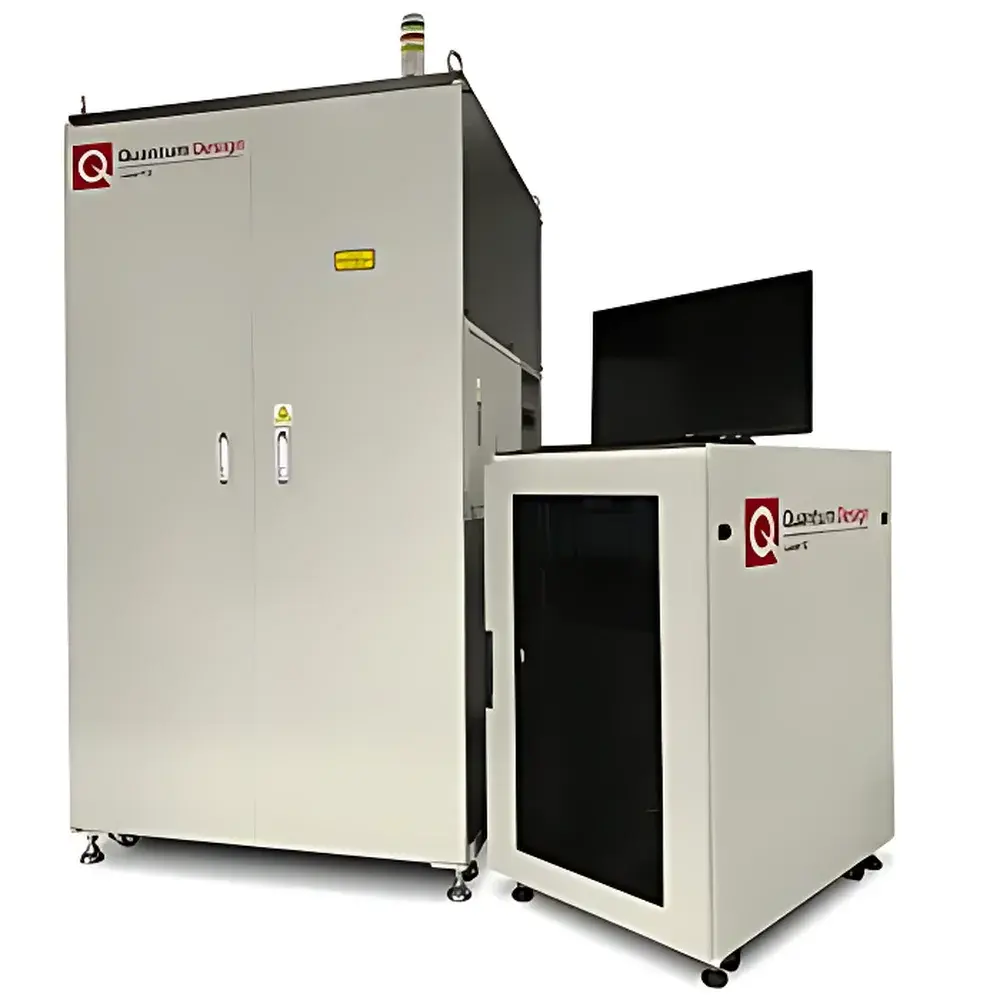
Quantum Design LFZ-2KW High-Performance Laser Floating-Zone Single Crystal Furnace
| Brand | Quantum Design |
|---|---|
| Origin | Japan |
| Manufacturer Type | Original Equipment Manufacturer (OEM) |
| Product Origin | Imported |
| Model | LFZ-2KW |
| Heating Method | Five-Beam Diode Laser Array |
| Maximum Laser Power | 2 kW |
| Melting Zone Temperature Range | 2600–3000 °C |
| Max. Crystal Diameter | 8 mm |
| Growth Rate | Up to 300 mm/hr |
| Rotation Speed | Up to 100 rpm |
| Chamber Pressure Rating | Up to 10 bar |
| Atmosphere Options | O₂, Ar, N₂, or custom gas mixtures |
| Real-Time Monitoring | Integrated HD visual feedback system |
| Control Interface | PC-based closed-loop temperature and motion control |
Overview
The Quantum Design LFZ-2KW High-Performance Laser Floating-Zone Single Crystal Furnace is an advanced materials synthesis platform engineered for the growth of high-quality single crystals under extreme thermal and chemical conditions. Unlike conventional resistance-heated or single-beam laser floating-zone systems, the LFZ-2KW implements a proprietary five-beam diode laser architecture developed in collaboration with RIKEN’s Center for Emergent Matter Science (CEMS). This configuration enables precise spatial control over energy deposition, minimizing thermal gradients across the molten zone and significantly reducing thermally induced lattice strain during solidification. The system operates on the principle of optical floating-zone melting—where a narrow, localized molten zone is stably maintained between two counter-rotating polycrystalline feed rods using focused laser irradiation—enabling containerless crystal growth essential for reactive, high-vapor-pressure, or ultra-high-melting-point materials. With a maximum operating temperature of 3000 °C and full compatibility with oxidizing, inert, or reducing atmospheres up to 10 bar, the LFZ-2KW supports research-grade synthesis of oxides, intermetallics, borides, nitrides, and other advanced functional materials where crucible contamination or thermal decomposition preclude conventional Bridgman or Czochralski methods.
Key Features
- Five-beam synchronized diode laser array delivering uniform axial and radial energy distribution across the molten zone, enhancing crystallinity and reducing twin formation
- Real-time integrated temperature monitoring and closed-loop feedback control based on pyrometric and image-based thermal profiling
- Modular vacuum/atmosphere chamber rated to 10 bar with multi-gas manifold support (O₂, Ar, N₂, forming gas, or user-defined mixtures)
- Precision motorized feed rod drive system with independent rotation (up to 100 rpm) and translation (up to 300 mm/hr), programmable via intuitive PC interface
- High-resolution coaxial HD imaging system with adjustable magnification and LED illumination for in-situ melt shape, meniscus stability, and defect tracking
- Robust mechanical design compliant with ISO 14644-1 Class 7 cleanroom integration standards; optional vibration isolation mounting available
Sample Compatibility & Compliance
The LFZ-2KW is specifically optimized for materials that challenge conventional crystal growth techniques—including but not limited to refractory oxides (e.g., Y₃Fe₅O₁₂, BaTiO₃), geometrically frustrated magnets (Dy₂Ti₂O₇, SmB₆), high-thermal-conductivity compounds (e.g., Sr₂RuO₄), and volatile chalcogenides. Its containerless operation eliminates crucible-induced impurities and interfacial reactions, ensuring stoichiometric fidelity and low dislocation density. The system meets structural and operational requirements aligned with ASTM F1529 (Standard Guide for Evaluation of Single-Crystal Growth Systems) and supports GLP-compliant documentation workflows when paired with validated data logging software. All electrical, optical, and pressure subsystems conform to IEC 61000-6-4 (EMC emission) and IEC 61000-6-2 (immunity) standards.
Software & Data Management
Control and acquisition are managed through Quantum Design’s proprietary LFZ-Control Suite—a Windows-based application supporting script-driven experiment sequencing, real-time parameter logging (temperature, position, rotation, gas flow, laser power), and synchronized video capture. Raw datasets are stored in HDF5 format with embedded metadata (user ID, timestamp, atmospheric composition, PID settings), enabling traceability per FDA 21 CFR Part 11 requirements when configured with electronic signature modules. Export options include CSV, MATLAB .mat, and TIFF sequences for post-processing in ImageJ, MATLAB, or Python-based analysis pipelines. Optional API access allows integration with laboratory information management systems (LIMS) and automated material discovery platforms.
Applications
- Growth of quantum spin ice and Kitaev candidate materials (e.g., Dy₂Ti₂O₇, α-RuCl₃ analogues) requiring oxygen-controlled atmospheres and minimal thermal stress
- Synthesis of high-purity ferrites and multiferroics (Ba₂Co₂Fe₁₂O₂₂, BiFeO₃) for microwave and spintronic device prototyping
- Preparation of stoichiometric ruby (Al₂O₃:Cr³⁺) and transition-metal perovskites for optical cavity and laser host studies
- Development of ultra-high-melting-point thermoelectric and superconducting phases (e.g., ReB₂, MgB₂ derivatives) under controlled partial pressures
- Method validation for ISO/IEC 17025-accredited crystallography labs requiring documented process repeatability and metrological traceability
FAQ
What types of materials are most suitable for growth in the LFZ-2KW?
Materials with melting points exceeding 2200 °C, high vapor pressure above 10⁻³ mbar at melting, or strong reactivity with crucible materials (e.g., Al₂O₃, Ir, W) — including rare-earth oxides, borides, nitrides, and certain intermetallics.
Is the system compatible with oxygen-rich atmospheres for oxide crystal growth?
Yes. The chamber supports continuous O₂ flow up to 10 bar, with mass flow controllers calibrated for reactive gas handling and leak-tight integrity verified per ISO 15848-1.
Can growth parameters be exported for regulatory audit trails?
Yes. All operational logs include digital signatures, time stamps, and configuration snapshots, meeting ALCOA+ principles for data integrity in GMP/GLP environments.
What is the typical maintenance interval for the laser module?
Diode laser stacks are rated for >10,000 hours of operation; preventive maintenance is recommended annually, including collimation verification and cooling system inspection.
Does Quantum Design provide application support for novel material systems?
Yes. Customers receive direct technical consultation from Quantum Design Japan’s applications team, including feasibility assessment, protocol development, and on-site commissioning support.