
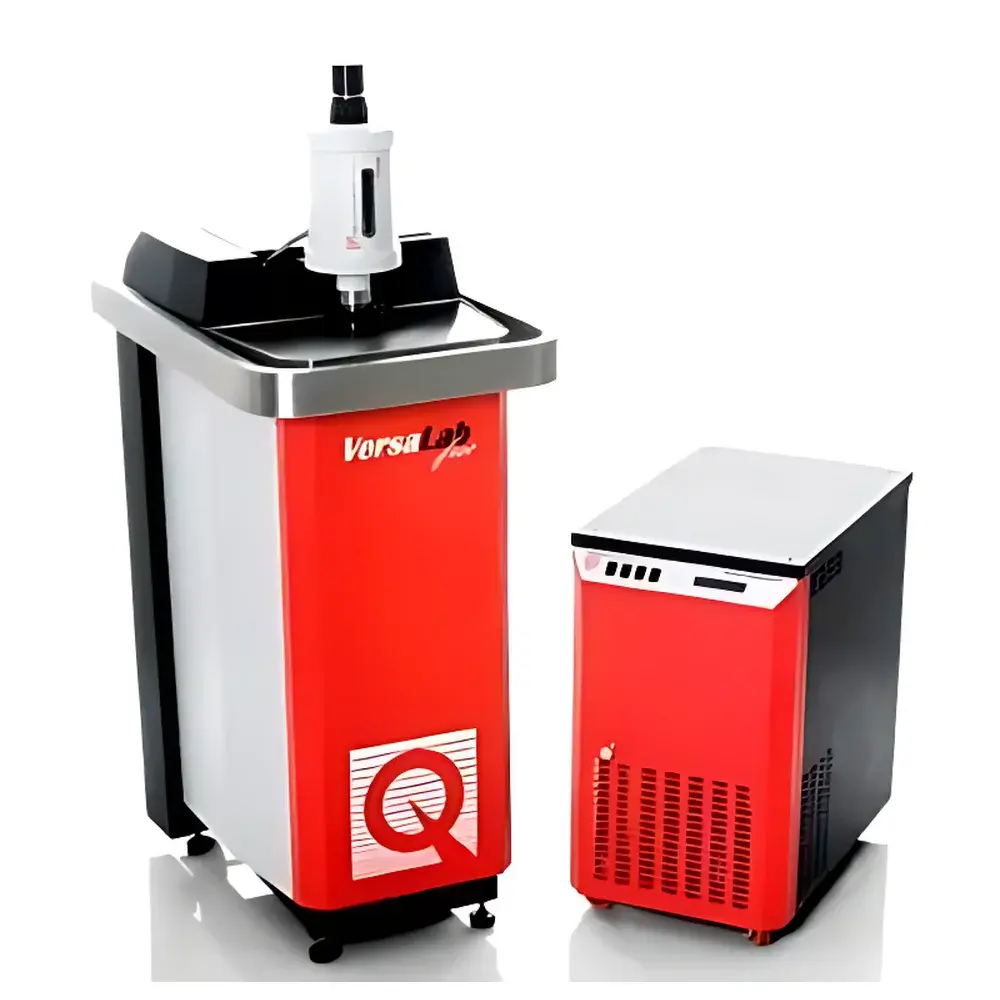
Quantum Design VersaLab Multifunctional Vibrating Sample Magnetometer System
| Brand | Quantum Design |
|---|---|
| Origin | USA |
| Manufacturer Type | Original Equipment Manufacturer (OEM) |
| Import Category | Imported |
| Model | VersaLab |
| Magnet Type | Superconducting Coil |
| Measurement Principle | Vibrating Sample Magnetometry (VSM) |
| Temperature Range | 50–400 K |
| Magnetic Field Range | Up to ~3 T |
| Temperature Ramp Rate | ~90 min from 300 K to 50 K (no load) |
| Field Sweep Rate | 0.1–300 Oe/s |
| Cryogen-Free Operation | Yes (integrated pulse-tube cryocooler) |
| Power Supply | Single-phase 220 V AC, 2.4 kW |
| System Weight | 86 kg |
| Height | 1.31 m |
Overview
The Quantum Design VersaLab Multifunctional Vibrating Sample Magnetometer System is a cryogen-free, modular physical property measurement platform engineered for precision magnetic, electrical, and thermal characterization of advanced materials under controlled temperature and magnetic field conditions. Operating on the fundamental principle of vibrating sample magnetometry (VSM), the system detects magnetic moment via induced voltage in pickup coils as a small sample oscillates at a fixed frequency within a uniform magnetic field generated by a persistent-mode superconducting magnet. Unlike conventional liquid-helium-dependent VSMs, the VersaLab integrates a closed-cycle pulse-tube cryocooler—eliminating the need for liquid cryogens across its entire operational range (50–400 K). Its 3 T superconducting magnet delivers high field homogeneity (<0.1% over 10 mm DSV) and stable background fields essential for quantitative hysteresis loop analysis, magnetic anisotropy mapping, and field-dependent transition studies. Designed as a cost-optimized counterpart to Quantum Design’s PPMS platform, the VersaLab retains identical measurement architecture, calibration protocols, and data acquisition firmware—ensuring traceable comparability with industry-standard PPMS datasets while reducing capital and operational expenditures.
Key Features
- Cryogen-free operation: Fully automated cooling from 50 K to 400 K using a single-stage pulse-tube refrigerator; no liquid helium or nitrogen required
- High-field superconducting magnet: Persistent-mode 3 T magnet with <0.1% field homogeneity over 10 mm diameter spherical volume (DSV)
- Modular multi-property capability: Native support for simultaneous or sequential VSM, DC/AC transport, heat capacity, thermal transport, and angle-resolved measurements
- Compact footprint & low infrastructure demand: 86 kg mass, 1.31 m height, and single-phase 220 V AC input (2.4 kW peak); no external chiller or water cooling required
- Automated angular control: Horizontal rotation probe with ±10° to +370° range, 0.05° (standard) or 0.0045° (high-precision) step resolution, and <1.0° repeatability
- Thermal stability: Temperature control accuracy ±0.1 K below 100 K and ±0.5 K up to 400 K; drift <5 mK/hour during isothermal holds
Sample Compatibility & Compliance
The VersaLab accommodates diverse sample geometries—including bulk crystals, thin films, powders, and microstructured devices—via interchangeable sample rods and mounting fixtures. All measurement modules comply with ASTM E1142 (Standard Practice for Heat Capacity Measurements by Relaxation Method) and ISO 11357-4 (Plastics—Differential Scanning Calorimetry—Part 4: Determination of Specific Heat Capacity). Electrical transport measurements adhere to IEEE Std 118-2022 (Recommended Practice for Resistivity Measurements of Semiconductor Materials) and include four-terminal sensing with guarded inputs to minimize leakage errors. The system supports GLP/GMP-aligned workflows through optional audit-trail-enabled software licensing compliant with FDA 21 CFR Part 11 requirements. All thermal and magnetic calibrations are traceable to NIST-certified standards, including SRM 720 (nickel sphere) for magnetic moment and SRM 735 (copper) for specific heat.
Software & Data Management
Measurement execution and real-time analysis are managed through Quantum Design’s proprietary MultiVu software—a Windows-based, multi-threaded application supporting synchronized acquisition across up to six independent channels (e.g., magnetization, voltage, current, temperature, field, time). Data files are stored in HDF5 format with embedded metadata (sample ID, operator, timestamp, instrument configuration, calibration coefficients), enabling FAIR (Findable, Accessible, Interoperable, Reusable) data principles. Export options include ASCII, CSV, and MATLAB-compatible .mat files. The software includes built-in fitting engines for Langevin, Brillouin, and modified Arrott plots; differential scanning calorimetry (DSC) deconvolution; and Seebeck coefficient extraction using linear regression with error propagation. Remote access and script-driven automation (via Python API) are supported for high-throughput screening applications.
Applications
- Magnetic phase transitions: Quantitative determination of Curie/Néel temperatures, critical exponents, and metamagnetic behavior in correlated oxides and intermetallics
- Spintronics material screening: Angle-resolved magnetoresistance, anomalous Hall effect, and spin-mixing conductance in heterostructures
- Thermoelectric optimization: Concurrent measurement of thermal conductivity (λ), Seebeck coefficient (S), and resistivity (ρ) to compute figure-of-merit ZT = S²σT/λ
- Low-dimensional magnetism: High-sensitivity moment detection down to 10⁻⁶ emu for monolayer magnets and molecular spin clusters
- Superconductor characterization: Upper critical field (Hc2) mapping, vortex pinning analysis, and specific heat jumps at Tc
- Dielectric and ferroelectric coupling: Integration with external RF sources and lock-in amplifiers via multifunction sample rod for magnetoelectric coefficient determination
FAQ
Is the VersaLab compatible with existing PPMS measurement protocols and data formats?
Yes—the VersaLab shares identical hardware firmware, calibration routines, and data structure definitions with the PPMS platform. Raw data files (.dat) and processed outputs (.mdata) are fully interoperable; third-party analysis tools developed for PPMS (e.g., MagLab’s MPro) function without modification.
Can the system perform measurements at temperatures above 400 K?
The base system operates from 50–400 K. An optional high-temperature furnace extends the upper limit to 1100 K for VSM-only measurements, maintaining RMS noise <1×10⁻⁵ emu and temperature stability ±0.5 K.
What is the minimum detectable magnetic moment under standard operating conditions?
At 300 K and 1 T, the system achieves a typical moment sensitivity of 1×10⁻⁶ emu for 10-second averaging; sensitivity improves at lower temperatures due to reduced thermal noise and enhanced signal-to-noise ratio.
Does the VersaLab support user-defined measurement sequences involving multiple property types?
Yes—MultiVu allows creation of nested scripts combining VSM sweeps, I–V ramps, relaxation calorimetry pulses, and thermal conductivity steps—all synchronized to common timebase and logged with unified metadata.
Are calibration standards provided with the system?
Each shipment includes NIST-traceable reference samples: Ni sphere (SRM 720) for magnetic moment, Cu disk (SRM 735) for specific heat, and calibrated resistor network for transport channel verification.



