
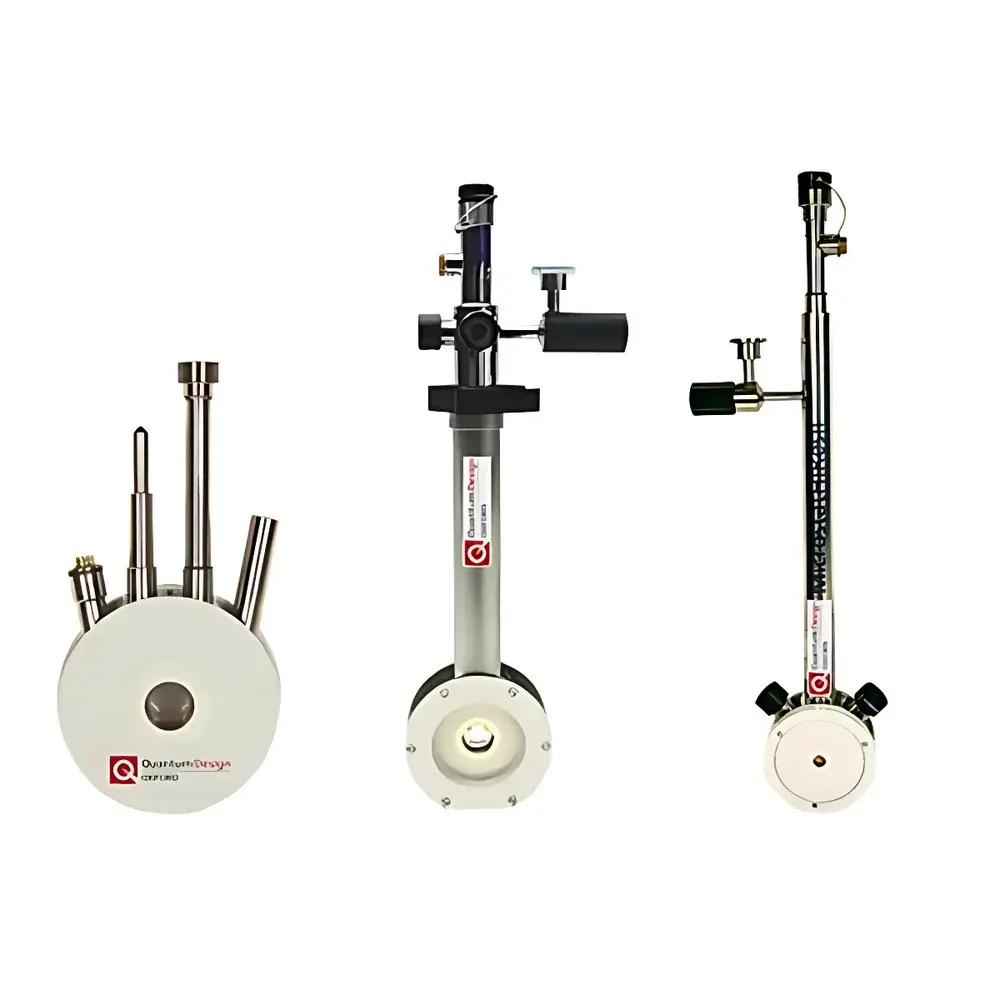
Quantum Design Microstat Series Optical Cryogenic Thermostats for Microscopy
| Brand | Quantum Design |
|---|---|
| Origin | USA |
| Manufacturer Type | Manufacturer |
| Origin Category | Imported |
| Model | Microstat |
| Price | Upon Request |
| Cooling Method | Vacuum-cryogen-cooled (Liquid Nitrogen or Liquid Helium) |
| Temperature Range | 2.2 K to 500 K |
| Sample Environment | High-vacuum chamber |
| Sample Space (diameter × height) | 20 × 2 mm (N), 20 × 5 mm (He, HiRes) |
| Working Distance | Adjustable from 2.2 mm to 24.5 mm |
| Temperature Stability | ±0.1 K (10 min, Microstat He/HiRes), ±0.5 K (10 min, Microstat N) |
| Cool-down Time | <10 min (N, He), <15 min (HiRes) |
| Cryogen Consumption | <0.5 L/h (He, ~4.2 K), <0.45 L/h (He, HiRes), ~4.2 L/h (LN₂, 77 K) |
| Vibration | <0.1 µm (N, He), <20 nm (HiRes) |
| Lateral Sample Drift | <1 µm/h (N, He), <150 nm/h (HiRes) |
| Electrical Feedthroughs | 4 DC (N), 10 DC (He, HiRes) |
| Controller | Mercury iTC Intelligent Temperature Controller (optional, touch-enabled, 0.1 mK stability, 80 W/channel heating, 24-bit ADC) |
Overview
The Quantum Design Microstat Series Optical Cryogenic Thermostats are precision-engineered platforms designed to deliver stable, vibration-isolated, and optically accessible low-temperature environments for advanced microscopy and spectroscopy applications. Built upon a vacuum-cryogen-cooled architecture—compatible with either liquid nitrogen (LN₂) or liquid helium (LHe)—the Microstat family enables continuous temperature control across an exceptionally broad range: from below 2.2 K up to 500 K. Unlike conventional cryostats relying on mechanical refrigerators or inefficient cold-finger designs, the Microstat utilizes direct thermal coupling between the cryogen reservoir and a high-stability cold stage, minimizing thermal lag and enabling rapid cooldown (<10–15 minutes depending on configuration). Its modular optical interface—featuring top- and bottom-mounted user-replaceable windows—supports both epi-illumination and transmission geometries, making it compatible with upright, inverted, and confocal microscopes. The system operates under high vacuum (<10⁻⁶ mbar typical), ensuring minimal thermal conduction losses and eliminating condensation-related optical artifacts during long-duration experiments.
Key Features
- Vacuum-sealed sample chamber with bake-out capability for ultra-low outgassing and stable base pressure
- Optically symmetric design with fully rotatable window orientation to accommodate complex microscope light paths
- Three core variants: MicrostatN (LN₂-cooled, 77 K base), MicrostatHe (LHe-cooled, 3.2 K base), and MicrostatHiRes (LHe-cooled, 3.4 K base, optimized for sub-20 nm vibration and <150 nm/h lateral drift)
- Integrated coaxial heat exchanger architecture in MicrostatHiRes, eliminating capillary-based finger coolers to suppress mechanical resonance and thermal drift
- Standard Spectrosil B fused silica windows (UV–mid-IR transmission), with optional custom windows available for UV, far-IR, and THz spectral ranges
- Mercury iTC intelligent controller (optional) featuring 24-bit ADC resolution, 0.1 mK temperature stability, programmable ramping, and multi-channel sensor/actuator support (up to 10 heaters, 16 sensors, 4 motorized valves)
- Modular electrical feedthroughs: 4 DC leads (MicrostatN) or 10 DC leads (MicrostatHe/HiRes) with low-thermal-conductivity wiring for simultaneous transport and optical measurements
Sample Compatibility & Compliance
The Microstat series accommodates solid, powdered, and granular samples within its standardized 20 mm diameter sample space. Each model supports standard sample mounting fixtures—including rectangular tail-mount holders for magneto-optical Kerr effect (MOKE) studies inside electromagnet gaps—and permits in situ temperature-dependent characterization without sample removal. All systems meet ISO 14644-1 Class 5 cleanroom compatibility when operated under proper venting protocols. Vacuum integrity complies with ASTM E595 for outgassing testing, and the high-vacuum architecture ensures compliance with UHV-compatible experimental workflows. For regulated environments, Mercury iTC firmware supports audit-trail logging and user-access controls aligned with GLP/GMP documentation requirements per FDA 21 CFR Part 11 when configured with secure network authentication and timestamped event logging.
Software & Data Management
Quantum Design provides native integration with LabVIEW™, Python (PyVISA), and MATLAB® via SCPI-compliant RS-232, USB, and Ethernet interfaces. The Mercury iTC controller includes embedded web-server functionality, enabling remote monitoring and scripting of temperature ramps, sensor calibrations, and heater power profiles. All temperature setpoints, sensor readings, and actuator states are logged with millisecond timestamp resolution and exported in CSV or HDF5 format for post-processing. Firmware updates are delivered through secure HTTPS channels with SHA-256 signature verification. Data provenance is preserved via immutable metadata tagging—including cryogen type, vacuum pressure history, and thermal soak duration—to support reproducibility in peer-reviewed publications and inter-laboratory comparisons.
Applications
- Micro-Raman Spectroscopy: In situ variable-temperature Raman mapping under vacuum, leveraging short working distances (as low as 2.2 mm) and low-drift performance for phonon-mode tracking across phase transitions
- Micro-Photoluminescence (PL) & Time-Correlated Single Photon Counting (TCSPC): Sub-micron spatial resolution PL mapping over 2.2–500 K, supporting carrier lifetime analysis in quantum dots, 2D materials, and perovskite semiconductors
- Fourier Transform Infrared (FTIR) Microspectroscopy: Integration with commercial FTIR microscopes using custom ZnSe, KBr, or polyethylene windows for spectral coverage from 0.1 to 1000 cm⁻¹
- Magneto-Optical Kerr Effect (MOKE): Real-time domain imaging under applied magnetic fields up to ±2 T, enabled by the MicrostatHe’s narrow-tail sample holder and optical access parallel to field direction
- UV-Vis Absorption/Reflection Microscopy: Quantitative extinction coefficient extraction across bandgap regions using Spectrosil B windows and calibrated halogen/deuterium sources
- Fluorescence Lifetime Imaging (FLIM): Temperature-resolved decay kinetics in organic emitters and single-photon sources, supported by synchronized TCSPC hardware triggering and thermal stabilization <±0.1 K
FAQ
What cryogens are compatible with the Microstat series?
Liquid nitrogen (LN₂) and liquid helium (LHe) are supported across all models; MicrostatN is LN₂-optimized, while MicrostatHe and MicrostatHiRes operate with either cryogen depending on required base temperature.
Can the Microstat be integrated with a commercial confocal microscope?
Yes—its modular window orientation, adjustable working distance (2.2–24.5 mm), and compact footprint allow seamless integration with Nikon, Olympus, Zeiss, and Leica confocal platforms without optical realignment.
Is vacuum pumping included with the system?
A turbomolecular pump station is available as an optional accessory; base systems include vacuum fittings and gauges but require external pumping infrastructure.
How is temperature calibration performed?
Each unit ships with factory-calibrated Cernox™ or RuO₂ sensors traceable to NIST standards; users may perform in situ recalibration using certified reference materials (e.g., Ga, In, Sn melting points) via Mercury iTC’s multi-point calibration wizard.
Are there options for RF or microwave signal feedthroughs?
Yes—custom coaxial and SMPM feedthroughs (DC–40 GHz) are available upon request, maintaining vacuum integrity and thermal anchoring at the 4 K stage.



