
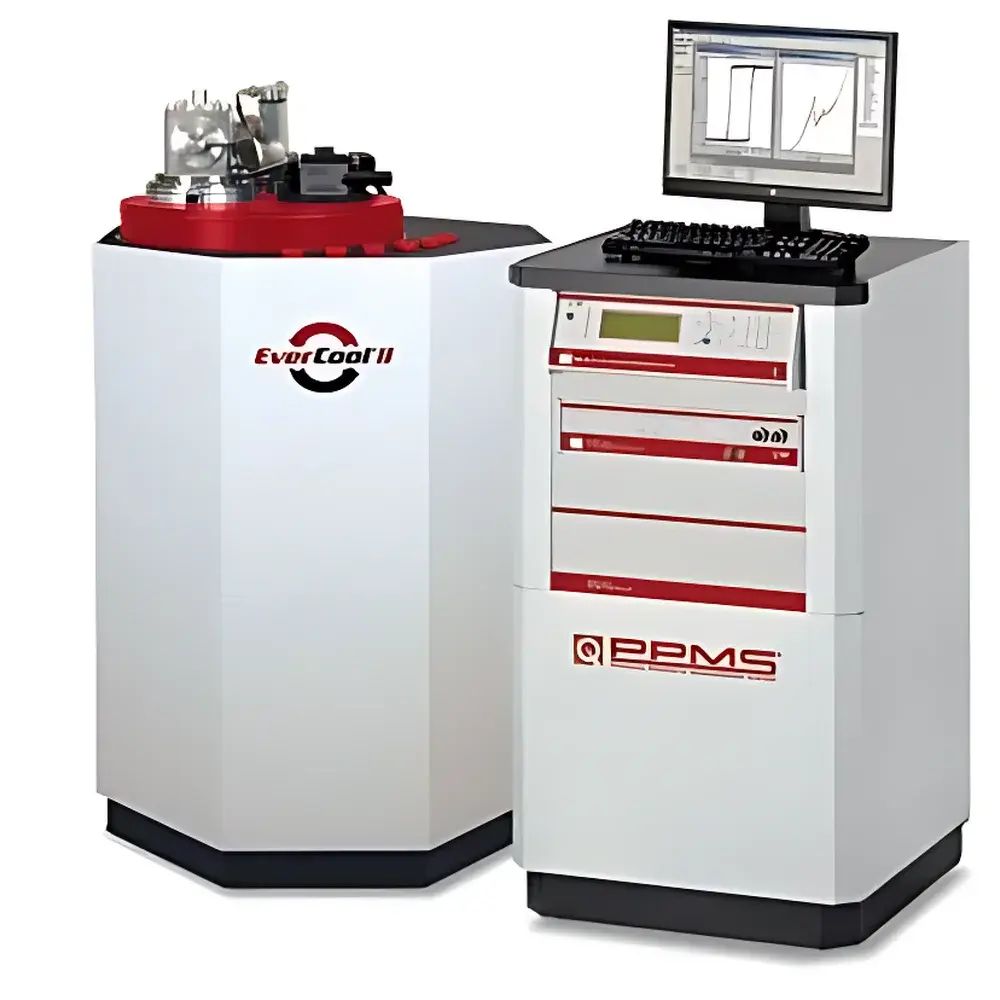
Quantum Design PPMS® Physical Property Measurement System
| Brand | Quantum Design |
|---|---|
| Origin | USA |
| Manufacturer Type | Manufacturer |
| Origin Category | Imported |
| Model | PPMS |
| Magnet Type | Superconducting Coil |
| Measurement Principle | SQUID (Superconducting Quantum Interference Device) |
| Temperature Range | 1.9 K – 400 K (continuous control) |
| Magnetic Field Range | ±9 T, ±14 T, or ±16 T |
| Magnetic Moment Resolution | AC: 1×10⁻⁸ emu @ 10 kHz |
| DC | 5×10⁻⁶ emu |
| Temperature Ramp Rate | 0.01 – 8 K/min (non-cryocooled models) |
| Field Sweep Rate | 10 – 200 Oe/s |
Overview
The Quantum Design PPMS® (Physical Property Measurement System) is a fully integrated, cryogenically cooled platform engineered for high-precision, multi-modal characterization of quantum materials under precisely controlled low-temperature and high-magnetic-field conditions. At its core, the system employs a superconducting magnet coupled with a SQUID-based magnetometer—enabling ultra-sensitive DC and AC magnetic moment detection—and integrates modular, software-synchronized measurement capabilities across magnetism, electrical transport, thermal transport, heat capacity, and dielectric/ferroelectric properties. Designed around a shared cryogenic environment (1.9 K–400 K), the PPMS eliminates experimental cross-contamination and thermal hysteresis associated with standalone instruments, ensuring measurement consistency and reproducibility across complementary physical probes. Its architecture supports both static and dynamic field/temperature protocols—including non-overshoot ramping, oscillatory field decay, and high-stability hold modes—making it suitable for studies requiring strict thermodynamic equilibrium (e.g., quantum phase transitions, vortex dynamics, and critical phenomena).
Key Features
- Modular, plug-and-play measurement options—each independently calibrated and electromagnetically shielded—to ensure mutual compatibility without signal crosstalk or mechanical interference.
- Ultra-stable temperature control: ±0.2% T below 10 K and ±0.02% T above 10 K; programmable ramp profiles (fast, non-overshoot, scan, and hold modes).
- High-field superconducting magnet with field resolution of 0.02 mT (≤1 T) and 0.2 mT (up to 9 T); long-term stability of ≤1 ppm/hour; residual field <5 Oe after oscillatory ramp-down from 9 T.
- Multi-channel hardware control via Model 6000 Controller, synchronized with MultiVu software for coordinated execution of hybrid measurements (e.g., simultaneous resistivity + AC susceptibility during field-cooled warming).
- Expandable cryogenic infrastructure: compatible with He-3 refrigerators (0.4 K), dilution refrigerators (50 mK), high-temperature furnaces (1000 K), and high-pressure cells (up to 3 GPa).
- Standardized, ASTM- and ISO-aligned measurement routines—including DC resistivity, Hall effect, AC magnetic susceptibility, M(H) hysteresis, Cp(T), thermal conductivity, Seebeck coefficient, and differential resistance—with traceable calibration protocols.
Sample Compatibility & Compliance
The PPMS accommodates diverse sample geometries—from bulk single crystals and thin films to nanowires, powders, and microfabricated devices—via interchangeable probe assemblies (e.g., Horizontal Rotator, Multi-Function Probe, AFM/MFM Option). All measurement modules comply with international metrological standards for low-temperature physical property testing. The system supports GLP- and GMP-aligned data integrity through MultiVu’s audit-trail logging, user-access controls, and electronic signature capability—fully compliant with FDA 21 CFR Part 11 requirements when configured with optional secure software licensing. Electrical transport and heat capacity modules adhere to ASTM E1530 (thermal diffusivity), ASTM F2187 (thin-film resistivity), and ISO 21710 (low-temperature specific heat) guidelines. Magnetic measurements follow IEC 60404-14 (SQUID calibration) and NIST-traceable reference standards.
Software & Data Management
MultiVu serves as the unified software interface for instrument control, experiment sequencing, real-time data visualization, and post-acquisition analysis. It provides scriptable workflows (Python API support), batch processing of multi-parameter datasets, and export in HDF5, ASCII, and MATLAB-compatible formats. Raw data files include embedded metadata (timestamp, field/temperature setpoints, sensor calibrations, and hardware configuration IDs) to ensure full experimental provenance. For regulated environments, optional Secure Mode enables role-based permissions, encrypted data storage, and automated backup to network-attached storage (NAS) or cloud repositories. All software updates undergo rigorous version-controlled validation and are documented per ISO/IEC 17025 quality management requirements.
Applications
- Quantum magnetism: spin frustration, spin liquids, and field-induced quantum phase transitions.
- Superconductivity: upper critical field mapping, vortex pinning, and anisotropy studies via torque magnetometry and angular-dependent resistivity.
- Topological materials: Berry curvature quantification via anomalous Hall effect and longitudinal magnetoconductance.
- Strongly correlated electron systems: Kondo lattice behavior, heavy fermion physics, and Mott insulator–metal transitions.
- Multiferroics and spintronics: coupled magnetoelectric response, domain wall dynamics, and current-induced switching under combined field/temperature stress.
- Thermoelectrics: ZT optimization via concurrent Seebeck, thermal conductivity, and carrier mobility extraction.
FAQ
What is the lowest base temperature achievable with standard PPMS configurations?
The standard PPMS achieves a base temperature of 1.9 K using pumped liquid helium. With optional He-3 or dilution refrigerator add-ons, the system extends down to 0.4 K or 50 mK, respectively.
Can multiple measurement types be performed simultaneously on the same sample?
Yes—MultiVu enables synchronized acquisition across up to four independent channels (e.g., AC susceptibility + resistivity + heat capacity), with hardware-level timing alignment to sub-millisecond precision.
Is the PPMS compatible with ultra-low-field (<1 Oe) magnetic measurements?
Yes, the Ultra Low Field Option includes active magnetic shielding, fluxgate compensation, and SQUID recalibration protocols to enable measurements down to 10 nT with sub-nemu sensitivity.
How does the system handle thermal drift during long-duration measurements?
The PPMS incorporates real-time temperature feedback via calibrated RuO₂ and Cernox™ sensors, with closed-loop correction applied at 10 Hz; thermal drift is typically <±5 mK over 24-hour holds at 4 K.
Are third-party probes or custom instrumentation supported?
Quantum Design provides SDK documentation and GPIO access for integration of externally developed probes, subject to electromagnetic compatibility verification and safety interlock validation.



