
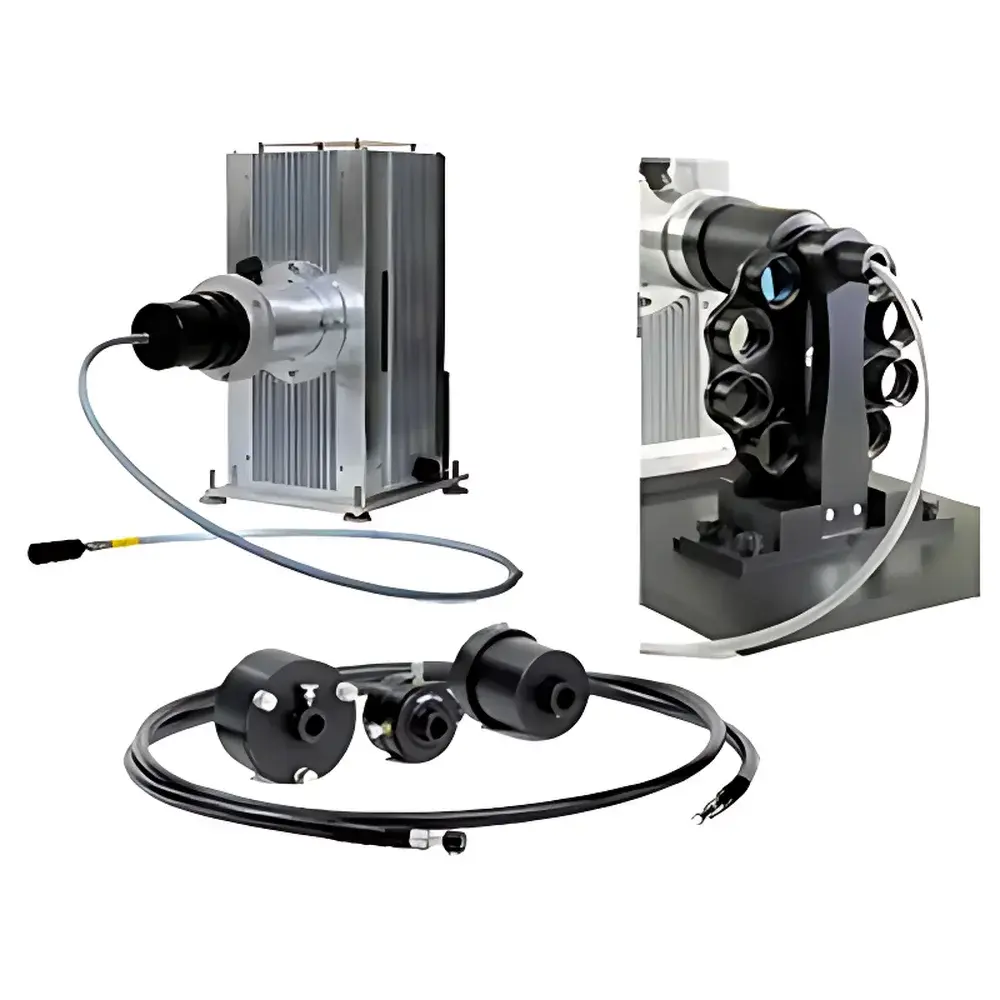
LOT Fiber-Output Solar Simulator
| Brand | Quantum Design |
|---|---|
| Origin | Germany |
| Manufacturer | LOT-Oriel Group (a Quantum Design Company) |
| Type | LOT Series |
| Illumination Mode | Steady-State |
| Light Source | 300 W Short-Arc Xenon Lamp (Ozone-Free) |
| Spectral Match Class | ASTM E927 Class B |
| Irradiance Instability | ≤1% RMS (typ.) |
| Output | Fiber-Coupled |
| Optional Filters | AM1.5G or AM0 |
| Optional Shutter | Digital or Manual Mechanical/Electronic |
| Optional Add-on | VSM-FOSH Photomagnetic Measurement Kit with Monochromatic Light Source (MLS), 360–845 nm, 150 W Xenon Lamp, UV-Vis-NIR Fiber Delivery (D320-UV: 325–900 nm |
| D320-IR | 375–2250 nm), Max Sample Diameter: 1.6 mm, Magnetic Sensitivity: <1×10⁻⁴ emu |
Overview
The LOT Fiber-Output Solar Simulator is a precision-engineered steady-state illumination system developed by LOT-Oriel Group — a German optical instrumentation pioneer founded in 1970 and integrated into Quantum Design since 2007. Designed for demanding photophysical and magneto-optical experiments, this simulator delivers calibrated, spectrally matched solar irradiance via flexible optical fiber coupling. Unlike conventional collimated or free-space solar simulators, the LOT fiber-output architecture enables remote illumination of samples located in spatially constrained or environmentally isolated environments — including cryostats, superconducting magnet bores, vacuum chambers, and gloveboxes. Its core light engine employs a 300 W ozone-free short-arc xenon lamp, providing high radiance and stable continuum emission from 250 nm to >2500 nm. Spectral output is certified to ASTM E927 Class B, ensuring fidelity to terrestrial (AM1.5G) or extraterrestrial (AM0) solar reference spectra when equipped with corresponding bandpass filters. The system operates exclusively in steady-state mode, eliminating temporal artifacts associated with pulsed illumination and supporting quantitative photometric, photoelectrochemical, and photomagnetic measurements requiring long integration times.
Key Features
- Fiber-coupled output enabling illumination of samples inaccessible to conventional beam paths — ideal for integration with physical property measurement systems (PPMS), vibrating sample magnetometers (VSM), and low-temperature transport platforms
- Ozone-free 300 W short-arc xenon lamp with high spatial coherence and thermal stability, engineered for ≥2000 h operational lifetime under continuous use
- Class B spectral match per ASTM E927-23, validated across 300–1200 nm using NIST-traceable spectroradiometry
- Irradiance stability ≤1% RMS (typical) over 30-minute intervals, monitored via integrated photodiode feedback loop with real-time logging capability
- Modular filter wheel interface supporting rapid switching between AM0 and AM1.5G spectral filters without optical realignment
- Dual shutter options: high-speed electronic shutter (≤10 µs rise time) for time-resolved studies, or manual mechanical shutter for routine calibration and dark-reference acquisition
- Expandable architecture compatible with optional monochromator-based MLS (Monochromatic Light Source) add-on, delivering tunable 360–845 nm illumination with ±0.5 nm wavelength repeatability
Sample Compatibility & Compliance
The LOT Fiber-Output Solar Simulator supports experimental configurations where sample access is physically limited. Its standard quartz-core multimode fiber (D320-UV or D320-IR) delivers broadband illumination to sample zones as small as Φ1.6 mm — suitable for single-crystal micro-samples, thin-film devices on cryogenic substrates, or magnetic specimens mounted inside VSM detection coils. The system complies with ISO/IEC 17025 requirements for calibration traceability and supports GLP/GMP-aligned workflows through optional audit-trail-enabled software modules. All optical components meet RoHS 2011/65/EU directives, and lamp housing design conforms to IEC 62471 photobiological safety standards for UV exposure. When configured with the VSM-FOSH photomagnetic measurement kit, the platform satisfies ASTM A977 and IEC 60404-14 protocols for light-induced magnetization characterization under controlled thermal and magnetic fields.
Software & Data Management
Control and monitoring are executed via Quantum Design’s proprietary QD-SimControl Suite — a Windows-based application supporting local USB or Ethernet communication. The software provides synchronized control of lamp power, shutter state, filter position, and (when installed) MLS wavelength and intensity. All irradiance measurements are timestamped and stored in HDF5 format, ensuring compatibility with MATLAB, Python (h5py), and LabVIEW analysis pipelines. For regulated environments, optional 21 CFR Part 11-compliant firmware enables electronic signatures, role-based user access, and immutable audit logs covering lamp runtime, calibration history, and operator interventions. Data export includes full spectral irradiance curves (W/m²/nm), temporal stability plots, and uncertainty budgets derived from NIST-calibrated reference detectors.
Applications
- Photoinduced magnetism studies in quantum materials (e.g., light-driven spin-state switching in Prussian blue analogs or multiferroics)
- In-situ photoelectrochemical characterization of perovskite solar cells inside inert-atmosphere gloveboxes
- Optical pumping of spin-polarized carriers in dilution refrigerator-mounted 2D heterostructures
- Calibration of space-qualified photodiodes and solar cell reference devices under AM0 spectrum
- Time-resolved magneto-optical Kerr effect (TR-MOKE) experiments requiring sub-millisecond optical triggering
- Photothermal deflection spectroscopy (PDS) of buried interfaces in semiconductor heterojunctions
FAQ
What is the maximum numerical aperture supported by the standard fiber output?
The system ships with SMA905-terminated fibers optimized for NA ≤ 0.22. Custom high-NA fibers (up to NA 0.39) are available upon request for enhanced étendue matching.
Can the simulator be integrated with third-party cryostats or magnet systems?
Yes — the fiber output permits seamless integration with commercial cryogenic platforms (e.g., Janis, BlueFors, CryoConcept) and superconducting magnets (e.g., Oxford Instruments, Quantum Design PPMS). Mechanical mounting brackets and vacuum feedthrough-compatible fiber sleeves are offered as accessories.
Is spectral recalibration required after filter changes?
No — factory-characterized filter transmittance profiles are embedded in software. Automatic spectral correction is applied in real time during irradiance calculation, maintaining traceability to NIST SRM 2241.
Does the system support automated irradiance uniformity mapping?
Uniformity assessment requires external scanning stage and reference detector. While not built-in, QD-SimControl provides API hooks for custom motion control integration and raster-scan data acquisition.






