
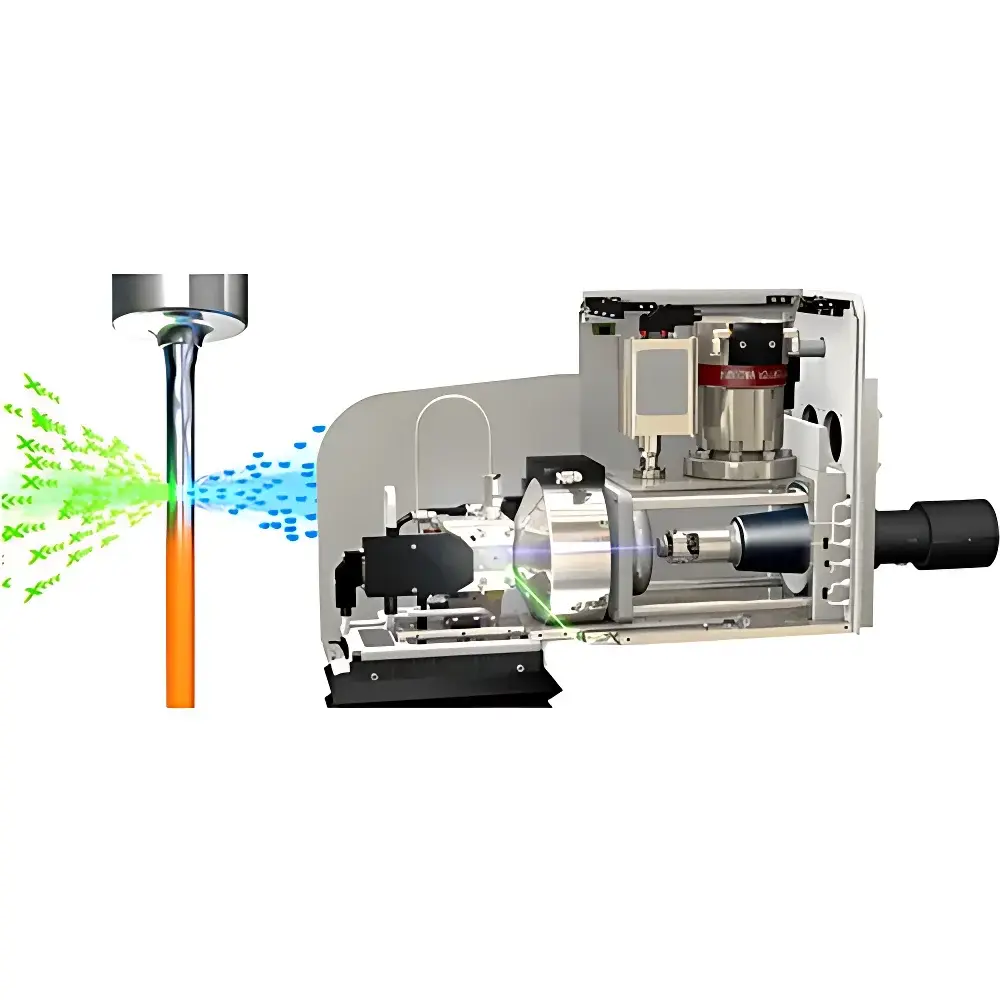
Excillum MetalJet Liquid-Metal-Jet X-ray Source
| Brand | Excillum |
|---|---|
| Origin | Sweden |
| Manufacturer Type | General Distributor |
| Origin Category | Imported |
| Model | Excillum |
| Price | Upon Request |
Overview
The Excillum MetalJet Liquid-Metal-Jet X-ray Source is an engineered laboratory-scale microfocus X-ray generator that leverages proprietary liquid-metal-jet anode technology to deliver unprecedented photon flux density in the hard X-ray regime. Unlike conventional solid-anode microfocus sources—whose thermal limits constrain electron-beam power loading—the MetalJet architecture employs a continuously regenerated, high-velocity (≈100 m/s) stream of molten metal (Ga or In alloy) as the electron-impact target. This eliminates thermal fatigue and enables stable operation at up to 1000 W electron-beam power while maintaining sub-10 µm focal spots. The source operates on the principle of bremsstrahlung and characteristic line emission (e.g., Ga Kα at 9.2 keV / 1.35 Å; In Kα at 24.2 keV / 0.51 Å), with spectral output defined by the choice of alloy composition. Its high brightness (photons·s⁻¹·mm⁻²·mrad⁻²·0.1%bw⁻¹), exceptional spatial stability (<1 µm focal position drift over 24 h), and intrinsic low divergence (13° or 30° full angle) make it suitable for demanding applications in laboratory-based X-ray imaging, scattering, and spectroscopy—traditionally requiring synchrotron-grade flux.
Key Features
- Ultra-high-brightness microfocus X-ray generation via liquid-metal-jet anode (Ga or In alloy)
- Two voltage configurations: 70 kV (300 W max) or 160 kV (1000 W max) acceleration potential
- Sub-10 µm minimum focal spot diameter with adjustable aspect ratio and emission angle
- LaB₆ thermionic cathode ensuring long operational lifetime and beam reproducibility
- Integrated radiation shielding compliant with IEC 61010-1 and local regulatory requirements
- No external water cooling required—self-contained closed-loop thermal management
- Optional dual X-ray exit ports, fast mechanical shutter, and remote control interface (TCP/IP, RS-232)
- Real-time intensity stabilization: <1% RMS variation over continuous operation
- Focus-to-sample working distance as short as 18 mm, enabling compact optical layouts
Sample Compatibility & Compliance
The MetalJet source is compatible with standard X-ray optical components—including polycapillary lenses, multilayer mirrors, zone plates, and grating interferometers—across a wide range of sample geometries and environmental conditions (vacuum, air, He atmosphere, or liquid cells). Its stable focal spot position and intensity enable quantitative, time-resolved measurements essential for GLP- and GMP-aligned workflows. The system conforms to ISO 17025 calibration traceability frameworks when integrated with certified X-ray detectors and positioning stages. While not itself a medical device, its use in preclinical imaging and materials characterization supports compliance with FDA 21 CFR Part 11 (when paired with validated software), ASTM E2827 (XRF mapping), ISO 21387 (X-ray phase-contrast imaging), and IEC 62495 (radiation safety for analytical equipment).
Software & Data Management
Excillum provides a vendor-neutral control suite supporting Windows/Linux platforms, offering programmable parameter sets (kV, mA, shutter timing, focal spot geometry), real-time intensity monitoring, and hardware synchronization triggers for external detectors or motion stages. All operational logs—including tube current/voltage history, thermal status, and focal spot diagnostics—are timestamped and exportable in CSV/JSON format. When deployed in regulated environments, the software architecture supports audit trail functionality, user access levels, and electronic signature capability—facilitating alignment with 21 CFR Part 11 requirements for electronic records and signatures. Integration with third-party platforms (e.g., Python-based PyXRF, MATLAB, or commercial CT reconstruction suites such as Octopus or Dragonfly) is enabled via documented APIs and standardized communication protocols.
Applications
- Small-angle and wide-angle X-ray scattering (SAXS/WAXS): Enables rapid structural analysis of proteins (e.g., Bcl-xL dimerization studies), nanocrystals (<50 µm), and soft-matter systems without cryo-cooling or synchrotron access.
- Micro-X-ray fluorescence (µ-XRF) and confocal XRF: Delivers high-flux excitation for Maia Mapper–class lab-scale elemental imaging; supports spectrally matched nanoparticle tracking (e.g., Mo-labeled tumors) with sub-30 µm resolution and quantitative correlation to ICP-MS.
- Phase-contrast and propagation-based imaging (PBI): Powers high-contrast, absorption-insensitive tomography of unstained biological specimens (e.g., zebrafish muscle, murine lung ventilation dynamics) at sub-micron resolution.
- X-ray microscopy and nanotomography: Provides sufficient monochromatic Kα flux for zone-plate-based optics, resolving features down to 150 nm in Siemens star test patterns—bridging the performance gap between lab and synchrotron facilities.
- Grating-based interferometry (GBI): Offers >10× higher usable flux than solid-anode sources in differential phase contrast setups, improving visibility and reducing scan time in biomedical tissue imaging.
FAQ
What distinguishes the MetalJet anode from conventional solid-anode X-ray sources?
The liquid-metal-jet anode eliminates thermal degradation by using a continuously flowing, self-renewing molten metal stream—enabling significantly higher electron-beam power loading and sustained brightness without focal spot drift or anode pitting.
Can the MetalJet source be used for crystallography of radiation-sensitive samples?
Yes—its high photon flux per unit area reduces exposure time, minimizing radiation damage. Combined with precise focal spot control and optional shuttering, it supports room-temperature serial crystallography and microcrystal screening.
Is spectral purity sufficient for energy-dispersive XRF applications?
The dominant Ga Kα (9.2 keV) or In Kα (24.2 keV) lines provide narrow-band excitation ideal for high-S/N XRF mapping. Broadband bremsstrahlung is minimized through optimized electron optics and inherent anode geometry.
How does the source integrate into existing X-ray instrumentation?
It features standard flange interfaces (CF-63 or ISO-KF), modular mounting options, and electrical/optical I/O compatible with most OEM stages, detectors, and vacuum systems—requiring no major re-engineering of host platforms.
What maintenance is required during routine operation?
No consumables beyond periodic cathode replacement (typical LaB₆ lifetime >10,000 hours); no water coolant servicing, oil changes, or anode refurbishment—resulting in <1 hour/year scheduled downtime.




