Lake Shore CRX-VF Cryogen-Free Superconducting Magnet Probe Station
| Brand | Lake Shore |
|---|---|
| Origin | USA |
| Manufacturer Type | Authorized Distributor |
| Origin Category | Imported |
| Model | CRX-VF |
| Pricing | Upon Request |
Overview
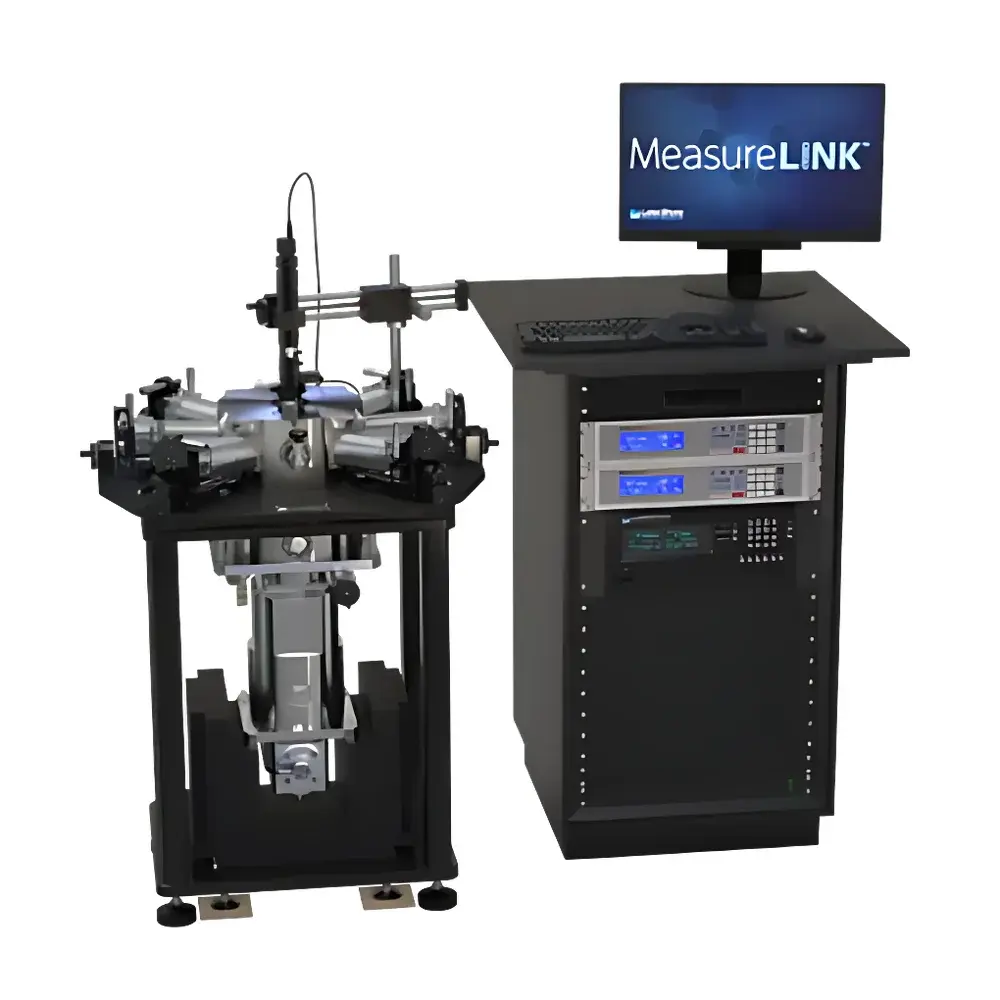
The Lake Shore CRX-VF is a cryogen-free, closed-cycle refrigerated probe station engineered for high-precision electrical, magneto-transport, and electro-optical characterization of semiconductor devices and quantum materials under variable temperature and high magnetic field conditions. At its core, the system integrates a vertically oriented superconducting solenoid magnet capable of delivering ±2.5 T (±25 kOe) fields—configurable up to ≥3 T upon request—within an ultra-stable thermal environment spanning 10 K to 500 K. Unlike traditional liquid helium–dependent systems, the CRX-VF employs an independent, two-stage pulse-tube cryocooler, enabling autonomous cooldown to base temperature without operator intervention or cryogenic infrastructure. Its vertical-field geometry supports true 90° planar probing across full 2-inch (51 mm) wafers, making it uniquely suited for Hall effect, carrier mobility, quantum oscillation, and anomalous Hall measurements in epitaxial heterostructures, 2D materials (e.g., graphene, TMDs), topological insulators, and organic semiconductors. The system’s design prioritizes measurement integrity: minimal thermal drift (<10 mK stability over 10–500 K), sub-micron mechanical stability (<1 µm sample vibration), and precise field homogeneity (≤0.5% over 10 mm Ø, ≤1% over 25 mm Ø), all critical for reproducible low-noise DC/RF/microwave transport data.
Key Features
- Cryogen-free operation via integrated two-stage pulse-tube cryocooler — eliminates dependency on liquid helium supply chains and associated operational overhead.
- Vertical superconducting magnet with programmable current control, delivering ±2.5 T (standard); optional ≥3 T configurations available for enhanced magneto-transport resolution.
- Full 2-inch (51 mm) wafer compatibility with true 90° orthogonal probe alignment — enables simultaneous multi-terminal I-V, C-V, and microwave S-parameter acquisition.
- Thermal operating range: 10 K (base) to 500 K — optimized for both cryogenic quantum phenomena and elevated-temperature reliability testing; sample cooling during warm-up mitigates condensation risk for hygroscopic or organic samples.
- Ultra-low-vibration platform (<1 µm RMS) with radiation-shielded probe arm mounts and thermally anchored probe holders (<50 K at base temperature).
- Modular probe architecture supporting up to six independently positionable arms — configurable with DC/RF probes (>100 GΩ insulation), microwave probes (DC–67 GHz), and fiber-coupled electro-optical probes.
- High-vacuum and ultra-high-vacuum options: standard TPS-FRG turbo-molecular pumping achieves <1×10⁻³ Torr in 90 min; PS-HV-CPX upgrade enables <5×10⁻⁷ Torr base pressure for surface-sensitive or air-sensitive experiments.
Sample Compatibility & Compliance
The CRX-VF accommodates rigid and flexible substrates up to 51 mm in diameter, including Si, GaAs, sapphire, quartz, and polymer-based organic electronics. Its vacuum-integrated sample transfer interface allows integration with glovebox or load-lock modules for atmosphere-sensitive sample loading—critical for perovskite photovoltaics, molecular crystals, and spin-coated thin films. All vacuum components comply with ISO-KF and CF flange standards; pressure monitoring and interlock logic meet CE machinery directive requirements. While not certified as a medical device, the system’s thermal and magnetic control architecture aligns with GLP-compliant laboratory practices for material qualification. Data logging timestamps, setpoint histories, and instrument state metadata are natively captured—supporting traceability frameworks required for ISO/IEC 17025-accredited testing labs.
Software & Data Management
Control and automation are managed through Lake Shore’s proprietary CryoSoft™ platform, which provides synchronized coordination of temperature ramping, magnetic field sweeping, probe positioning, and multi-channel source-measure unit (SMU) triggering. The software supports scripting via Python API (PyLakeshore), enabling custom test sequences for parameter sweeps (e.g., B–T–Vg maps), real-time lock-in detection, and automated Hall bar resistance extraction. Raw data export follows HDF5 format with embedded metadata (units, calibration coefficients, timestamp, hardware configuration), ensuring FAIR (Findable, Accessible, Interoperable, Reusable) compliance. Audit trails—including user login, parameter changes, and emergency stops—are retained for ≥180 days, satisfying internal QA requirements and preliminary FDA 21 CFR Part 11 readiness (when deployed with validated IT infrastructure and electronic signature protocols).
Applications
- Quantum transport studies: Shubnikov–de Haas oscillations, quantum Hall effect, Berry curvature mapping in van der Waals heterostructures.
- Device-level characterization: Gate-controlled carrier density profiling, contact resistance extraction, and mobility anisotropy in FETs and Hall bars.
- Low-noise metrology: Sub-picoampere leakage current analysis in high-k dielectrics and ferroelectric gate stacks.
- Microwave device validation: On-wafer S-parameter measurements of coplanar waveguides, resonators, and spintronic microwave emitters up to 67 GHz.
- Electro-optical correlation: In situ photoluminescence excitation under magnetic field for exciton g-factor determination in 2D semiconductors.
- Reliability stress testing: Thermal cycling between 10 K and 500 K while monitoring parametric shift in threshold voltage or series resistance.
FAQ
What is the minimum base temperature achievable with the CRX-VF, and how does magnetic field strength affect it?
The system reaches a base temperature of ≤10 K without applied field. At ±2.5 T, the practical base temperature is ~11 K; at ±2 T, it remains near 10 K; and at ±1 T, full 10 K performance is maintained.
Can the CRX-VF be integrated with third-party SMUs, RF analyzers, or laser sources?
Yes — all electrical, RF, optical, and vacuum interfaces conform to industry-standard connectors (SMA, K, V, FC/PC) and follow IEEE-488 (GPIB), USB-TMC, and Ethernet (VXI-11) communication protocols.
Is remote operation supported, and what cybersecurity safeguards are implemented?
CryoSoft supports secure remote desktop access via TLS-encrypted VNC; no default open ports or cloud dependencies are enabled. Local network isolation and role-based user authentication are configurable per institutional IT policy.
Does the system support in situ sample rotation or backside illumination?
No — the CRX-VF is optimized for vertical-field planar probing only; neither sample rotation nor backside optical access is mechanically supported in the standard configuration.
What vacuum level is required for organic semiconductor characterization, and how is outgassing minimized?
For air-sensitive organics, the PS-HV-CPX option (<5×10⁻⁷ Torr) is recommended; all internal surfaces undergo vacuum-bake conditioning, and stainless-steel construction with metal gaskets ensures low outgassing rates per ASTM E595 specifications.