
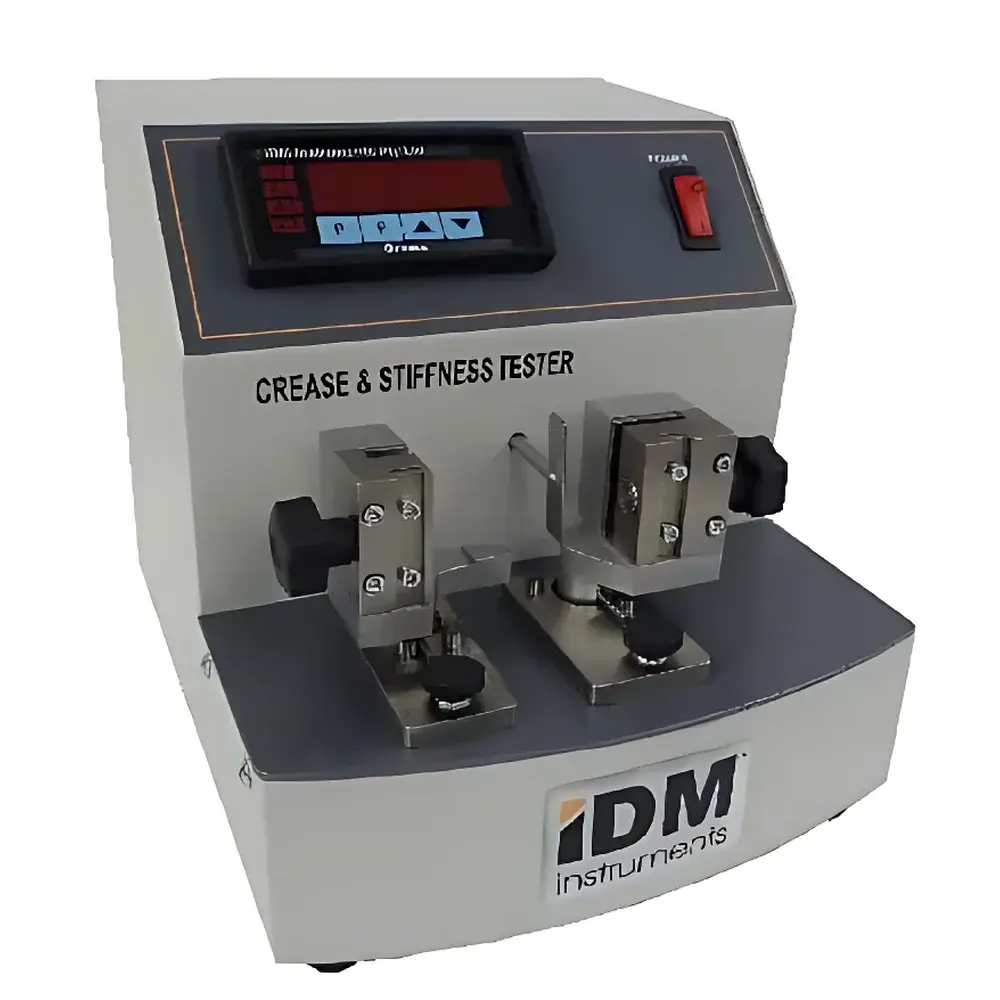
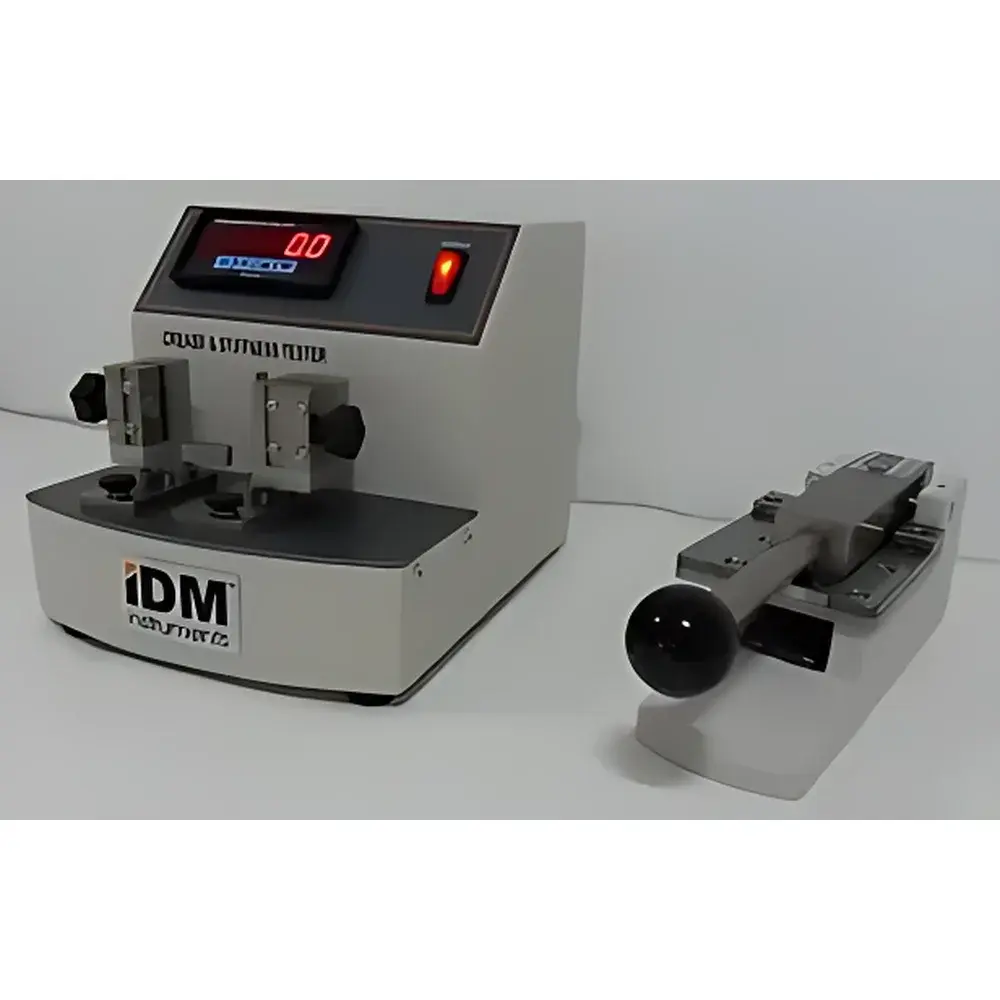
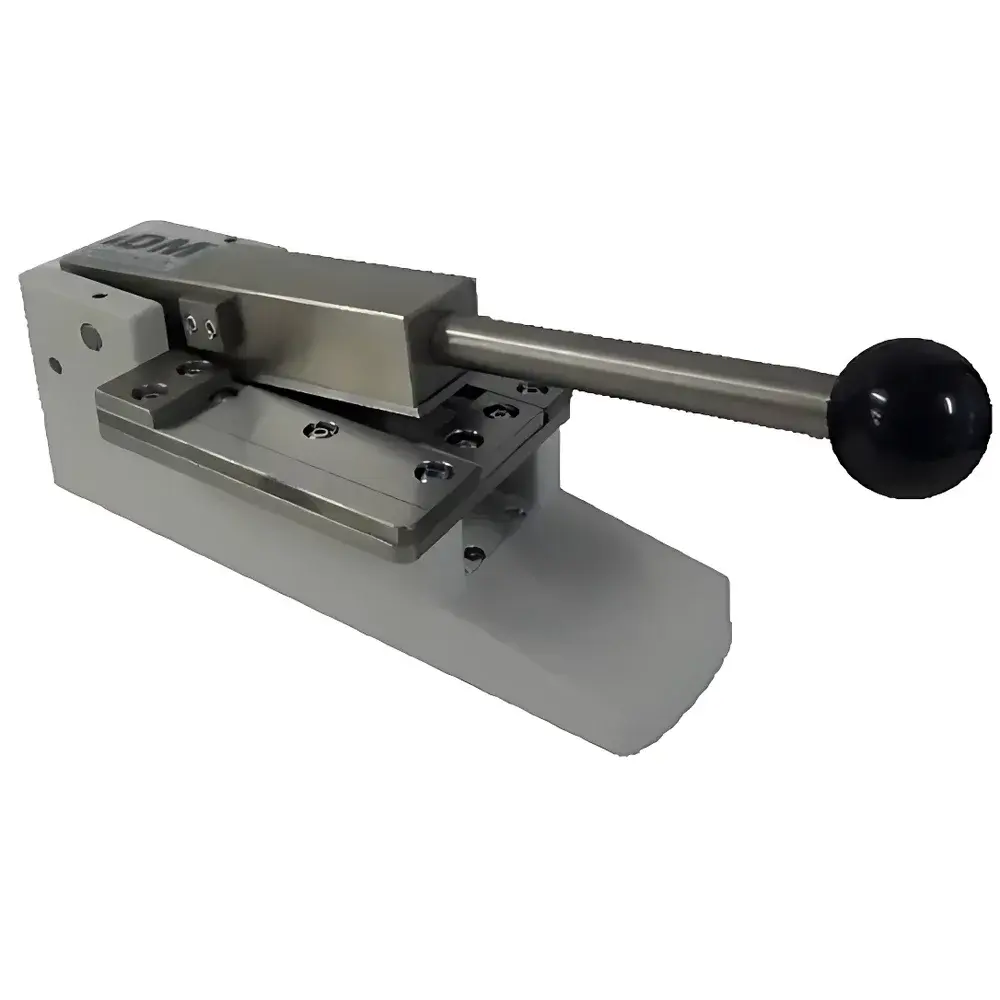
IDM C0039 Crease Stiffness Tester
| Brand | IDM |
|---|---|
| Origin | Australia |
| Model | C0039 |
| Measurement Range | 0–1000 gf |
| Resolution | 0.5 gf |
| Crease Bending Angle | 90° |
| Board Stiffness Bending Angle | 15° |
| Sample Dimensions (Board Stiffness) | 70 × 38 mm |
| Sample Dimensions (Crease Stiffness) | 38 × 36 mm |
| Test Duration | 15 s |
| Calibration Weight | 200 g |
| Compliance Standards | BS 6965, BS 3748, ISO 2493:1992 |
| Data Interface | RS232 |
| Power Supply | 220/240 V @ 50 Hz or 110 V @ 60 Hz (configurable at order) |
| Dimensions (H×W×D) | 140 × 275 × 150 mm |
| Weight | 5 kg |
Overview
The IDM C0039 Crease Stiffness Tester is a precision-engineered instrument designed specifically for packaging R&D laboratories and quality control environments where quantitative assessment of folding endurance and structural rigidity in corrugated board, solid bleached sulfate (SBS), coated duplex board, and laminated carton materials is critical. It operates on the principle of controlled angular deflection under static load, measuring the resisting force generated when a standardized sample is bent to defined angles—15° for general board stiffness evaluation and 90° for crease-specific resistance. Unlike generic bending testers, the C0039 replicates real-world folding dynamics encountered during high-speed carton erecting, tucking, and gluing operations. Its dual-mode functionality enables direct correlation between measured crease resistance and predicted machine-set parameters such as creasing rule depth, scoring wheel pressure, and pre-bending dwell time—thereby supporting predictive process optimization rather than reactive troubleshooting.
Key Features
- Dual-function measurement architecture: simultaneous determination of board stiffness (at 15° bend) and crease stiffness (at 90° bend), eliminating need for separate instruments or manual reconfiguration.
- High-resolution force transduction system with ±0.5 gf accuracy, enabling detection of subtle material variations across production batches or substrate formulations.
- Standardized sample holders with fixed geometry (70 × 38 mm for board mode; 38 × 36 mm for crease mode) ensure strict adherence to BS 6965, BS 3748, and ISO 2493:1992 test protocols.
- Integrated 15-second timed recovery measurement for crease resilience assessment—critical for evaluating memory retention in digitally printed or heavily coated substrates prone to springback-induced misalignment.
- RS232 serial interface supports traceable data export to LIMS or statistical process control (SPC) platforms, fulfilling GLP/GMP documentation requirements for regulated packaging validation.
- Universal power input (110 V / 220–240 V, 50/60 Hz) with factory-configurable voltage selection ensures operational continuity across global manufacturing sites.
Sample Compatibility & Compliance
The C0039 accommodates standard-grade paperboard ranging from 200–800 g/m² basis weight, including uncoated kraft, clay-coated SBS, metallized laminates, and UV-cured inkjet-printed substrates. Its mechanical design complies fully with ISO 2493:1992 (determination of stiffness of paper and board using the Taber-type tester), BS 3748 (methods for determining stiffness of paper and board), and BS 6965 (specification for apparatus for testing stiffness of paper and board). All test fixtures are manufactured to dimensional tolerances specified in Annex A of ISO 2493, ensuring inter-laboratory reproducibility. Environmental conditioning prior to testing (per ISO 187) is recommended; the instrument itself does not regulate ambient temperature/humidity but is calibrated for stable operation within 15–30°C and 30–65% RH.
Software & Data Management
While the C0039 operates as a standalone benchtop unit with digital LCD readout, its RS232 port enables bidirectional communication with external PCs running custom or third-party data acquisition software. Raw force values (in gf), bend angle status, and timestamped test events are transmitted in ASCII format, compatible with CSV import into Excel, Minitab, or JMP for capability analysis (Cp/Cpk), ANOVA of material lots, or trend monitoring against historical baselines. Audit trails—including operator ID, calibration date, and firmware version—can be appended via host-side logging, satisfying FDA 21 CFR Part 11 requirements when paired with validated software infrastructure.
Applications
- Optimization of creasing rule geometry and pressure settings for rotary die-cutters and flatbed presses.
- Validation of substrate suitability for high-speed auto-bottom box erecting machines.
- Comparative analysis of coating systems (e.g., aqueous vs. UV-curable) on fold endurance and crack resistance.
- QC release testing of incoming board rolls against supplier specifications per ISO 12625-5.
- Root cause analysis of field failures related to box collapse, flap misalignment, or glue joint separation.
- Supporting sustainability initiatives by quantifying minimum viable board grammage without compromising fold integrity.
FAQ
Does the C0039 comply with current ISO standards for stiffness testing?
Yes—the C0039 meets all mechanical and procedural requirements of ISO 2493:1992, BS 6965, and BS 3748. Unlike earlier C0039 variants, this revision includes full alignment with the 1992 edition of ISO 2493.
Can the instrument differentiate between elastic and plastic deformation during crease bending?
It measures total resistive force at 90° deflection and records residual angle after 15 s recovery. While not a dynamic viscoelastic analyzer, this two-point metric provides empirical insight into dominant deformation behavior under packaging-line loading conditions.
Is environmental conditioning required before testing?
Per ISO 187, samples must be conditioned at 23°C ±1°C and 50% RH ±2% for ≥24 h prior to measurement. The instrument itself requires no climate control but performs optimally within standard lab temperature ranges.
What maintenance is required to sustain metrological traceability?
Annual verification using NIST-traceable calibration weights (supplied: 200 g) and periodic zero-point validation are recommended. Full recalibration by an accredited service provider is advised every 24 months or after mechanical impact.
How does the C0039 support regulatory compliance in pharmaceutical or food packaging QA?
Its documented repeatability (±0.5 gf), standardized sample geometry, and RS232 audit trail capability enable integration into GMP-compliant validation protocols—particularly for carton integrity qualification per USP and EU Annex 15.





