
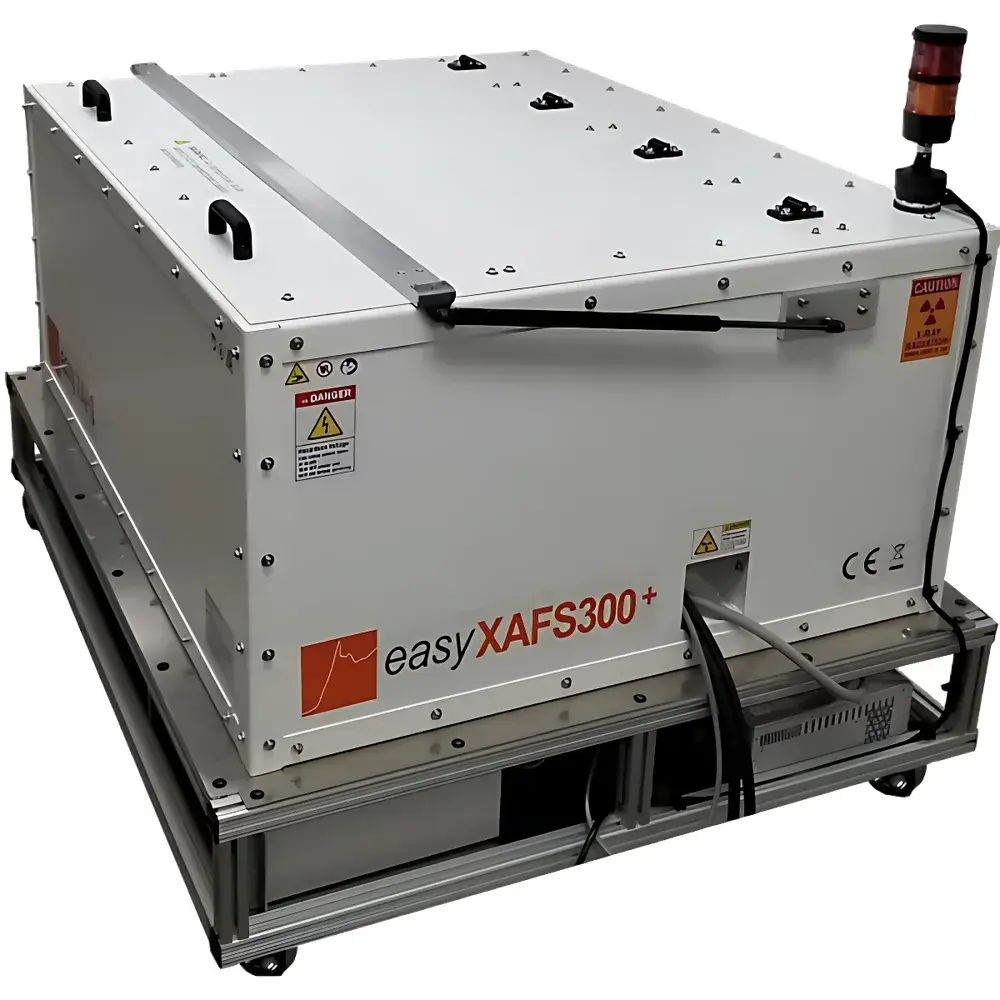
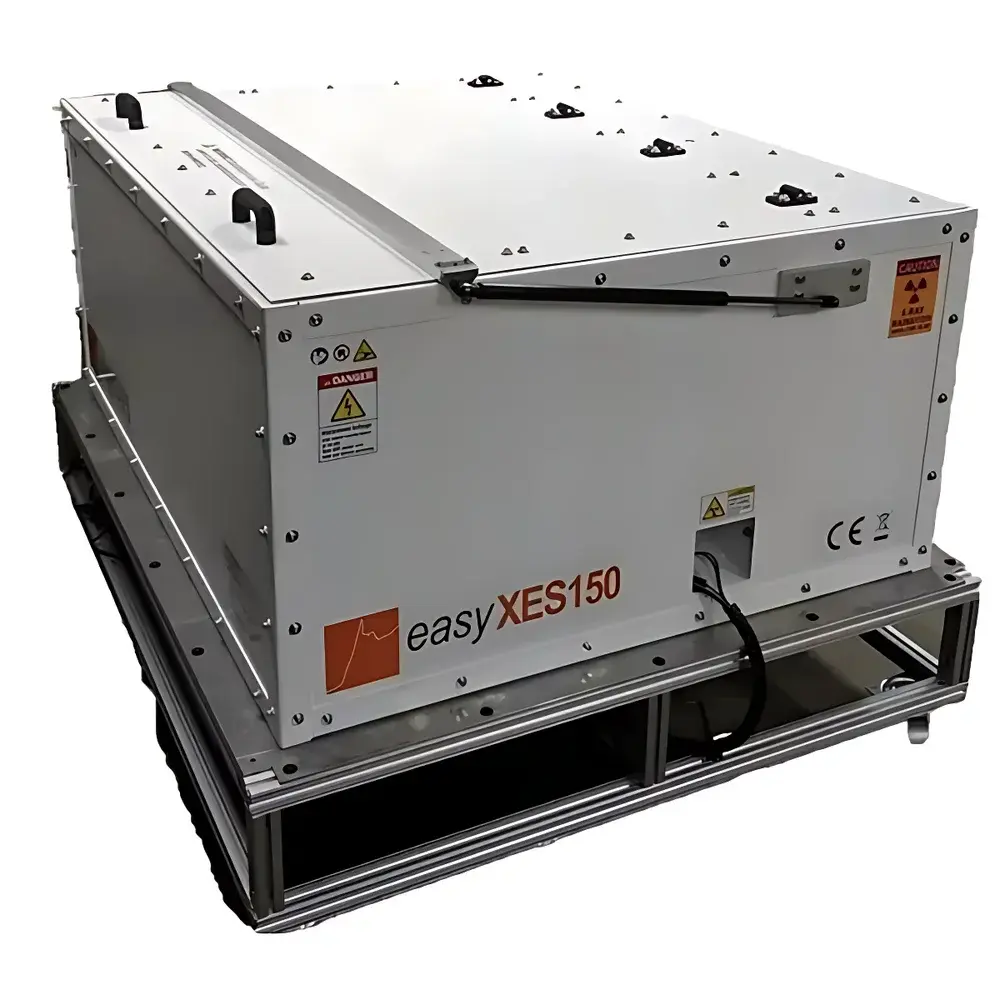
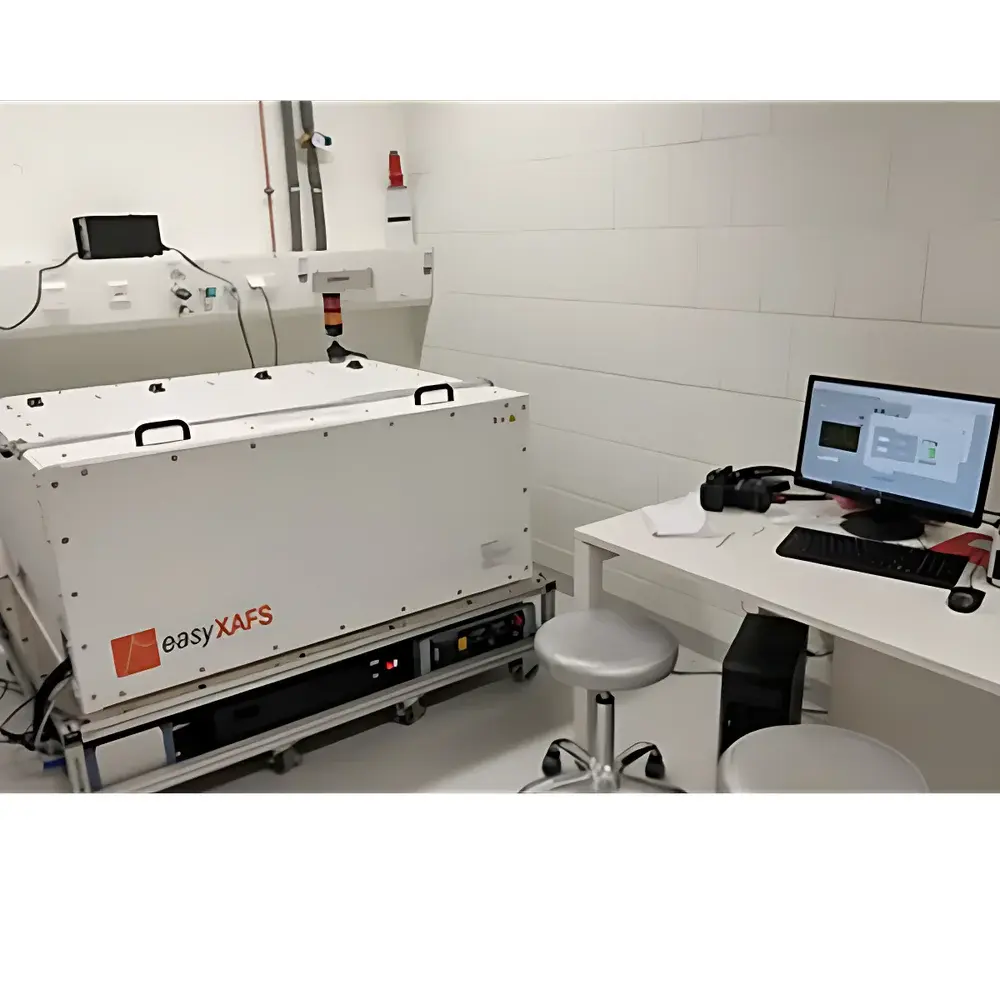
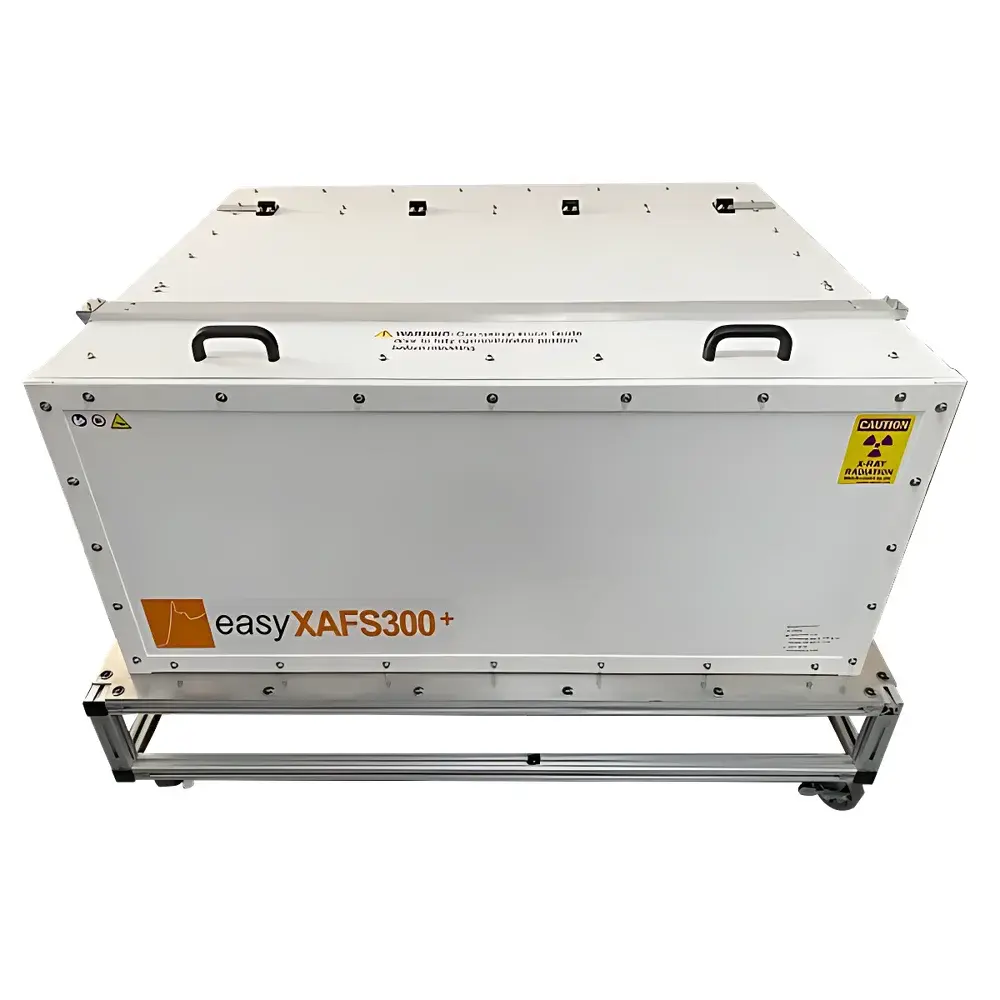
easyXAFS XES150 Benchtop In Situ Hard X-ray Emission Spectrometer (XES) and X-ray Absorption Fine Structure (XAFS) Spectrometer
| Brand | easyXAFS |
|---|---|
| Origin | USA |
| Manufacturer Type | Authorized Distributor |
| Product Origin | Imported |
| Model | XES150 |
| X-ray Source Power | XAFS Mode: 1.2 kW (Mo/W anode, for XRD-compatible operation) |
| XES Mode | 100 W (Pd/W anode, air-cooled microfocus tube) |
| Monochromatic X-ray Flux | XAFS: 300,000–500,000 photons/s (7–9 keV) |
| XES | 100,000–150,000 photons/s (7–9 keV) |
| Minimum Detectable Elemental Concentration | 0.1 wt% |
| Tunable X-ray Absorption Energy Range | 4.9–20.5 keV |
| XAFS Scan Speed | 0.1–2.0 eV/s |
Overview
The easyXAFS XES150 is a benchtop, laboratory-scale spectrometer engineered for simultaneous and complementary hard X-ray emission spectroscopy (XES) and X-ray absorption fine structure (XAFS) measurements — including XANES (X-ray absorption near-edge structure) and EXAFS (extended X-ray absorption fine structure). Unlike conventional synchrotron-dependent techniques, the XES150 employs a proprietary high-throughput double-crystal monochromator coupled with optimized source-detector geometry to deliver synchrotron-comparable spectral resolution and flux in a standard analytical laboratory environment. Its core measurement principle relies on element-specific core-level excitation: in XAFS mode, incident monochromatic X-rays induce photoelectron wave scattering from neighboring atoms, enabling quantitative determination of local coordination number, bond distance, and disorder; in XES mode, the system detects radiative decay following K- or L-shell ionization, yielding high-resolution fluorescence spectra sensitive to oxidation state, spin configuration, ligand field symmetry, and covalency. Designed for in situ and operando studies, the instrument supports controlled sample environments (e.g., gas cells, electrochemical cells, cryostats) via standardized vacuum flanges and external trigger interfaces.
Key Features
- Benchtop footprint (≤ 1.2 m²) with integrated vibration-damped optical table and radiation-shielded enclosure compliant with IEC 61000-6-3 and ANSI N43.3 standards
- Dual-source architecture: independent 100 W Pd/W air-cooled microfocus tube for high-resolution XES (energy resolution ≤ 1.2 eV at Cr Kα), and 1.2 kW Mo/W rotating anode tube for high-flux XAFS acquisition
- Modular monochromator system with Si(111) and Si(311) crystals, enabling continuous energy scanning across 4.9–20.5 keV without realignment
- 8-position automated sample wheel with motorized XYZ stage (±100 µm repeatability) and optional cryogenic (8–300 K) or electrochemical cell integration
- High-efficiency silicon drift detector (SDD) array with 140 eV FWHM at Mn Kα and 100,000 cps maximum count rate, optimized for both fluorescence yield (XES) and transmission (XAFS) detection geometries
- Fully automated alignment routines and energy calibration using certified reference foils (e.g., Fe, Ni, Cu, Zn) traceable to NIST SRM standards
Sample Compatibility & Compliance
The XES150 accommodates solid powders, pressed pellets, thin films, electrodes, catalysts on conductive substrates, and encapsulated liquid/gas-phase samples (via custom cells). It supports non-destructive analysis of heterogeneous, air-sensitive, and radiation-sensitive materials with minimal sample preparation (< 5 mg required for most XAFS measurements; < 1 mg for XES). All operational protocols comply with ISO/IEC 17025:2017 for testing laboratories, and data acquisition workflows meet GLP and GMP documentation requirements, including full audit trails, electronic signatures, and 21 CFR Part 11–compliant metadata logging. Instrument validation follows ASTM E2533-18 (Standard Guide for XAFS Data Acquisition) and ISO 18551:2017 (X-ray fluorescence spectrometry — Calibration and verification procedures).
Software & Data Management
Control and analysis are performed via easyXAFS Control Suite v4.x — a Python-based platform featuring real-time spectrum preview, automated background subtraction, energy calibration, and multi-edge fitting. Raw data are stored in HDF5 format with embedded metadata (sample ID, acquisition parameters, calibration references, environmental conditions). Integrated modules support Athena-style normalization, Artemis EXAFS modeling (with FEFF-based theoretical paths), and REX2020-compatible XES deconvolution. All processing steps are scriptable and reproducible; batch analysis pipelines can be exported as Jupyter notebooks. Data export complies with NeXus format standards for long-term archival and cross-platform interoperability with synchrotron beamline software (e.g., Dioptas, Larch, Demeter).
Applications
The XES150 enables rigorous local-structure characterization across multiple domains: in battery research, it resolves V⁴⁺/V⁵⁺ redox evolution during Zn²⁺ intercalation in hydrated vanadates (Nano Energy, 2020); in catalysis, it quantifies Ni/Fe coordination changes and oxygen vacancy formation in LDHs under OER conditions (J. Mater. Chem. A, 2021); in environmental science, it discriminates Cr(III) from Cr(VI) in polymer matrices at sub-ppm levels via Cr Kα XES peak centroid and width analysis (Anal. Chem., 2018); in nuclear materials, it tracks U L₃-edge speciation in spent fuel simulants; and in geochemistry, it maps Fe/Mn valence coupling in layered oxides under variable pO₂. Its ability to acquire both XAFS and XES on identical sample positions provides self-consistent electronic + geometric structural constraints — eliminating inter-instrument variability inherent in correlative synchrotron studies.
FAQ
Does the XES150 require synchrotron radiation?
No. It operates entirely with laboratory X-ray sources and proprietary monochromator optics, delivering performance comparable to bending-magnet beamlines for routine XAFS/XES applications.
Can the system perform both transmission and fluorescence XAFS?
Yes. The optical layout supports interchangeable detectors and sample stages for transmission (ideal for homogeneous solids/films) and fluorescence-yield (ideal for dilute or heterogeneous samples) modes.
What elements can be measured with XES on this system?
Elements from phosphorus (P, Kα = 2.01 keV) through uranium (U, Lα = 13.61 keV) are accessible; optimal performance is achieved for 3d (V, Cr, Mn, Fe, Co, Ni), 4d (Zr, Mo, Ru, Rh, Pd), and 5d (Hf, Ta, W, Re, Ir, Pt) transition metals, plus S, Se, As, and U.
Is remote operation supported?
Yes. The control suite includes secure TLS-encrypted remote desktop access, scheduled acquisition queues, and cloud-synced project repositories with version-controlled analysis scripts.
How is energy calibration maintained over time?
Automated daily calibration uses internal reference foils; long-term stability is verified quarterly against NIST-traceable standards, with drift compensation applied in real time during scans.
Related Products



