
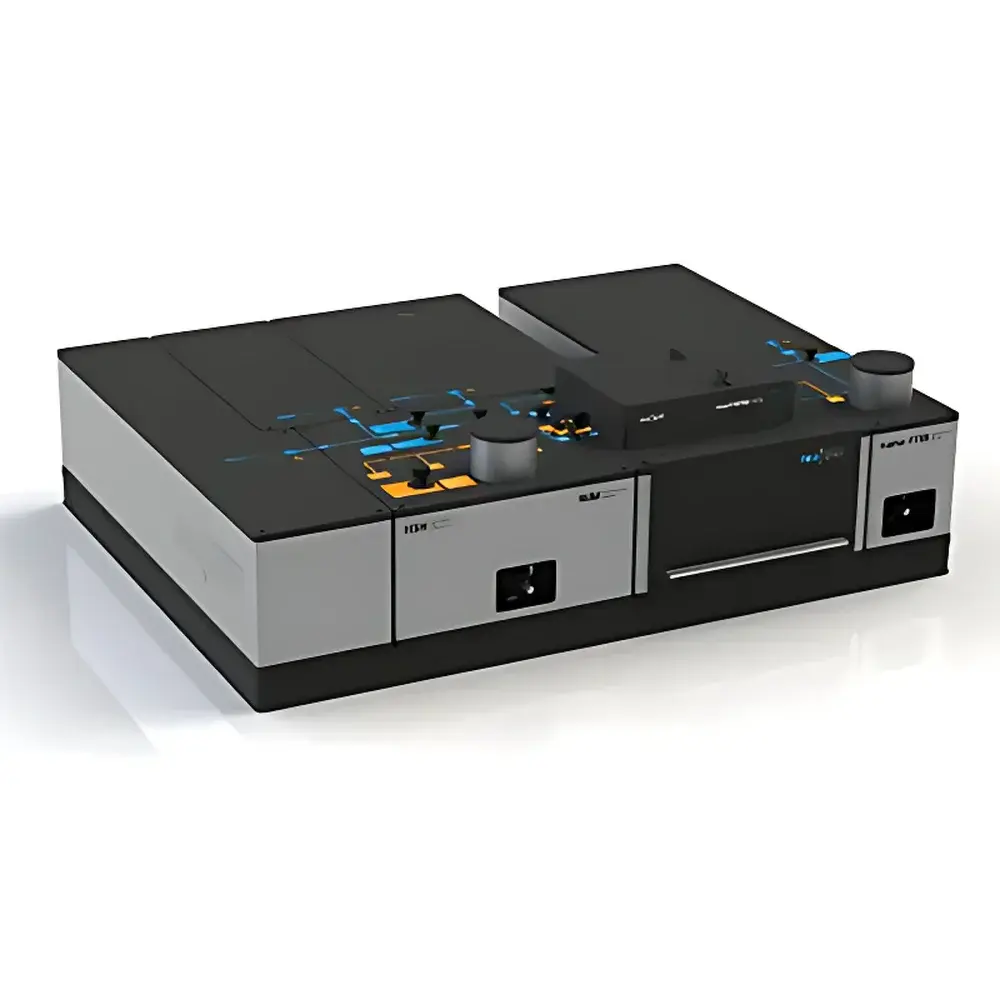
Neaspec Nano-FTIR & Ultrafast Pump-Probe Spectroscopy System
| Brand | Neaspec |
|---|---|
| Origin | Germany |
| Configuration | Near-field infrared and terahertz pump-probe nanoscopy system with visible–NIR excitation and mid-IR/THz detection |
| Spatial Resolution | 20–50 nm |
| Temporal Resolution | down to 50 fs |
| Probe Spectral Ranges | 650–2200 cm⁻¹ (mid-IR) or 0.5–2 THz |
| Pump Laser Compatibility | tunable visible to near-infrared sources |
Overview
The Neaspec Nano-FTIR & Ultrafast Pump-Probe Spectroscopy System is a hybrid near-field platform engineered for simultaneous nanoscale spatial and ultrafast temporal characterization of quantum materials. It integrates scattering-type scanning near-field optical microscopy (s-SNOM) with time-resolved pump-probe spectroscopy, enabling coherent, phase-sensitive measurements at the intersection of nanoscale morphology and femtosecond carrier dynamics. Unlike conventional far-field ultrafast spectrometers limited by diffraction, this system overcomes the spatial resolution barrier through atomic-force-microscope (AFM)-based interferometric detection of scattered probe light from a metallized tip apex. The pump beam—tunable across visible and near-infrared wavelengths—selectively excites electronic, vibrational, or collective excitations, while the delayed probe (mid-IR or THz) interrogates transient changes in local dielectric response with sub-50-fs temporal gating. This dual-domain capability is grounded in coherent heterodyne detection, lock-in demodulation at higher harmonics of AFM tapping frequency, and phase-stable optical delay line architecture—ensuring quantitative, background-free near-field spectra with high signal-to-noise ratio and reproducibility.
Key Features
- Simultaneous nanoscale and ultrafast resolution: 20–50 nm spatial fidelity co-registered with ≤50 fs temporal resolution
- Dual-probe spectral flexibility: interchangeable mid-infrared (650–2200 cm⁻¹) or terahertz (0.5–2 THz) detection modules
- Modular pump laser integration: compatible with Ti:sapphire oscillators, OPA systems, and fiber-based femtosecond sources (700–1000 nm typical)
- Interferometric s-SNOM architecture: amplitude and phase-resolved near-field signals acquired via pseudo-heterodyne detection
- High-stability mechanical design: vibration-isolated optical table integration, active tip-sample distance control, and thermal drift compensation
- Quantitative near-field spectroscopy: calibrated optical density extraction enabled by reference arm normalization and tip-enhancement modeling
Sample Compatibility & Compliance
The system supports a broad range of solid-state and 2D material samples—including exfoliated or CVD-grown transition metal dichalcogenides (e.g., WSe₂), black phosphorus, graphene, topological insulators, vanadium dioxide (VO₂), plasmonic nanostructures, semiconductor nanowires (e.g., InAs), and polymer thin films—without requiring conductive substrates or vacuum environments. All measurements are performed under ambient or controlled atmosphere (N₂, Ar glovebox integration optional). The platform complies with ISO/IEC 17025 guidelines for measurement uncertainty estimation in nanoscale optical metrology. Data acquisition protocols support audit trails and electronic signatures per FDA 21 CFR Part 11 when deployed in regulated research environments. Instrument control firmware includes GLP/GMP-ready metadata logging (timestamp, laser energy, tip condition, environmental parameters).
Software & Data Management
Operation is managed through Neaspec’s proprietary NEAview software suite, built on a modular LabVIEW-based framework with Python API extension. It enables synchronized control of pump-probe delay stages, AFM feedback loops, spectral acquisition engines, and multi-dimensional hyperspectral data stacking (x, y, t, ω). Raw interferograms are processed using fast Fourier transform (FFT) routines with apodization and phase correction algorithms; near-field absorption spectra are extracted via complex demodulation and reference-subtraction workflows. Data formats comply with HDF5 standards, supporting FAIR principles (Findable, Accessible, Interoperable, Reusable). Export options include ASCII, MAT, and vendor-neutral SPC files compatible with Origin, Igor Pro, and Python-based analysis pipelines (e.g., SciPy, scikit-learn for clustering of transient spectral features).
Applications
- Ultrafast carrier dynamics in van der Waals heterostructures (e.g., interlayer exciton dissociation in MoS₂/WSe₂)
- Nanoscale mapping of photoinduced phase transitions in VO₂ microdomains
- Plasmon-polariton lifetime imaging in graphene nanoribbons and doped semiconductor nanowires
- Coherent phonon spectroscopy of lattice instabilities in correlated oxides
- Time-resolved nanoinfrared imaging of polymer crystallinity evolution under photoexcitation
- Terahertz near-field probing of superconducting gap dynamics in Fe-based thin films
- Sub-diffraction mapping of hot-carrier transport anisotropy in black phosphorus
FAQ
What is the minimum detectable transient absorption change?
The system achieves noise-equivalent absorption sensitivity of ~10⁻⁴ OD (optical density) in single-scan mode at 1 kHz repetition rate, scalable to ~10⁻⁵ OD with averaging over 10⁴ scans.
Can the system perform polarization-resolved measurements?
Yes—both pump and probe beams can be independently polarized using motorized half-wave plates; full Stokes parameter acquisition is supported for vectorial near-field analysis.
Is cryogenic operation available?
The base system operates at room temperature; optional cryostat integration (4–300 K) is available with low-vibration closed-cycle coolers and IR-transparent windows.
How is tip lifetime managed during ultrafast experiments?
Tips are fabricated from PtIr-coated Si cantilevers with nominal resonance frequencies >200 kHz; wear is mitigated by amplitude-modulated tapping mode and real-time force monitoring; tip replacement and alignment are fully automated within NEAview.
Does the system support third-harmonic generation (THG) or sum-frequency generation (SFG) detection?
While primarily optimized for linear pump-probe contrast, harmonic generation modalities can be implemented via external nonlinear crystal insertion and spectral filtering—custom configurations require consultation with Neaspec application engineering.






