
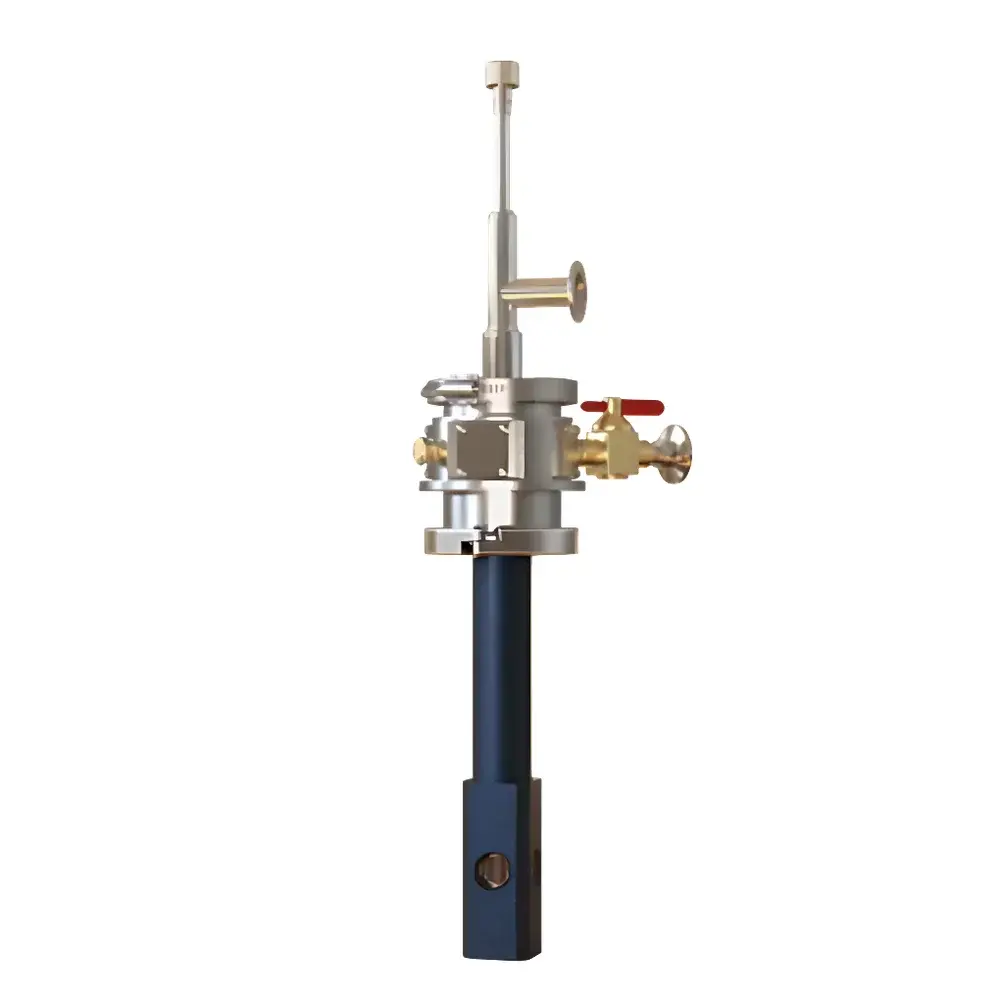
Lake Shore ST-300 Compact Optical Cryogenic Thermostat
| Brand | Lake Shore |
|---|---|
| Origin | USA |
| Model | ST-300 |
| Temperature Range | 2 K to 500 K |
| Temperature Stability | ±50 mK |
| Sample Environment | High Vacuum (Typical Operating Pressure: ~10⁻⁵ Torr) |
| Cooling Medium | Liquid Helium (down to 2 K) or Liquid Nitrogen (down to 77 K) |
| Cool-down Time to 5 K | ≤15 min |
| System Mass (excl. Transfer Lines) | ~4.6 kg |
| LN₂ Consumption @ 80 K | 0.1 L/h |
| LHe Consumption @ 5 K | 0.6 L/h |
| Initial LHe Fill (RT → Base Temp) | 0.4 L |
| Vacuum Requirement (Initial) | ~10⁻³ Torr |
| Optical Access | Standard Integrated Windows |
| Mounting Orientation | Omnidirectional |
| Compatibility | RGC Helium Recirculation Cryocooler (Helium-Free Operation) |
Overview
The Lake Shore ST-300 Compact Optical Cryogenic Thermostat is a high-performance, vacuum-integrated cryostat engineered for precision low-temperature experiments under optical, magneto-optical, or electrical characterization conditions. Based on Janis’ continuous-flow cryogenic architecture, the ST-300 utilizes direct liquid helium or liquid nitrogen delivery to a cold finger, enabling stable operation from 2 K to 500 K. Its compact, modular design—particularly the ST-300-C variant—features minimal radial footprint and ultra-narrow optical window blocks, making it uniquely suited for integration into tight-space environments such as superconducting magnet bores, confocal microscope stages, Fourier-transform infrared (FTIR) spectrometers, and terahertz time-domain spectroscopy (THz-TDS) platforms. The system maintains sample integrity within a high-vacuum environment (<1×10⁻⁵ Torr), eliminating convective heat transfer and minimizing thermal drift. Temperature regulation is achieved via integrated resistive heaters and Lake Shore’s Model 335 Temperature Controller, delivering closed-loop stability of ±50 mK across the full operating range.
Key Features
- Ultra-compact form factor optimized for narrow-gap magnets and optical microscopes; ST-300-C offers the smallest optical window block in its class
- Continuous-flow cooling with dual-cryogen flexibility: liquid helium (2–500 K) or liquid nitrogen (77–500 K)
- Rapid cooldown: ≤15 minutes from ambient to 5 K using liquid helium
- Full helium-free operation possible when coupled with Lake Shore RGC-series helium recirculation cryocoolers—enabling multi-day unattended measurements without cryogen replenishment
- Omnidirectional mounting capability supports vertical, horizontal, or inverted installation without performance compromise
- Integrated high-vacuum chamber with bake-out compatible flanges and standard CF-35/CF-63 ports
- Thermal mass-optimized cold stage ensures high thermal reproducibility and minimal temperature overshoot during ramping
Sample Compatibility & Compliance
The ST-300 accommodates solid, thermally conductive samples mounted directly to the cold finger or via custom sample holders. Its vacuum-sealed architecture eliminates atmospheric absorption and scattering, supporting high-fidelity optical transmission from X-ray through THz frequencies. Optional window materials—including UV-grade fused silica, CaF₂, sapphire, polyethylene (for THz), and diamond—enable spectral optimization across 0.1 nm to 1 mm wavelength ranges. Electrical characterization is supported by multiple feedthrough configurations: DC, BNC, SMA, and triaxial options, all rated for <1 nA leakage current at 4 K. The system complies with standard laboratory safety protocols for cryogenic handling (ANSI Z136.1 for laser integration) and meets vacuum integrity requirements per ISO 27893. When operated with RGC cryocoolers and controlled via 21 CFR Part 11–compliant software interfaces, it supports GLP/GMP traceability for regulated R&D environments.
Software & Data Management
Temperature control and monitoring are managed through Lake Shore’s CrossLink™ software suite, which provides real-time PID tuning, multi-zone logging (up to 16 channels), and automated ramp/soak sequences. CrossLink supports export to CSV, HDF5, and MATLAB-compatible formats, and integrates with LabVIEW™, Python (PyVISA), and EPICS for synchronized acquisition with spectrometers, lock-in amplifiers, or AFM controllers. Audit trails, user access levels, and electronic signatures are available when configured for FDA-regulated workflows. All firmware updates are delivered via secure HTTPS with SHA-256 signature verification.
Applications
- Low-temperature photoluminescence (PL) and cathodoluminescence (CL) spectroscopy of quantum dots, 2D materials, and perovskites
- Magneto-transport measurements in high-field vector magnets (up to 12 T) with simultaneous optical access
- THz emission/detection studies requiring sub-10 K base temperatures and broadband transparency
- In-situ XRD and XAS experiments under cryogenic vacuum conditions
- Calibration of IR/THz detectors and bolometers against NIST-traceable blackbody sources
- Quantum device testing (SQUIDs, single-photon detectors, superconducting qubits) requiring vibration-isolated, EMI-shielded thermal environments
FAQ
Can the ST-300 operate without liquid helium?
Yes—when interfaced with an RGC-series helium recirculation cryocooler, the ST-300 achieves fully autonomous operation from 2.5 K to 350 K with zero liquid helium consumption.
What vacuum level is required for optimal optical performance?
A base pressure of ≤1×10⁻⁵ Torr is recommended; the system achieves this typically within 2 hours using a standard turbomolecular pump and cryo-trap.
Is the ST-300 compatible with commercial confocal microscopes?
Yes—the ST-300-C variant features a 25 mm outer diameter and 12 mm clear optical aperture, designed specifically for OEM integration into Nikon, Zeiss, and Olympus microscope platforms.
How is temperature uniformity ensured across the sample mount?
The copper cold finger incorporates embedded Pt-100 sensors and distributed heater traces, enabling active gradient compensation and achieving <±20 mK spatial uniformity over a 10 mm diameter area.
Are custom electrical feedthroughs available for high-frequency RF measurements?
Yes—Lake Shore offers hermetic SMA and 1.0 mm V-connectors rated to 67 GHz, with return loss >20 dB up to 40 K, and calibrated S-parameter files provided upon request.
Related Products



