
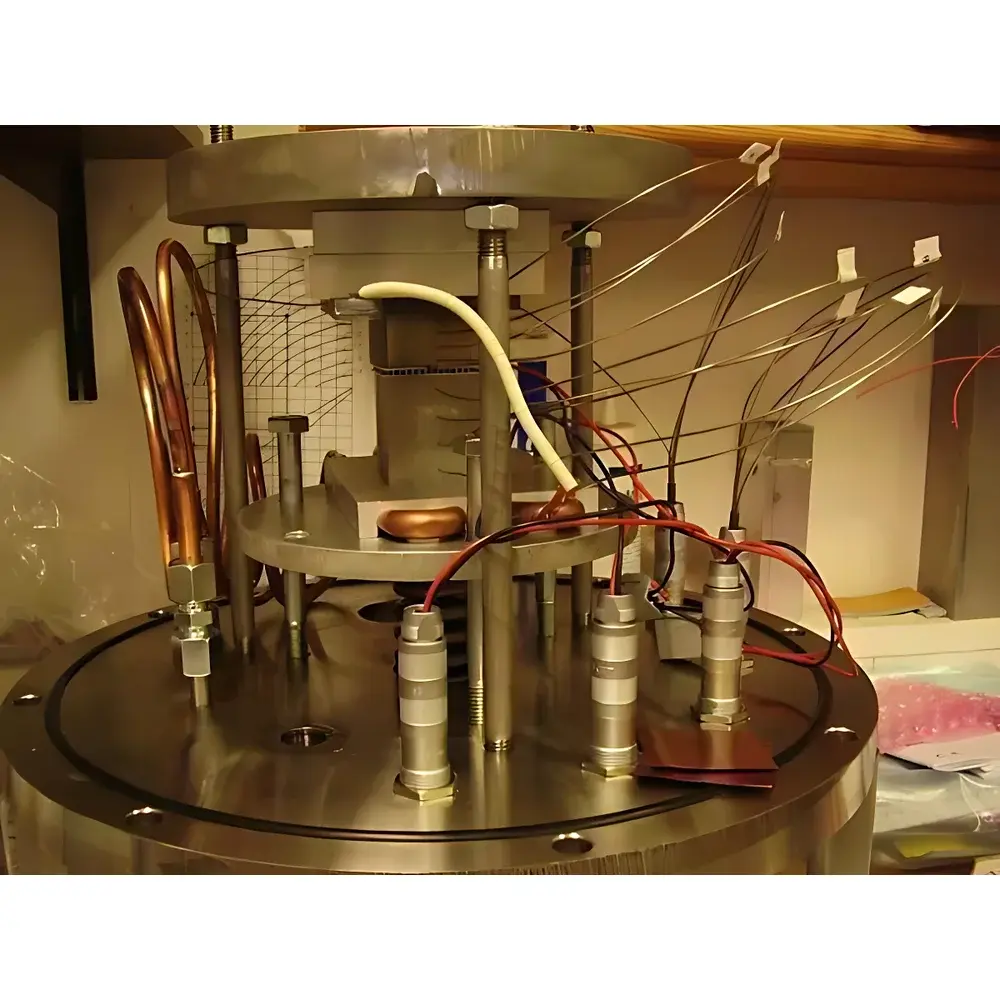
Panco TEGeta Multifunctional Thermoelectric Property Measurement System
| Brand | Panco |
|---|---|
| Origin | Germany |
| Manufacturer Type | Authorized Distributor |
| Origin Category | Imported Instrument |
| Model | TEGeta |
| Measurement Principle | Steady-State Heat Flow Method (Thermal Gradient + Simultaneous Electrical & Thermal Response) |
| Typical Sample Area | 50 mm × 50 mm |
| Customizable Sample Area | up to 80 mm × 80 mm |
| Temperature Range | Up to 900 °C |
| Voltage Range | 0–60 V (±1% accuracy) |
| Current Range | 0–30 A (±2% accuracy) |
| Heating Power | Up to 800 W (±10% tolerance) |
| Measured Parameters | Thermal Flux, Average Seebeck Coefficient (µV/K), Average Thermal Conductivity (W/m·K), Average Electrical Resistivity (µΩ·m), Maximum Output Power (mW/cm²), Conversion Efficiency (%) |
| Repeatability | High |
| Accuracy Class | High-Precision Laboratory Grade |
| Compliance Context | Designed for ASTM E1530, ISO 22007-2, and GB/T 33792–2017 compliant workflows |
Overview
The Panco TEGeta Multifunctional Thermoelectric Property Measurement System is a laboratory-grade, steady-state thermal gradient platform engineered for comprehensive characterization of bulk thermoelectric materials. It operates on the principle of establishing a controlled, unidirectional temperature gradient across a planar sample—typically mounted between actively regulated hot and cold blocks—while simultaneously acquiring synchronized thermal flux, voltage, and current data under variable electrical load conditions. This architecture enables concurrent determination of three fundamental thermoelectric transport properties: the Seebeck coefficient (S), electrical resistivity (ρ), and thermal conductivity (κ), from which the dimensionless figure of merit (zT = S²σT/κ) is rigorously derived. Unlike transient or laser-flash methods, the TEGeta employs direct heat-flow measurement via calibrated thermal sensors and precision DC excitation, ensuring traceable, low-noise, and reproducible results under equilibrium conditions. Its design prioritizes metrological integrity over speed, making it suitable for R&D laboratories requiring GLP-aligned validation, inter-laboratory comparison studies, and certification-grade material qualification.
Key Features
- Integrated dual-zone temperature control with independent PID regulation, supporting operation from ambient to 900 °C with thermal stability better than ±0.5 °C over 30-minute dwell periods.
- Simultaneous multi-parameter acquisition: real-time logging of thermal flux (via guarded heat-flux transducers), open-circuit voltage (±1 µV resolution), loaded current (±10 mA resolution), and contact thermocouple readings at both interfaces.
- Programmable electronic load module enabling automated resistance sweep (0.01–10 kΩ range) for maximum power point tracking and efficiency mapping across temperature steps.
- Modular sample stage accommodating standard 50 mm × 50 mm specimens, with optional extended fixtures for 80 mm × 80 mm samples—compatible with pressed pellets, sintered bars, and thin-sectioned ingots.
- Rugged stainless-steel vacuum-compatible chamber (base pressure <10⁻² mbar) with quartz viewport and feedthroughs for inert-atmosphere testing (N₂, Ar, forming gas).
- Built-in reference calibration routines using NIST-traceable SRM 3451 (chromel–alumel) and certified constantan standards for cross-validation of Seebeck and resistivity measurements.
Sample Compatibility & Compliance
The TEGeta system accepts electrically insulating or semiconducting solid-state thermoelectric materials—including skutterudites, half-Heuslers, Bi₂Te₃-based alloys, Mg₂Si composites, and oxide perovskites—in disk, bar, or rectangular slab geometries. Surface flatness ≤1 µm and parallelism ≤5 µm are recommended for optimal interfacial thermal contact. All measurement protocols align with ASTM E1530 (Standard Test Method for Measuring Thermal Resistance of Materials by Means of a Guarded Heat Flow Meter) and ISO 22007-2 (Plastics — Determination of Thermal Conductivity and Thermal Diffusivity — Part 2: Transient Plane Source Method, adapted for steady-state interpretation). Data audit trails comply with FDA 21 CFR Part 11 requirements when operated in conjunction with validated Panco ControlSuite software.
Software & Data Management
Panco ControlSuite v4.2 provides full instrument orchestration via Ethernet-connected Windows host PC. The application supports script-driven temperature ramping, load sequencing, and adaptive sampling rate control (1–10 Hz). Raw sensor outputs are stored in HDF5 format with embedded metadata (timestamp, operator ID, calibration certificate IDs, environmental logs). Export modules generate ASTM-compliant PDF reports including uncertainty budgets per parameter (based on GUM propagation), zT curves vs. temperature, and comparative overlays against historical datasets. Role-based user accounts enforce access control, while electronic signatures and immutable audit logs satisfy GLP/GMP documentation requirements.
Applications
- Quantitative benchmarking of novel thermoelectric compositions during alloy development and doping optimization.
- Temperature-dependent zT profiling for high-temperature waste-heat recovery material screening (e.g., automotive exhaust, industrial furnaces).
- Interface resistance quantification at electrode–material junctions using differential thermal gradient analysis.
- Validation of computational models (e.g., Boltzmann transport equation solvers) against experimental S, ρ, and κ datasets.
- Supporting ISO/IEC 17025-accredited testing services for third-party thermoelectric certification.
FAQ
Does the TEGeta support measurements under vacuum or controlled atmosphere?
Yes—the chamber is rated for base vacuum <10⁻² mbar and includes sealed electrical and thermocouple feedthroughs compatible with inert gas purging or static vacuum operation.
Can the system measure anisotropic thermoelectric properties?
It measures in-plane (x–y) averaged properties under uniaxial gradient; for directional anisotropy, orthogonal sample mounting and reorientation are required, with manual alignment verification.
What calibration standards are included with delivery?
Each system ships with NIST-traceable chromel–alumel thermocouple pairs, a certified constantan reference bar (ρ = 49.0 ± 0.5 µΩ·m at 25 °C), and a thermal conductivity standard (k = 0.25 ± 0.01 W/m·K at 50 °C).
Is remote operation supported?
Full remote monitoring and sequence execution are enabled via TLS-secured VNC or Panco’s RESTful API interface, subject to local network security policy approval.
How is thermal contact resistance minimized during testing?
The system uses spring-loaded, water-cooled copper electrodes with integrated graphite foil interlayers and programmable contact force control (5–50 N adjustable) to ensure uniform pressure distribution and minimal interfacial thermal resistance.



