
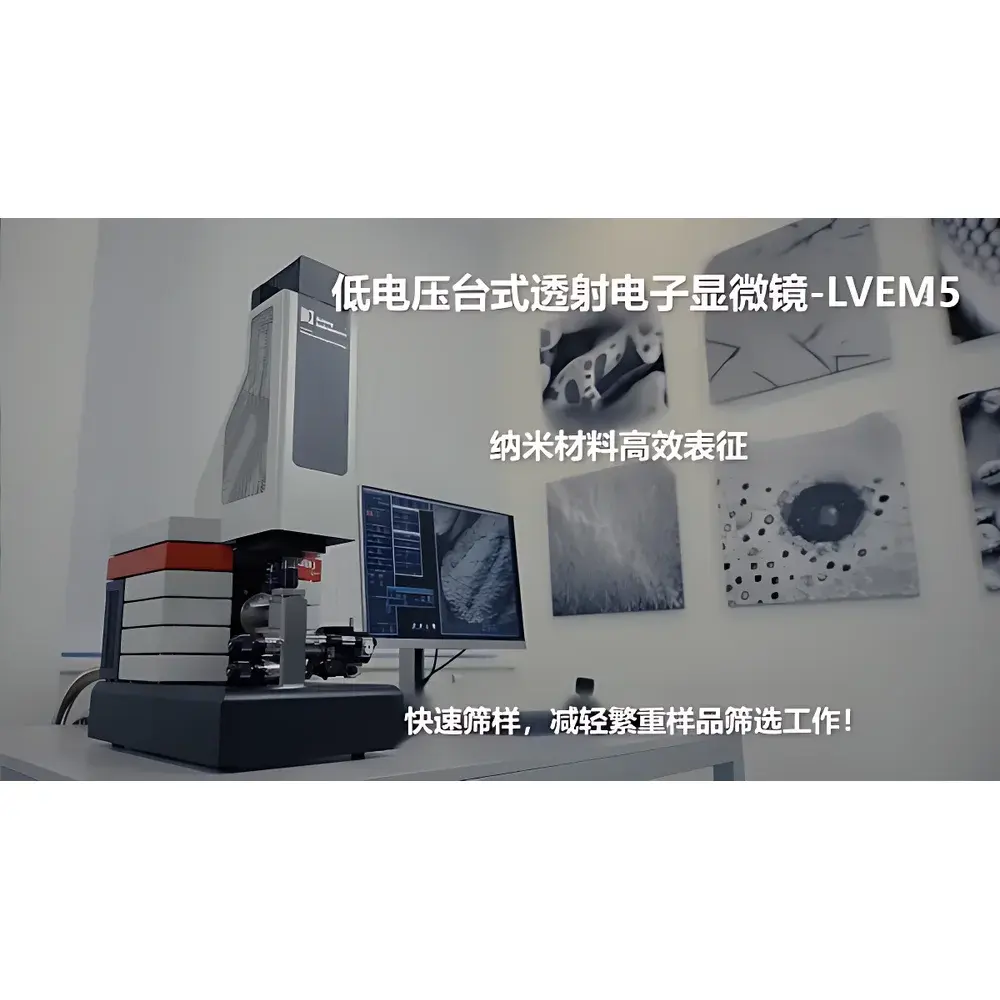
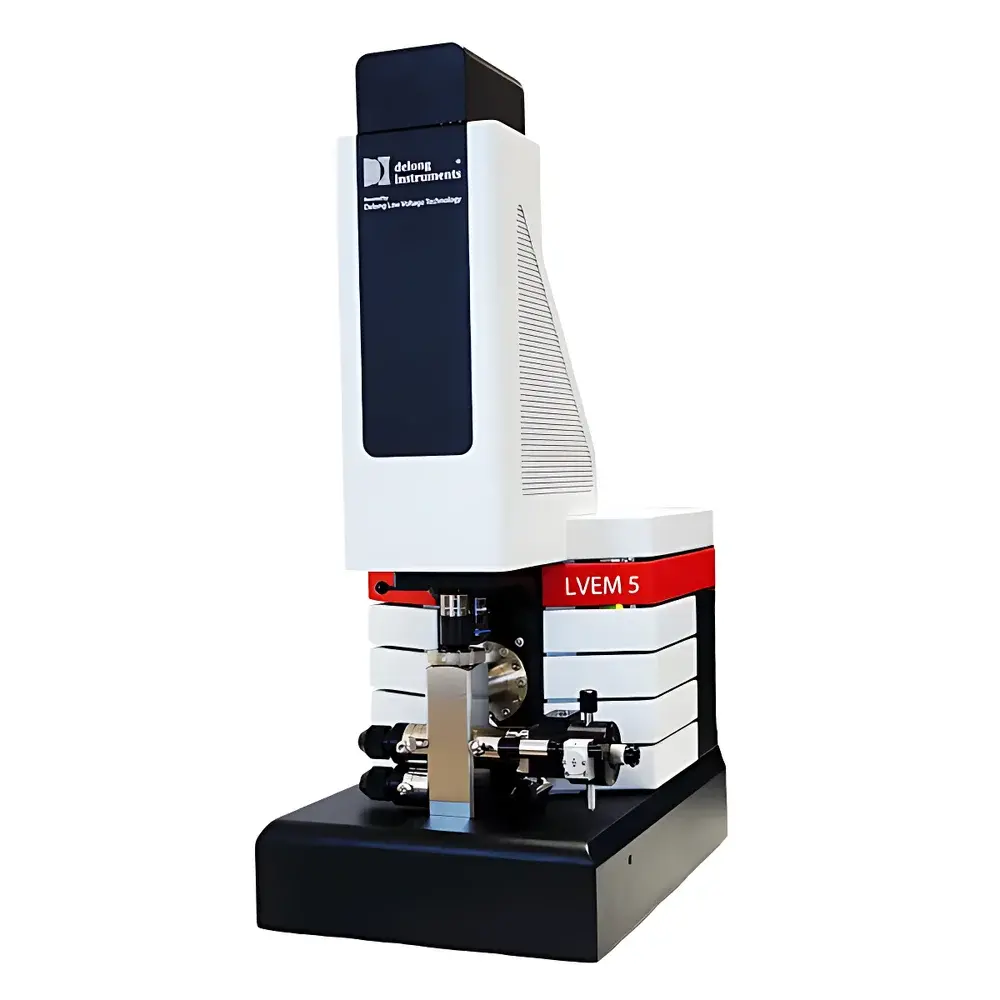
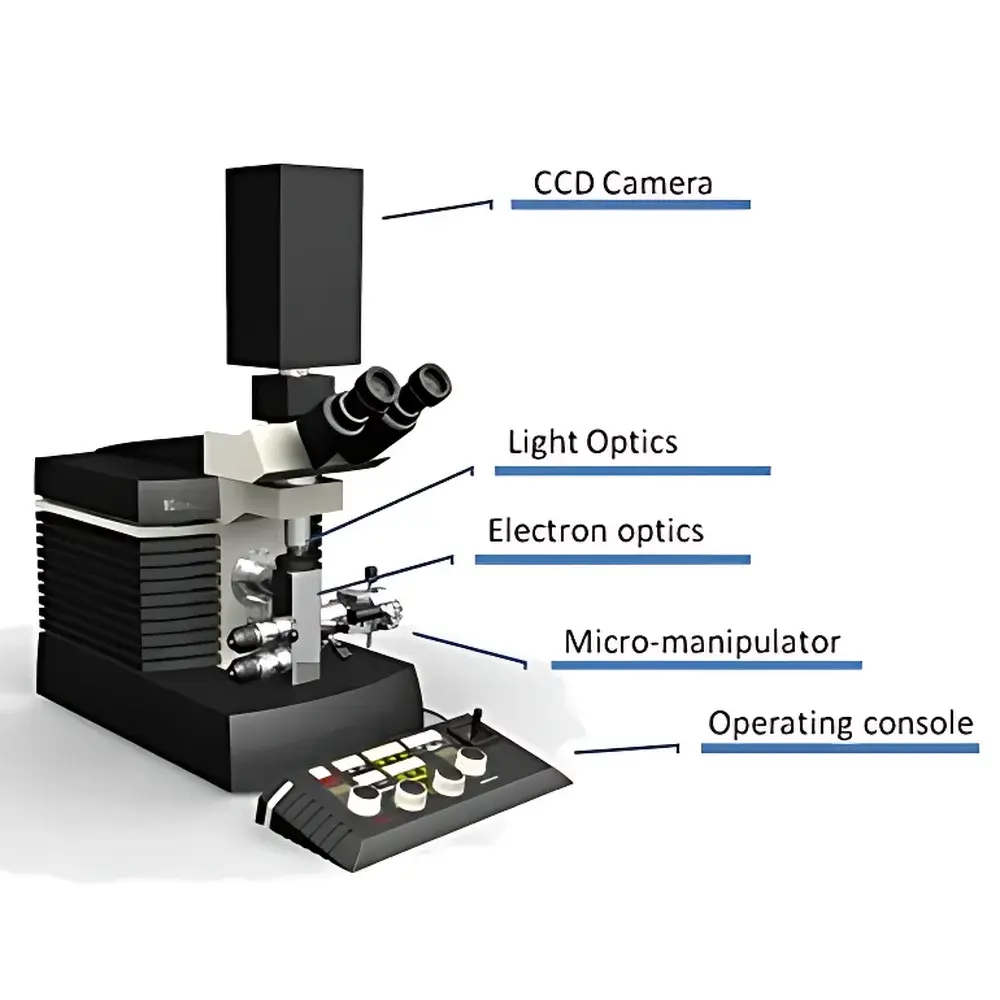
Delong LVEM5 Benchtop Low-Voltage Transmission Electron Microscope
| Brand | Delong Instruments |
|---|---|
| Origin | USA |
| Model | LVEM5 |
| Accelerating Voltage | 5 kV |
| Maximum Magnification | 700,000× |
| TEM Resolution | 1.5 nm (with TEM upgrade option) |
| SEM Resolution | 10 nm |
| STEM & ED Capabilities | Integrated |
| Sample Chamber | Ambient-pressure compatible, no external cooling required |
| Dimensions | Compact benchtop footprint (~1/10 volume of conventional TEM) |
| Electron Source | Inverted Schottky field-emission gun (FEG), >2000 h lifetime |
Overview
The Delong LVEM5 is a compact, benchtop low-voltage transmission electron microscope engineered for high-contrast nanoscale imaging without the infrastructure demands of conventional high-voltage TEM systems. Unlike traditional TEMs operating at 80–300 kV, the LVEM5 utilizes a precisely stabilized 5 kV accelerating voltage — a fundamental design choice that enhances elastic scattering cross-sections for light elements (C, N, O, H), thereby delivering exceptional intrinsic contrast in unstained biological specimens and soft materials. Its inverted Schottky field-emission electron gun provides high brightness (>10⁸ A/cm²·sr) and temporal coherence, enabling robust performance across TEM, STEM, SEM, and electron diffraction (ED) modalities within a single platform. The instrument’s vacuum architecture employs a differential pumping system with turbomolecular pumps only — eliminating the need for liquid nitrogen cooling, water chillers, or dedicated RF-shielded rooms. With a footprint under 0.5 m² and weight below 200 kg, the LVEM5 integrates seamlessly into standard laboratory or office environments, satisfying ISO 14644-1 Class 8 cleanroom compatibility requirements without structural modification.
Key Features
- Multi-modal operation: Simultaneous TEM, STEM, SEM, and selected-area electron diffraction (SAED) in one platform
- 5 kV low-accelerating voltage optimized for high-contrast imaging of beam-sensitive, low-Z materials including polymers, hydrogels, viruses, and ultrathin tissue sections
- Inverted Schottky FEG with >2000 h operational lifetime and <0.5 eV energy spread, ensuring stable probe current and minimal chromatic aberration
- TEM resolution of 1.5 nm (with optional high-resolution TEM upgrade); SEM resolution of 10 nm using segmented backscattered electron (BSE) detection
- Sample exchange time ≤ 3 minutes via airlock-integrated load-lock chamber — no full-system venting required
- No cryogenic cooling, no external water supply, no high-power electrical phase — operates on standard 120 V / 60 Hz (USA) or 230 V / 50 Hz (EU) circuits
- Full digital control interface with intuitive GUI; automated alignment routines reduce operator dependency and training time
Sample Compatibility & Compliance
The LVEM5 accommodates a broad range of uncoated, non-conductive, and radiation-sensitive specimens — including unstained biological thin sections (e.g., cardiac tissue, neurons), carbon-supported nanoparticles, hydrated hydrogels, and polymer blends — without sputter coating or heavy-metal staining. This capability supports compliance with Good Laboratory Practice (GLP) and Good Manufacturing Practice (GMP) documentation workflows where artifact-free structural fidelity is critical. All image acquisition and metadata logging conform to FDA 21 CFR Part 11 requirements when used with validated software configurations. Instrument design meets IEC 61000-6-3 (EMC emission) and IEC 61000-6-2 (immunity) standards. Vacuum interlocks, beam shuttering, and real-time pressure monitoring ensure adherence to ISO 14040 environmental impact assessment guidelines for lab-scale instrumentation.
Software & Data Management
Acquisition and analysis are managed through Delong’s proprietary LVEM Control Suite v4.x, a Windows-based application supporting DICOM-compliant TIFF, MRC, and EMDB-compatible file formats. The software implements audit-trail functionality with user-level access controls, timestamped parameter logging, and electronic signature support for regulated environments. Batch acquisition protocols can be scripted using Python API integration, enabling reproducible workflows for QC/QA applications. Image processing includes FFT-based crystallographic indexing for ED patterns, drift-corrected STEM line scans, and multi-channel BSE signal mixing for compositional contrast enhancement. Raw data export supports third-party platforms including DigitalMicrograph, ImageJ/Fiji, and MATLAB for advanced quantitative analysis.
Applications
- Life Sciences: Visualization of unstained cellular ultrastructure, virus morphology, and extracellular matrix organization at sub-10 nm scale — validated in peer-reviewed studies on murine myocardial tissue and neuronal synapses
- Materials Science: Characterization of ZnO nanowire crystallinity (via SAED), polyethylene lamellar stacking (STEM), and carbon nanotube dispersion homogeneity (TEM)
- Pharmaceutical Development: Nanocarrier integrity assessment, amorphous-to-crystalline phase transitions, and excipient distribution mapping in lyophilized formulations
- Quality Control: Rapid failure analysis of microelectronics packaging, composite fiber alignment verification, and contaminant identification in filtration membranes
FAQ
Does the LVEM5 require a dedicated vibration-isolated floor or Faraday cage?
No. Its mechanical damping design and low-kV operation make it tolerant to typical laboratory ambient vibrations and electromagnetic noise. Installation has been verified in shared academic offices and ISO Class 8 cleanrooms without supplemental shielding.
Can the LVEM5 image frozen-hydrated samples?
Not natively — it lacks a cryo-transfer stage. However, ambient-temperature hydrated gels and vitrified thin films (e.g., plunge-frozen grids stored at room temperature for short-term observation) have been successfully imaged with minimal dehydration artifacts.
What maintenance schedule is recommended?
Annual calibration of high-voltage supply and detector gain; quarterly cleaning of apertures and electron-optical alignment verification. No filament replacement is required during normal FEG lifetime.
Is remote operation supported?
Yes — via secure RDP or VNC over local network with role-based authentication. Full instrument control, including stage navigation and mode switching, is available remotely without latency compromise.
How does LVEM5 data comply with journal submission requirements?
All exported images include embedded metadata (accelerating voltage, magnification, pixel size, date/time, operator ID), satisfying Nature, Science, and JMB requirements for structural biology and materials characterization submissions.




