
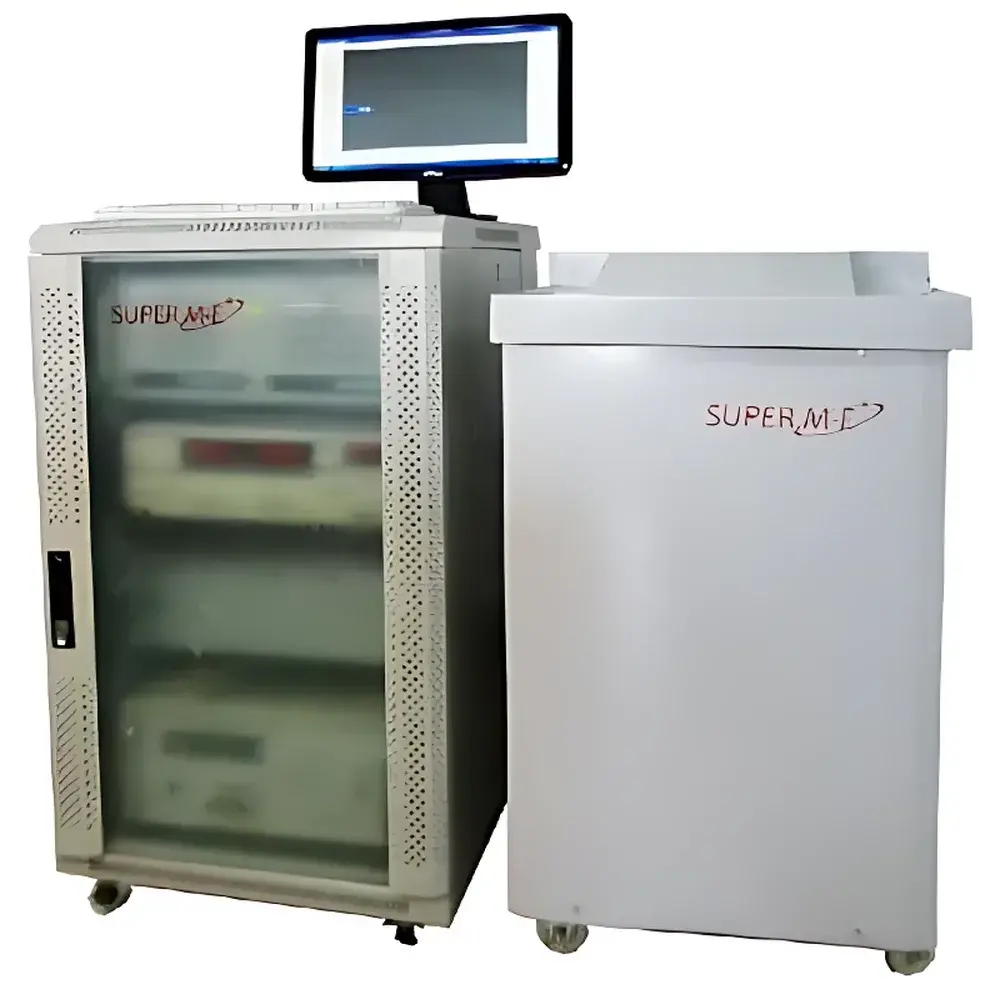
SuperME-II Multi-Ferroic Magnetoelectric Measurement System by Quantum Design
| Brand | Quantum Design |
|---|---|
| Origin | Beijing, China |
| Manufacturer Type | Original Equipment Manufacturer (OEM) |
| Product Category | Domestic |
| Model | Super-ME-II |
| Pricing | Available Upon Request |
Overview
The SuperME-II Multi-Ferroic Magnetoelectric Measurement System is a high-precision, fully automated instrumentation platform engineered for quantitative characterization of magnetoelectric (ME) coupling in multiferroic materials. Based on the foundational methodology developed in Prof. Cewen Nan’s laboratory at Tsinghua University and further refined by Quantum Design, the system implements a dual-field excitation approach—combining precisely controlled static (DC) magnetic bias fields with tunable alternating (AC) magnetic fields—to directly measure the linear magnetoelectric coefficient αij = ∂Pi/∂Hj (in units of ps/m) as a function of multiple experimental parameters. The measurement principle relies on lock-in detection of the induced electric polarization response (voltage signal across sample electrodes) under harmonic AC magnetic excitation, enabling resolution of both amplitude and phase of the ME voltage coefficient αV = VME/tHac, where t denotes sample thickness. This architecture supports rigorous investigation of intrinsic ME coupling mechanisms—including strain-mediated, charge-mediated, and exchange-bias-driven contributions—in bulk ceramics, single crystals, and thin-film heterostructures.
Key Features
- Simultaneous control and sweep of DC magnetic field (±1 T), AC magnetic field amplitude (up to 6 Oe), frequency (10 Hz – 1 MHz), and sample orientation (±90°, 1° step resolution)
- Dual-mode magnetoelectric signal acquisition: high-sensitivity lock-in mode (1 µV resolution) and broadband oscilloscope mode (1 mV range)
- Integrated complementary measurement modules: four-probe resistivity (0.5% accuracy) and magnetostriction (via cantilever-based strain transduction)
- Temperature-controlled cryogenic stage operating from 100 K to 300 K with ±0.5 K stability, compatible with standard PPMS-style dewars or closed-cycle refrigerators
- Dedicated sample holders optimized for both freestanding bulk specimens and epitaxial thin films (including bottom-electrode contact schemes for capacitor-like geometry)
- Modular hardware design supporting future expansion with optional RF impedance analyzers, piezoresponse force microscopy interfaces, or time-resolved pulsed-field capabilities
Sample Compatibility & Compliance
The SuperME-II accommodates a broad spectrum of multiferroic material forms: polycrystalline ceramics (e.g., BiFeO3-based composites), single-crystal oxides (e.g., Cr2O3, TbMnO3), sputtered or PLD-grown thin films (5 nm – 500 nm thickness), and laminated heterostructures (e.g., PMN-PT/CoFeB, PZT/Ni). All electrical contacts conform to IEEE Std 117–2015 guidelines for low-noise voltage measurement. Magnetic field generation complies with IEC 61000-4-8 (power-frequency magnetic field immunity) and incorporates active shielding to minimize stray field interference. Data acquisition adheres to GLP-compliant metadata tagging (timestamp, operator ID, calibration traceability), and raw signal logs are stored in HDF5 format for long-term archival and third-party analysis.
Software & Data Management
The system is operated via MEStudio, a Python-based graphical user interface providing real-time visualization, multi-dimensional parameter sweeps (e.g., Hdc–f–T mapping), and automated curve fitting using physically constrained models (e.g., Landau–Lifshitz–Gilbert + piezoelectric constitutive equations). All measurement protocols are scriptable and exportable in JSON format for integration into lab-wide workflow orchestration tools. Audit trails—including instrument configuration history, calibration events, and user-initiated modifications—are maintained per FDA 21 CFR Part 11 requirements. Export options include CSV (for Excel/Origin), MATLAB .mat, and standardized NeXus/HDF5 formats compliant with ICAT and Materials Data Facility (MDF) repositories.
Applications
- Quantification of direct and converse magnetoelectric coefficients in candidate room-temperature multiferroics
- Phase diagram mapping of ME coupling strength versus temperature, magnetic field orientation, and mechanical boundary conditions
- Interface engineering studies in oxide heterostructures (e.g., strain transfer efficiency across SrRuO3/BiFeO3 interfaces)
- Dynamic ME response analysis for RF tunable devices (filters, phase shifters) and energy-harvesting transducers
- Correlation of ME activity with domain dynamics observed via in situ PFM or Lorentz TEM
- Validation of first-principles predictions (e.g., DFT-calculated αij tensors) against macroscopic measurements
FAQ
What sample geometries are supported?
Standard configurations include disc-shaped bulk samples (diameter 5–12 mm, thickness 0.2–2 mm) and rectangular thin films (up to 10 × 10 mm²) with interdigitated or parallel-plate electrode layouts.
Is vacuum or inert atmosphere operation possible?
Yes—the sample space is compatible with standard vacuum feedthroughs and can be integrated into glovebox-compatible cryostat inserts for air-sensitive materials.
Can the system perform time-domain ME measurements?
While primarily optimized for steady-state AC characterization, optional pulse-field modules enable transient ME voltage recording with sub-microsecond temporal resolution.
How is magnetic field homogeneity ensured during angular rotation?
The rotating sample stage is co-aligned with the center of the magnet’s homogeneous region (±2 Oe over 10 mm diameter), and field vector components are recalculated in real time using calibrated Hall probe feedback.
Does the software support batch processing of multi-temperature datasets?
Yes—MEStudio includes a “Thermal Sweep Analyzer” module that automatically aligns, normalizes, and extracts critical temperatures (e.g., TN, TC) from sequential α(T) curves.



