
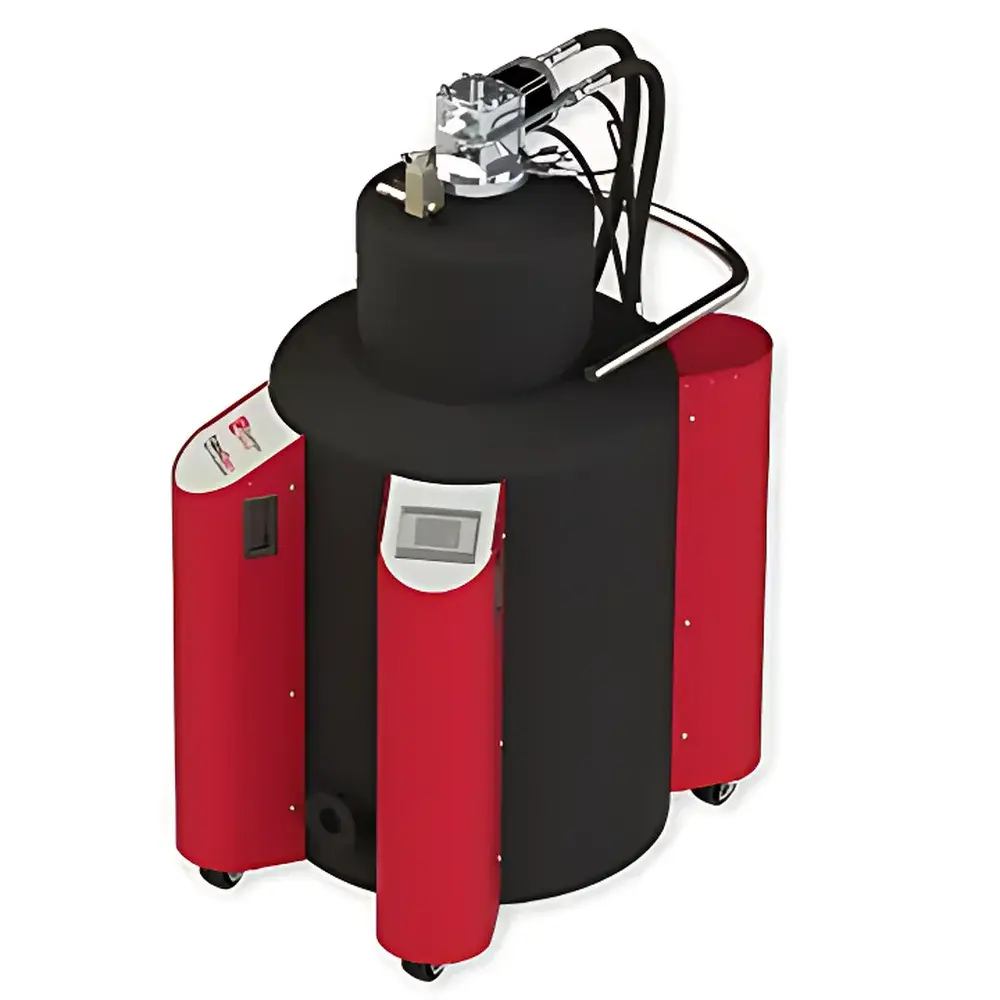
Quantum Design NexGen Series Helium Liquefaction and Recovery Systems
| Brand | Quantum Design |
|---|---|
| Origin | USA |
| Manufacturer Type | Original Equipment Manufacturer (OEM) |
| Import Category | Imported Instrument |
| Model | NexGen 160 / NexGen 250 / ATL 160XL / ATP30 |
| Liquidation Rate | ≥25 L/day (NexGen 160 & 250), ≥35 L/day (ATL 160XL) |
| Dewar Capacity | 160 L (NexGen 160, ATL 160XL), 250 L (NexGen 250) |
| Helium Purity Requirement | 99.999% (feed gas), 99.9995% (post-ATP30 purification) |
| Purification Capacity | 30 L/min (ATP30, typical) |
| Regeneration Time | 5 h (filterless, fully automated) |
| System Dimensions (L×W×H) | 104×71×152 cm (NexGen 160), 114×81×160 cm (NexGen 250), 104×76×151 cm (ATL 160XL), 60×69×148 cm (ATP30) |
| Compressor Type | Water-cooled (VFD option available) |
| Power Input | 6.5–7.5 kW, 110 V or 380 V AC |
| Operating Pressure | 1 psig (liquefaction stage) |
| Safety Architecture | Multi-stage fault-tolerant interlocks, helium containment integrity monitoring, real-time pressure/temperature/flow diagnostics |
Overview
The Quantum Design NexGen Series Helium Liquefaction and Recovery Systems are engineered for closed-loop cryogenic infrastructure in research and clinical environments where liquid helium (LHe) is consumed by superconducting instrumentation. These systems operate on the principle of Joule–Thomson expansion combined with multi-stage compression, precooling, and catalytic recombination—enabling efficient re-liquefaction of boil-off helium gas recovered from cryostats, superconducting magnets, and low-temperature measurement platforms. Unlike industrial-scale liquefiers, the NexGen architecture prioritizes laboratory integration: compact footprint, modular scalability, and seamless compatibility with existing cryogenic infrastructure—including PPMS®, MPMS®, NMR spectrometers, MEG systems, STM cryostats, and MRI magnets. Each system maintains full traceability of helium mass flow, temperature, and purity throughout the recovery cycle, supporting compliance with ISO/IEC 17025 quality management requirements for metrologically critical cryogenic operations.
Key Features
- Fully automated operation with intuitive touchscreen HMI and remote web-based access via secure HTTPS interface;
- Modular design enabling incremental capacity expansion—from single-instrument direct recovery to multi-system high-pressure centralized networks;
- Integrated fault-protection architecture: real-time helium purity monitoring, overpressure relief valves, dewar-level sensors, and compressor thermal shutdown protocols;
- VFD-compatible water-cooled compressors for adaptive energy modulation and reduced acoustic emissions (≤65 dB(A) at 1 m);
- 1 psig liquefaction pressure enables immediate transfer to standard LHe Dewars without auxiliary pressurization;
- Self-cleaning regeneration cycle (ATP30) eliminates consumable filters and ensures continuous 99.9995% He purity without manual intervention;
- 250 L dewar option (NexGen 250) supports extended operational autonomy between transfers, minimizing handling frequency and associated vapor loss;
- Pre-engineered connection kits for standardized interfaces to Quantum Design PPMS, MPMS, and DynaCool systems, as well as third-party NMR, MRI, and STM platforms.
Sample Compatibility & Compliance
The NexGen systems are validated for integration with helium-cooled instrumentation requiring continuous or intermittent LHe supply, including but not limited to superconducting quantum interference devices (SQUIDs), high-field NMR magnets (up to 1.2 GHz), whole-body MRI scanners (1.5–7 T), magnetoencephalography (MEG) arrays, scanning tunneling microscopes (STM), and dilution refrigerators. All models meet UL 61010-1 and IEC 61000-6-3 electromagnetic compatibility standards. The ATP30 helium purifier complies with ASTM D7606–22 for ultra-high-purity gas analysis methodology. Data logging and audit trails conform to FDA 21 CFR Part 11 requirements when deployed in GLP/GMP-regulated biomedical imaging facilities.
Software & Data Management
Quantum Design’s CryoLink™ software provides unified control across all NexGen configurations. It records time-stamped helium mass balance (recovered vs. liquefied), compressor runtime, energy consumption per liter liquefied, and dewar fill-level history. Exportable CSV logs support integration with institutional LIMS platforms. Remote diagnostics include predictive maintenance alerts based on compressor oil degradation modeling and heat exchanger fouling indices. Firmware updates are delivered over TLS-encrypted channels, with version rollback capability and SHA-256 integrity verification.
Applications
- Centralized helium recovery for multi-NMR laboratories (e.g., 6-unit 900 MHz NMR suite at University of Georgia Chemistry Department);
- Biomedical imaging infrastructure: concurrent recovery from dual MRI + MEG systems (Institute of Biophysics, CAS);
- Low-noise condensed matter physics labs: sealed mid-pressure recovery for solid-state NMR and quantum transport measurements (UC Davis);
- Cost-optimized single-instrument deployment: direct recovery from PPMS/MPMS platforms (Nanjing University);
- High-throughput materials characterization centers: scalable high-pressure networks serving optical cryostats, dilution refrigerators, and SQUID magnetometers (Shanghai Advanced Research Center).
FAQ
What helium purity is required for optimal liquefaction efficiency?
Feed gas must be ≥99.999% pure helium; residual nitrogen, oxygen, or hydrocarbons above 1 ppm will impair catalyst performance and reduce liquefaction yield.
Can the system operate continuously without operator intervention?
Yes—fully automated cycles include dewar auto-fill termination, compressor load balancing, and ATP30 regeneration scheduling; unattended operation exceeds 14 days under nominal load.
Is retrofitting possible for legacy cryogenic equipment?
All standard Quantum Design cryostats (PPMS, MPMS, DynaCool) feature native helium recovery ports; third-party instruments require custom adapter manifolds certified to ASME B31.3 process piping standards.
How does the system handle helium loss during transfer?
The 1 psig liquefaction pressure eliminates need for active pressurization; transfer lines use vacuum-jacketed, low-heat-leak conduits with integrated vapor-cooled shields to limit boil-off to <0.5% per transfer event.
What safety certifications apply to installation in university cleanrooms or hospital basements?
Systems carry CE marking for EMC and LVD directives; local authority approval requires submission of site-specific risk assessment per NFPA 56 and ISO 14644-1 Class 7 airflow validation.



