
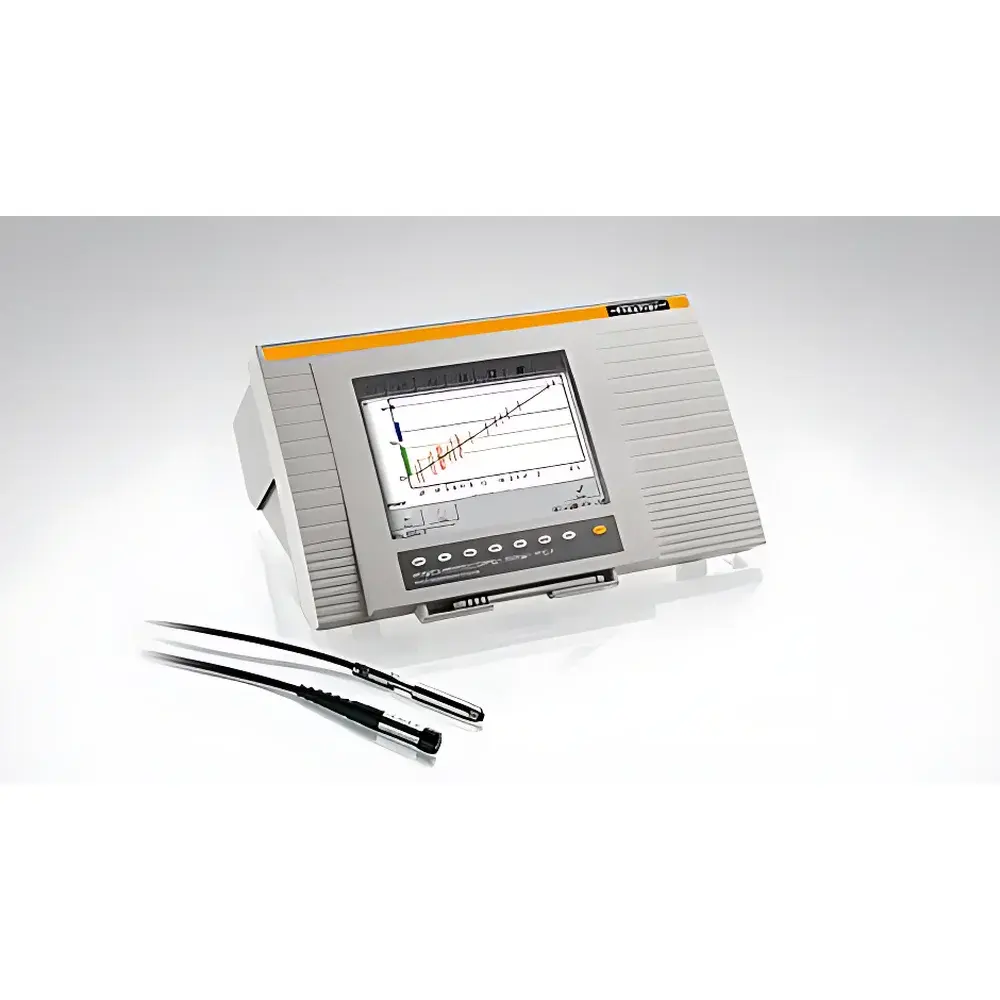
FISCHERSCOPE MMS PC2 Electromagnetic Eddy Current & Magnetic Induction Thickness Gauge
| Brand | Fischer |
|---|---|
| Origin | Germany |
| Model | MMS PC2 |
| Operating System | Windows CE |
| Connectivity | LAN, USB |
| Measurement Principles | Eddy Current (amplitude & phase-sensitive), Magnetic Induction, Beta Backscatter, X-ray Fluorescence (via optional modules) |
| Supported Properties | Coating thickness (non-conductive on non-ferrous, non-conductive on ferrous, conductive on non-ferrous), Ferrite content in austenitic steels, Electrical conductivity of non-ferrous metals |
| Compliance | ISO 2178, ISO 2360, ASTM B244, ASTM B536, DIN 50981, DIN 50982, EN ISO 2178, EN ISO 2360 |
| Data Management | Onboard storage, CSV export, GLP-compliant audit trail (via software), FDA 21 CFR Part 11 ready (with validated software package) |
Overview
The FISCHERSCOPE® MMS PC2 is a modular, benchtop-based physical property measurement system engineered for high-precision, multi-technique analysis of surface coatings and bulk material characteristics. Designed and manufactured in Germany, it integrates four complementary non-destructive testing principles—phase- and amplitude-sensitive eddy current, magnetic induction, beta backscatter, and optional X-ray fluorescence—into a single platform. This architecture enables traceable, repeatable quantification of coating thickness across diverse substrate-coating combinations: non-conductive layers (e.g., paint, anodizing, lacquer) on ferrous or non-ferrous metals; conductive layers (e.g., Au, Cu, Ni, Sn) on non-ferrous substrates; and ferromagnetic coatings on non-magnetic bases. Beyond thickness, the system supports standardized measurement of ferrite content in duplex and austenitic stainless steels per ISO 8249 and ASTM A800, as well as electrical conductivity of aluminum, copper, titanium, and other non-ferrous alloys per ISO 2178 and ASTM E1004. Its core functionality is governed by international metrological standards, ensuring data integrity in regulated environments.
Key Features
- Modular hardware architecture with hot-swappable probe cartridges—each calibrated and identified automatically upon insertion
- Integrated 7-inch high-resolution resistive touchscreen with Windows CE 6.0 interface, supporting keyboard/mouse input for lab or production-floor operation
- Dual communication pathways: 10/100 Mbps Ethernet (LAN) for integration into MES/QMS platforms and USB 2.0 for direct PC connection or peripheral device linking
- Onboard data storage (≥100,000 measurements) with timestamping, operator ID tagging, and customizable batch/group assignment
- Real-time statistical evaluation including mean, standard deviation, min/max, Cp/Cpk, histogram generation, and trend charting
- Rugged industrial-grade chassis rated IP20, designed for continuous operation in controlled laboratory and clean-room manufacturing settings
Sample Compatibility & Compliance
The MMS PC2 accommodates flat, curved, and structured surfaces with radii down to 3 mm (dependent on probe selection). It supports measurement on automotive brake discs, piston rings, PCBs, solar cell substrates (glass/CdTe), precision connectors, and medical device components. Probe families include PERMASCOPE® (for non-conductive coatings on ferrous metals), SIGMASCOPE® (for conductivity and conductive coatings on non-ferrous), NICKELSCOPE® (for Ni plating on steel), BETASCOPE® (for thin metallic layers via beta backscatter), and SR-SCOPE® (for multilayer copper stack analysis in PCBs). All measurement modes comply with ISO 2178 (magnetic induction), ISO 2360 (eddy current), ASTM B244 (anodize thickness), ASTM B536 (electrodeposited coatings), and EN ISO 2178/2360. Optional software validation packages support GLP, GMP, and FDA 21 CFR Part 11 compliance—including electronic signatures, audit trails, and user access control.
Software & Data Management
The embedded firmware supports real-time data visualization, pass/fail threshold configuration, and automated report generation in PDF or CSV format. For advanced analysis, Fischer’s WinFTM® software (Windows-based) provides extended statistical process control (SPC), measurement method scripting, multi-instrument fleet monitoring, and database synchronization with SQL Server or Oracle. All exported data retain full metrological metadata: probe serial number, calibration date, temperature compensation values, measurement mode, and raw signal parameters (e.g., phase angle, impedance magnitude). Audit logs record every configuration change, user login/logout, and data export event—fully traceable for internal audits or regulatory inspections.
Applications
- Automotive: Graphite lubricant layers on pistons, corrosion-resistant coatings on brake rotors, Ni/Cr plating on fasteners
- Electronics: Cu thickness in PCB blind vias and surface traces, solder mask (LPI) thickness, gold flash on contact pads
- Aerospace: Anodized Al alloy skins, Ti alloy conductivity verification, thermal barrier coating base layers
- Energy: CdTe thin-film thickness on glass substrates, anti-reflective coatings on photovoltaic cells
- Medical Devices: PVD-coated surgical tools, electroplated radiopaque markers, biocompatible polymer layer uniformity
- Steel Processing: Ferrite content mapping in welded duplex stainless joints, Zn coating mass on galvanized sheet
FAQ
Can the MMS PC2 measure coating thickness on curved surfaces?
Yes—curvature compensation is applied automatically when using radius-specific probes (e.g., PERMASCOPE® R-series), with minimum measurable radius as low as 3 mm depending on probe geometry and coating-substrate combination.
Is calibration traceable to national standards?
All Fischer-certified calibration standards are traceable to PTB (Physikalisch-Technische Bundesanstalt) and NIST through accredited calibration laboratories, with documented uncertainty budgets provided per ISO/IEC 17025.
Does the system support automated reporting for ISO 9001 audits?
Yes—built-in report templates include measurement uncertainty statements, operator identification, equipment ID, environmental conditions, and compliance references to ISO 2178/2360, enabling direct use in quality management system documentation.
How is probe interchangeability managed?
Each probe contains an EEPROM chip storing calibration coefficients, measurement range limits, and sensor geometry data; the instrument reads this on insertion and configures signal processing parameters accordingly—no manual setup required.
Can raw impedance or phase data be exported for third-party analysis?
Yes—WinFTM® software exports time-domain or frequency-domain raw sensor signals (including complex impedance Z*, phase φ, and amplitude U) in ASCII format for advanced modeling or research applications.



