
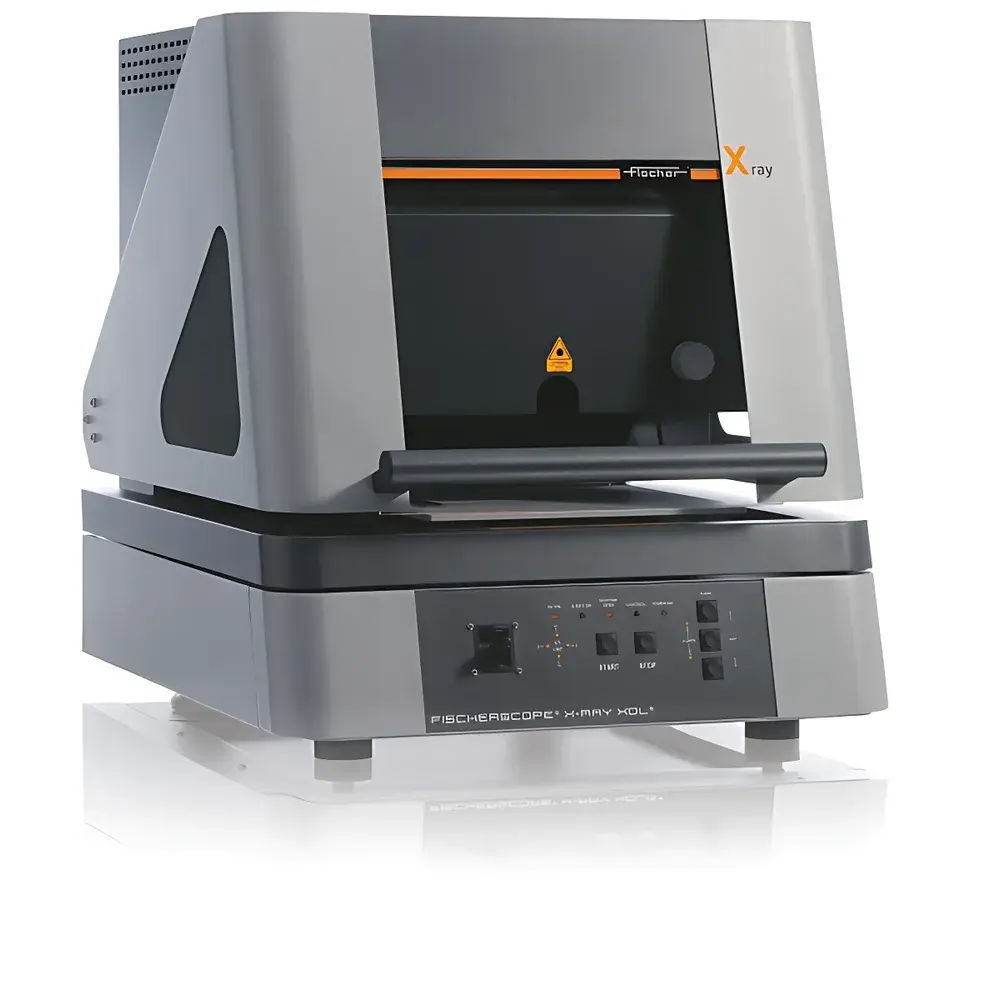
FISCHERSCOPE X-RAY XDL Series Energy-Dispersive X-ray Fluorescence Coating Thickness Analyzer
| Brand | Fischer |
|---|---|
| Origin | Germany |
| Model | XDL |
| Measurement Principle | Energy-Dispersive X-ray Fluorescence (ED-XRF) |
| Elemental Range | Cl (Z=17) to U (Z=92) |
| Sample Positioning Options | Fixed or Motorized X/Y/Z Stages (XDL 210–240 variants) |
| Collimator Options | Circular or Rectangular |
| Detector Type | Proportional Counter |
| Measurement Distance | 0–80 mm |
| DCM Technology | Patented Distance Compensation Method |
| Camera System | High-Resolution CCD Color Imaging |
| Operating Temperature | 10–40 °C |
| Relative Humidity | ≤95% RH (non-condensing) |
| Weight | 100–120 kg |
| Compliance | Designed for ISO 3497, ASTM B568, DIN 50987, and EN ISO 3497-compliant measurement workflows |
| Software | FISCHER WinFTM® v8+ with GLP/GMP audit trail, 21 CFR Part 11 optional modules |
Overview
The FISCHERSCOPE X-RAY XDL Series is a benchtop energy-dispersive X-ray fluorescence (ED-XRF) analyzer engineered for non-destructive, quantitative determination of coating thicknesses and elemental composition in industrial quality assurance environments. Based on the well-established XDL-B platform, the XDL Series implements fundamental parameter (FP) methodology — eliminating dependency on calibration standards for both layered systems and bulk or liquid samples. This physics-based quantification relies on first-principles modeling of X-ray excitation, absorption, and secondary fluorescence yield, enabling traceable, matrix-independent analysis across multi-layered electroplated structures, thin-film coatings, and electrolyte solutions. The instrument operates within an elemental range spanning chlorine (Z = 17) to uranium (Z = 92), supporting applications from decorative chromium (≤0.1 µm) to functional NiP or Au/Pd layers in PCB manufacturing and semiconductor packaging. Its modular mechanical architecture accommodates varying throughput and precision requirements — from fixed-stage manual operation (XDL 210) to fully programmable motorized X/Y/Z motion with door-interlocked sample positioning (XDL 240).
Key Features
- Fundamental Parameter (FP) quantification engine — no standard reference materials required for routine measurement of single/multi-layer coatings, alloys, or plating baths
- Patented Distance Compensation Method (DCM) — dynamically corrects for measurement distance variations between 0 mm and 80 mm, ensuring repeatability across irregular or warped substrates
- High-resolution CCD color camera with live zoom and crosshair overlay — enables precise targeting of features as small as 50 µm, critical for PCB trace analysis and fine-pitch connector plating
- Interchangeable collimators (circular: Ø0.1–1.0 mm; rectangular: 0.2×0.5 mm to 1.0×2.0 mm) — optimized spatial resolution without sacrificing count rate
- Motorized Z-axis (XDL 220+) with programmable approach control — ensures consistent take-off angle and minimizes geometry-induced intensity drift
- WinFTM® v8 software platform — supports method-driven workflows, automated batch reporting, and configurable pass/fail logic per layer and element
Sample Compatibility & Compliance
The XDL Series is validated for use with rigid and semi-rigid substrates including steel, Cu, brass, Al, plastics, and ceramic carriers. It accommodates flat, curved, and stepped geometries via DCM-enabled distance tolerance. Liquid samples (e.g., electroplating baths) are analyzed in standardized quartz or PTFE cells with helium flush capability. All configurations comply with IEC 61000-6-3 (EMC) and IEC 61000-6-4 (immunity) standards. Measurement protocols align with ISO 3497 (metallic coatings), ASTM B568 (XRF coating thickness), DIN 50987 (layer analysis), and EN ISO 3497 Annex A (multi-layer uncertainty estimation). Optional 21 CFR Part 11 compliance packages include electronic signature support, full audit trail logging, and user role-based access control — suitable for regulated environments under GLP or GMP.
Software & Data Management
WinFTM® v8 provides a validated, method-centric interface with embedded uncertainty calculation per ISO/IEC 17025 guidelines. Each measurement method stores excitation parameters, FP model settings, collimator ID, and DCM calibration data. Batch processing supports CSV, XML, and PDF export with embedded metadata (operator ID, timestamp, instrument serial number). Raw spectra are archived in standardized .fis format for retrospective reprocessing. Audit logs record all parameter changes, result modifications, and user logins — retained for ≥36 months. Optional database integration (ODBC) enables direct upload to LIMS or MES platforms for SPC charting and real-time process feedback loops.
Applications
- Quality control of decorative Cr/Ni/Cu stacks on automotive trim and consumer hardware
- In-line verification of functional Au, Pd, Sn, or ENIG layers on PCBs and IC leadframes
- Thickness uniformity mapping across wafer-level electroplated interconnects
- Concentration monitoring of Cu, Ni, Sn, and additive organics in acid sulfate and methanesulfonate plating baths
- Compliance testing for RoHS-restricted elements (Pb, Cd, Hg, Cr⁶⁺, Br) in finished assemblies
- Failure analysis of delamination or interdiffusion in multi-layer metallization systems
FAQ
Does the XDL require certified reference standards for daily operation?
No — the fundamental parameter algorithm enables calibration-free analysis of unknown matrices, though standards may be used for method validation or extended uncertainty assessment.
Can the XDL measure coatings on flexible or heat-sensitive substrates?
Yes — low-power X-ray excitation (max. 50 kV, 1 mA) and optional helium purge minimize thermal load; DCM compensates for minor bending or warpage during measurement.
Is remote diagnostics and software update supported?
Yes — WinFTM® includes secure remote desktop capability (with customer authorization) and over-the-air firmware/software updates via encrypted HTTPS channel.
What maintenance intervals are recommended?
Annual preventive maintenance includes detector resolution verification, collimator alignment check, DCM recalibration, and X-ray tube output stability test — documented per ISO/IEC 17025 traceability requirements.



