
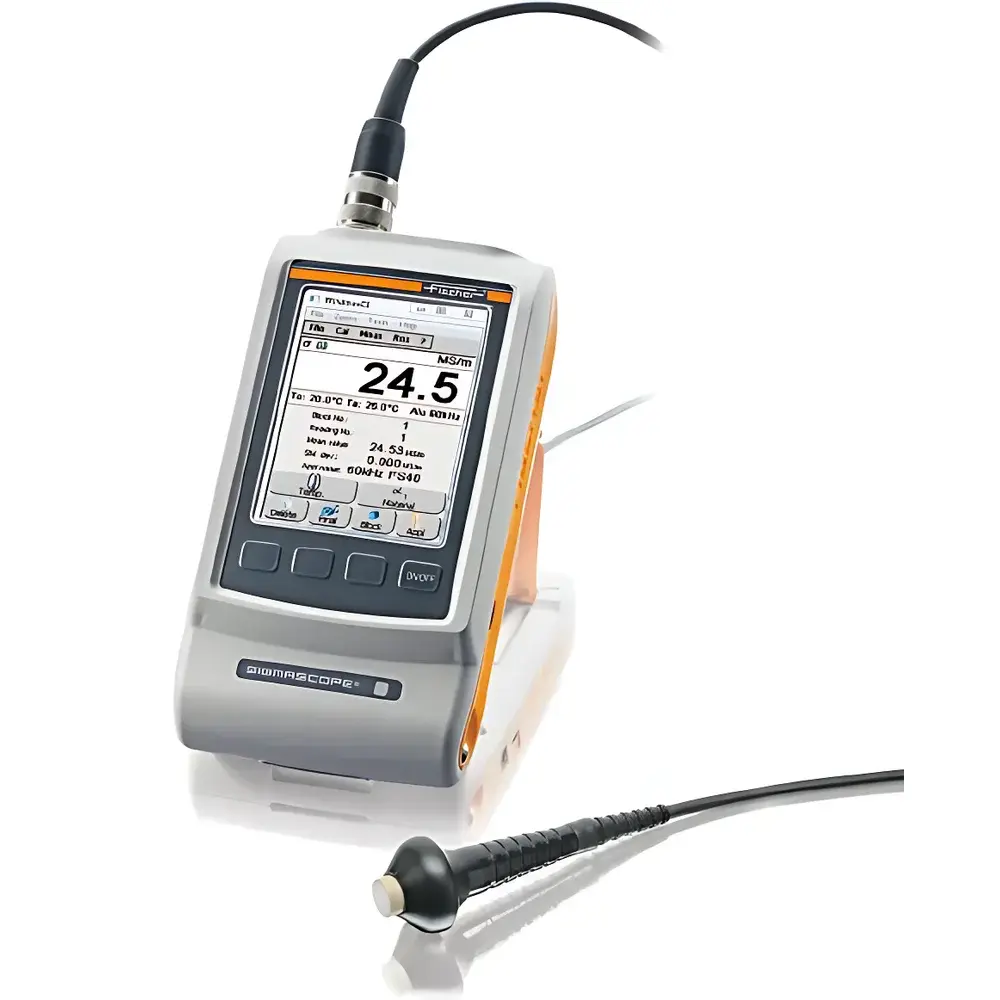
Fischer SIGMASCOPE SMP350 Handheld Eddy Current Conductivity Meter
| Brand | Fischer |
|---|---|
| Origin | Germany |
| Model | SIGMASCOPE_SMP350 |
| Portability | Portable |
| Conductivity Range | 0.5–65 MS/m |
| Temperature Range | 10–60 °C |
| Accuracy | ±0.5% FS |
| Minimum Resolution | 0.001 µS/cm |
| Measurement Principle | Eddy Current Phase Analysis per DIN EN 2004-1 & ASTM E1004 |
| Probe Frequency Options | 60, 120, 240, 480 kHz |
| Temperature Compensation | Automatic (via integrated ES40 probe sensor or optional external sensor) |
| Compliance | Traceable to international calibration standards (NIST/PTB-equivalent), certified reference standards available for full IACS range |
Overview
The Fischer SIGMASCOPE SMP350 is a handheld, battery-powered eddy current conductivity meter engineered for non-destructive, contactless measurement of electrical conductivity in non-ferrous metals—primarily aluminum, copper, and their alloys. It operates on the principle of eddy current phase analysis, as standardized in DIN EN 2004-1 and ASTM E1004. This method induces high-frequency alternating magnetic fields into the test material and analyzes the phase shift between the excitation and response signals—a parameter directly correlated to bulk electrical conductivity. Unlike direct-contact four-point probe methods, the SMP350 enables reliable measurements through non-conductive surface layers—including paint, anodized coatings, and polymer films up to 500 µm thick—without requiring surface preparation. Its design prioritizes metrological integrity in industrial QA/QC environments where traceability, repeatability, and compliance with aerospace-grade specifications are mandatory.
Key Features
- Four selectable test frequencies (60, 120, 240, and 480 kHz) to optimize skin depth penetration and signal-to-noise ratio across varying material thicknesses and microstructures
- Integrated temperature compensation using either the built-in thermistor in probe ES40 or an optional external Pt100 sensor—enabling automatic correction to 20 °C conductivity values per IACS convention
- Large, sunlight-readable touchscreen display running Windows CE with intuitive, customizable interface navigation and context-sensitive prompts for calibration and operation
- Onboard storage capacity for over 1,000 user-defined applications and nearly one million individual measurement records—with full timestamping (date/time), operator ID, and location tagging support
- Statistical process control (SPC) functionality including real-time calculation of Cp, Cpk, mean, standard deviation, histograms, and graphical upper/lower limit overlays
- Acoustic feedback for pass/fail status during continuous or externally triggered measurement sequences
- Multi-language UI support (English, German, French, Spanish, Chinese, Japanese) and full keyboard input for annotation and report generation
- Factory-calibrated at 20 °C using eight certified reference standards spanning the full 1–112% IACS range (0.5–65 MS/m), with calibration traceability to national metrology institutes (e.g., PTB, NIST)
Sample Compatibility & Compliance
The SMP350 is validated for use on flat or moderately curved non-ferrous surfaces—including wrought, cast, and heat-treated aluminum alloys (e.g., 2024, 6061, 7075), copper, brass, and titanium alloys. Its eddy current architecture inherently suppresses sensitivity to surface roughness (Ra ≤ 10 µm) and thin insulating layers, making it suitable for in-line verification prior to anodizing, coating, or assembly. The instrument complies with ISO/IEC 17025 requirements for calibration laboratories and supports GLP/GMP documentation workflows. Reference standards supplied with the system are certified per ISO/IEC 17025 and traceable to primary standards maintained by accredited national laboratories. The device meets electromagnetic compatibility (EMC) requirements per EN 61326-1 and safety standards per EN 61010-1.
Software & Data Management
Data export is supported via USB and Bluetooth to Fischer’s proprietary FISCHER DataCenter software (Windows-based), enabling advanced reporting, SPC charting, database integration, and audit trail generation compliant with FDA 21 CFR Part 11 requirements—including electronic signatures, user access controls, and immutable change logs. Raw measurement files (.fcd format) retain full metadata: probe ID, frequency, temperature, operator, GPS coordinates (if enabled), and environmental timestamps. Customizable report templates support company-specific QA formats and automated PDF generation with embedded statistical summaries and trend plots.
Applications
- Aerospace manufacturing: Verification of heat treatment efficacy in aluminum airframe components (e.g., solution heat treatment and aging cycles), detection of thermal degradation or over-aging in service-exposed parts
- Automotive supply chain: Incoming inspection of extruded aluminum profiles and cast engine blocks; sorting of scrap alloys based on conductivity-derived composition estimates
- Electrical conductor production: Rapid screening of copper rod and wire for purity deviations affecting ampacity and resistivity
- Surface finishing facilities: Pre-anodizing conductivity checks to ensure alloy consistency and avoid coating adhesion failures
- Recycling & metal trading: Non-destructive grade identification of mixed non-ferrous scrap streams without chemical dissolution or sampling
- R&D laboratories: Correlation studies between conductivity, tensile strength, hardness, and microstructural parameters (e.g., precipitate density, grain size)
FAQ
Does the SMP350 require physical contact with the sample surface?
No—it performs true non-contact measurements using high-frequency eddy currents; only proximity (typically <1 mm lift-off) is required.
Can it measure through anodized layers?
Yes—up to 500 µm of non-conductive oxide or polymer coatings, provided the underlying substrate is non-ferrous and electrically continuous.
What is the calibration interval recommendation?
Annual recalibration against certified reference standards is recommended; more frequent verification is advised in high-usage or regulated environments (e.g., AS9100-certified facilities).
Is temperature compensation mandatory for accurate results?
Yes—electrical conductivity is temperature-dependent; the SMP350 requires either integrated or external temperature sensing to normalize readings to 20 °C per IACS definition.
How is traceability ensured for quality audits?
Each instrument ships with a certificate of calibration referencing eight NIST/PTB-traceable standards covering the full 0.5–65 MS/m range, with documented uncertainty budgets and serial-numbered reference blocks.





