
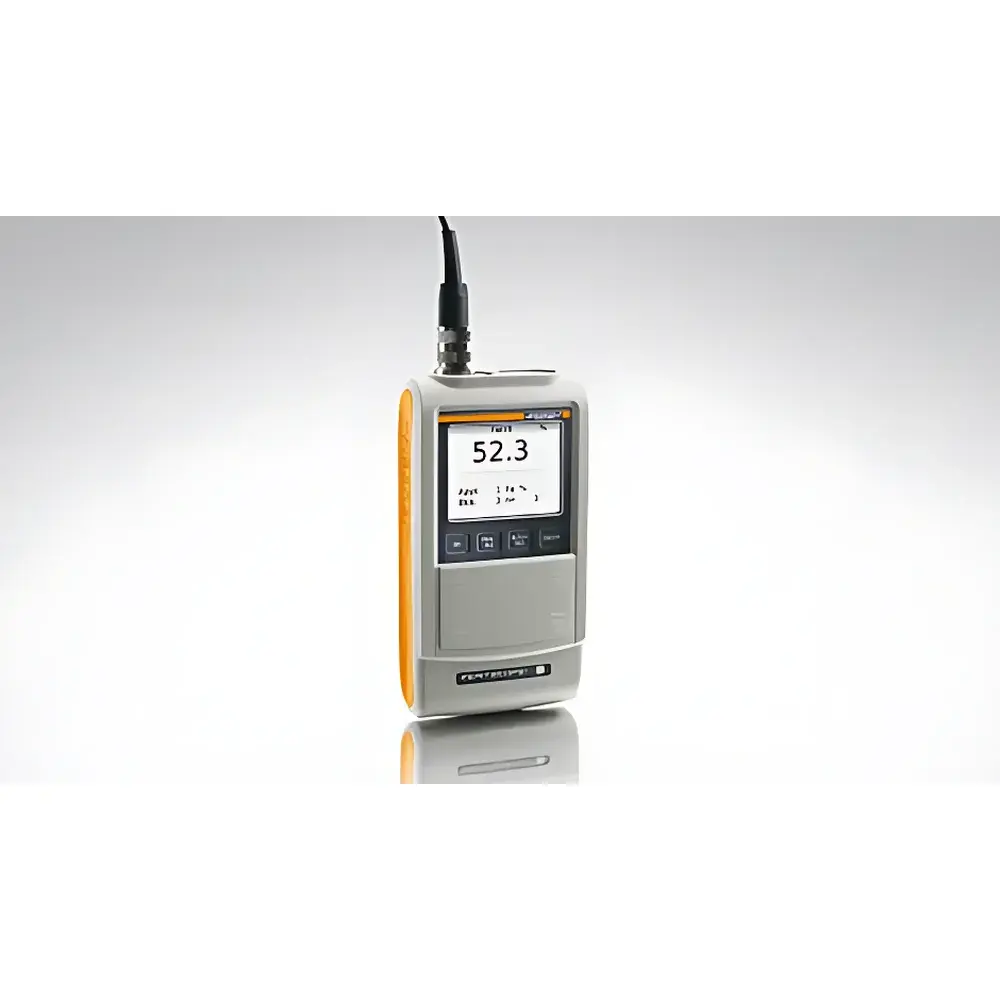
FERITSCOPE FMP30 Portable Ferrite Content Meter by Fischer
| Brand | Fischer |
|---|---|
| Origin | Germany |
| Model | FERITSCOPE FMP30 |
| Measurement Principle | Magnetic Induction (Ferrite-Specific Permeability Detection) |
| Display | Backlit LCD, 128 × 64 pixels |
| Probe Interface | Interchangeable modular probe connector |
| Calibration | Single-point calibration across full measurement range |
| Units | % Fe (ferrite number equivalent) and vol.% Fe |
| Compliance | Designed per ISO 8249:2017, ASTM A802, EN 17068 |
| Operating Temperature | 0 °C to 50 °C |
| IP Rating | IP65 (dust- and water-resistant) |
| Power Supply | Rechargeable Li-ion battery (≥10 h continuous operation) |
| Data Output | USB 2.0, optional Bluetooth 4.2 module |
Overview
The FERITSCOPE FMP30 is a handheld, battery-powered ferrite content meter engineered by Helmut Fischer GmbH (Germany) for rapid, non-destructive quantification of delta-ferrite in austenitic and duplex stainless steels. It operates on the principle of magnetic induction—specifically measuring the local magnetic permeability deviation caused by ferromagnetic delta-ferrite phases embedded within predominantly paramagnetic austenitic matrices. Unlike optical or metallographic methods, this technique requires no surface preparation beyond standard cleaning and delivers repeatable results in under 2 seconds per measurement. The device is calibrated traceably to internationally recognized reference standards—including certified TWI Grade II ferrite standards—and conforms to the metrological requirements of ISO 8249:2017 (“Non-destructive testing — Measurement of ferrite content in austenitic and duplex stainless steels”) and ASTM A802 (“Standard Practice for Conducting Magnetic Particle Examination”). Its compact form factor, ruggedized housing, and IP65 ingress protection make it suitable for field deployment in demanding industrial environments including offshore platforms, refinery piping networks, and power plant boiler installations.
Key Features
- Modular probe architecture supporting multiple interchangeable sensor heads—including flat-surface, curved-surface, and miniature-diameter probes—for access to weld caps, pipe interiors, and narrow-radius joints.
- Large backlit monochrome LCD display (128 × 64 pixels) with high-contrast numeric readout in both % Fe (ferrite number scale) and volumetric % Fe units, configurable via on-device menu.
- Automatic measurement initiation upon probe contact—no manual trigger required—ensuring consistent operator-independent data acquisition.
- Single-point calibration protocol covering the full operational range (0–100 % Fe), eliminating need for multi-point recalibration during routine use.
- Integrated rechargeable lithium-ion battery providing ≥10 hours of continuous measurement time; battery status indicated in real time on display.
- USB 2.0 interface for firmware updates and raw data export; optional Bluetooth 4.2 module enables wireless synchronization with PC-based analysis software.
Sample Compatibility & Compliance
The FERITSCOPE FMP30 is validated for use on wrought, cast, and welded austenitic and duplex stainless steels—including UNS S32205/S32206, S32750, S32760, and 304L/316L base materials. It is insensitive to surface roughness up to Ra 6.3 µm and unaffected by non-magnetic coatings ≤50 µm thick (e.g., passivation layers, thin paint films). Measurement accuracy remains stable across ambient temperatures from 0 °C to 50 °C. All factory calibrations are traceable to NIST-traceable TWI Grade II reference standards, and calibration certificates comply with ISO/IEC 17025 requirements. The instrument supports GLP/GMP-aligned documentation workflows when paired with Fischer’s MMS PC2 desktop platform, enabling audit-ready electronic records compliant with FDA 21 CFR Part 11 (when configured with user authentication and electronic signature modules).
Software & Data Management
Raw measurement data—including timestamp, probe ID, location tag (manually entered), and measurement unit—is stored internally (up to 10,000 readings). Data export via USB yields CSV-formatted files compatible with Excel, MATLAB, and statistical process control (SPC) platforms. When integrated with the MMS PC2 desktop system, the FMP30 functions as a field-deployable sensor module, enabling synchronized calibration management, batch reporting, trend analysis across weld seams, and automated generation of ISO 8249-compliant test reports. Firmware updates are delivered through Fischer’s secure web portal and require no third-party tools.
Applications
- On-site verification of ferrite content in girth welds of process piping systems prior to hydrostatic testing.
- Quality assurance during fabrication of pressure vessels, heat exchangers, and reactor components in chemical and petrochemical plants.
- In-process monitoring of heat-affected zone (HAZ) ferrite stability during post-weld heat treatment (PWHT) cycles.
- Verification of filler metal compatibility in multipass welding procedures for duplex stainless steel structures.
- Periodic inspection of aging infrastructure—including offshore risers and LNG transfer lines—to detect microstructural degradation linked to sigma phase formation.
FAQ
What is the measurement uncertainty of the FERITSCOPE FMP30?
Typical expanded uncertainty (k=2) is ±0.5 % Fe for measurements between 5–70 % Fe, based on repeatability studies per ISO 8249 Annex B.
Can the FMP30 measure ferrite in superaustenitic or precipitation-hardening stainless steels?
No—it is specifically validated for standard austenitic (e.g., 304, 316) and duplex (e.g., 2205, 2507) grades. Superaustenitics (e.g., AL-6XN) and PH steels (e.g., 17-4PH) exhibit different magnetic responses and require dedicated calibration protocols not supported by default.
Is probe replacement user-serviceable?
Yes—probes connect via a standardized LEMO 00 connector and can be swapped without tools; each probe carries its own calibration offset stored in an onboard EEPROM chip.
Does the device support custom calibration for proprietary alloys?
Custom calibration is possible using Fischer’s certified reference standards and the MMS PC2 calibration suite—but requires documented validation per ISO/IEC 17025 and is typically performed at authorized Fischer service centers.
How often must the instrument be recalibrated?
Annual recalibration is recommended; however, daily verification using a certified check standard (e.g., TWI Grade II block) is required before critical measurements per ASME BPVC Section V, Article 7.



