
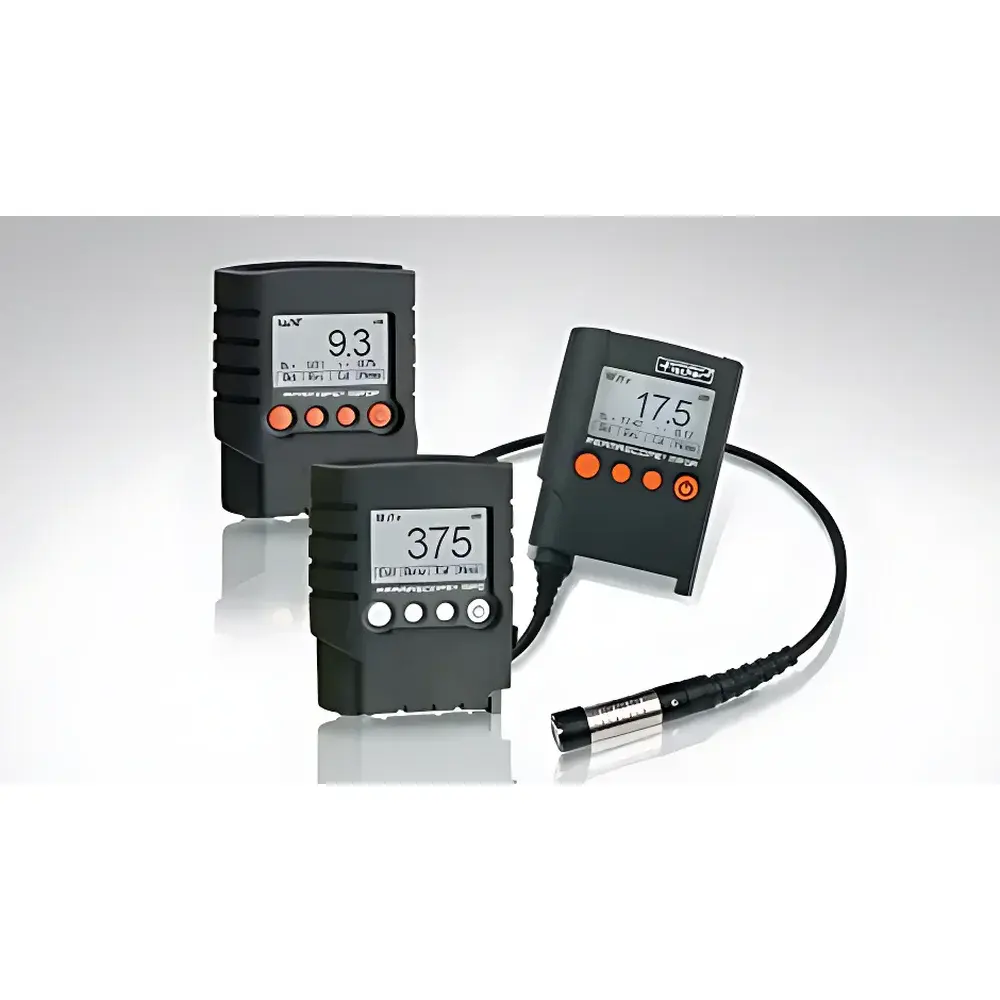
Fischer MP0/MP0R Electromagnetic & Eddy Current Coating Thickness Gauge
| Brand | Fischer |
|---|---|
| Origin | Germany |
| Model | MP0/MP0R |
| Measurement Principle | Dual-mode electromagnetic induction (for ferrous substrates) and eddy current (for non-ferrous substrates) |
| Display | Dual independent pivotable LCD screens with backlight |
| Housing | IP65-rated ruggedized enclosure |
| Probe | Wear-resistant integrated probe |
| Compliance Modes | IMO PSPC, SSPC-PA2 |
| Operating Temperature | −10 °C to +50 °C |
| Battery Life | Up to 30,000 measurements per charge (standard alkaline AA batteries) |
| Data Output | USB interface for PC transfer |
| Calibration | Factory-calibrated with traceable NIST-equivalent reference standards |
Overview
The Fischer MP0/MP0R is a handheld, dual-technology coating thickness gauge engineered for high-reliability, non-destructive measurement on metallic substrates. It combines electromagnetic induction (EMI) for ferromagnetic base materials—such as steel and iron—and high-frequency eddy current (EC) for non-ferromagnetic conductors—including aluminum, copper, brass, stainless steel (austenitic), and titanium. Unlike single-principle instruments, the MP0/MP0R automatically detects substrate type and selects the appropriate measurement mode without manual switching or probe replacement. This capability enables seamless transition between ferrous and non-ferrous applications in field, workshop, or shipyard environments where substrate composition may vary unpredictably across a single structure. The instrument operates on the fundamental physical principles of magnetic permeability variation (EMI) and electrical conductivity-induced impedance shift (EC), both calibrated against internationally recognized reference standards traceable to national metrology institutes. Its compact form factor, ergonomic single-hand operation, and dual-pivot illuminated displays ensure usability in confined spaces, overhead positions, or low-light conditions—critical for marine, infrastructure, and industrial maintenance inspections.
Key Features
- Dual-sensor architecture: Integrated electromagnetic and eddy current transduction within a single probe assembly, eliminating need for interchangeable probes or recalibration when switching substrates.
- Ruggedized field-ready design: IP65-rated housing with shock-absorbing elastomer overmold; operating temperature range from −10 °C to +50 °C; tested to MIL-STD-810G for vibration and drop resistance.
- Compliance-integrated measurement modes: Dedicated firmware configurations for IMO PSPC (Performance Standard for Protective Coatings) and SSPC-PA2 (SSPC Paint Application Standard No. 2), including automatic pass/fail evaluation based on specified acceptance criteria and statistical sampling rules.
- Real-time dual-display interface: Two independently rotatable LCD screens—one showing live thickness value and unit, the other displaying substrate identification, measurement status, and statistical indicators (e.g., min/max/avg, standard deviation).
- Traceable calibration: Supplied with factory calibration certificate referencing DIN EN ISO 2178 (non-magnetic coatings on magnetic substrates) and DIN EN ISO 2360 (non-conductive coatings on non-ferrous metals), aligned with ASTM B499 and ASTM D7091.
Sample Compatibility & Compliance
The MP0/MP0R supports quantitative thickness measurement of non-conductive and non-magnetic coatings—including epoxies, polyurethanes, zinc, chrome, paint, enamel, and plastic layers—on both ferrous and non-ferrous metallic substrates. Typical use cases include marine hull coatings (IMO PSPC-compliant surveys), bridge maintenance (AASHTO M242), offshore platform integrity programs, and aerospace component QC. The device complies with ISO/IEC 17025 requirements for in-field instrumentation used in accredited testing laboratories. When operated under SSPC-PA2 protocols, it records measurement location, date/time stamp, operator ID (via optional RFID badge integration), and statistical summary per test area—supporting audit readiness for GLP/GMP and regulatory inspection frameworks.
Software & Data Management
Data export is supported via USB 2.0 interface to Fischer’s proprietary FISCHER DataCenter software (Windows-compatible), enabling batch analysis, report generation (PDF/CSV/XLSX), and long-term trend monitoring. All measurement sessions include embedded metadata: instrument serial number, calibration date, probe ID, environmental temperature, and user-defined project tags. Audit trail functionality meets FDA 21 CFR Part 11 requirements for electronic records and signatures when configured with user authentication and electronic signature modules. Raw data files are stored in encrypted binary format with SHA-256 checksums to ensure integrity and prevent tampering.
Applications
- Marine & Offshore: Verification of protective coating thickness on ballast tanks, cargo holds, and deck structures per IMO PSPC Clause 3.3 and PSPC-SPM Annex A.
- Infrastructure: Inspection of corrosion protection systems on bridges, pipelines, and transmission towers under ASTM D7091 and ISO 19840.
- Automotive & Aerospace: In-process QC of primer, topcoat, and anodized layer thickness on stamped steel panels and aluminum airframe components.
- Manufacturing QA: Final inspection of electroplated zinc, nickel, or chromium layers on fasteners, hydraulic components, and precision machined parts.
- Renewable Energy: Coating verification on wind turbine towers (steel) and nacelle housings (aluminum alloys) prior to commissioning.
FAQ
Does the MP0/MP0R require separate calibration for ferrous and non-ferrous substrates?
No—the instrument performs automatic substrate recognition and applies the corresponding calibration curve internally. Only one initial two-point calibration (zero and span) is required per coating/substrate combination.
Can measurement data be exported to LIMS or ERP systems?
Yes—CSV and XML export formats are supported via DataCenter software, and custom API integration is available through Fischer’s Enterprise Interface Kit (EI-KIT) for direct ingestion into laboratory information management systems.
Is the MP0R model suitable for underwater or humid environments?
While the IP65 rating protects against dust and low-pressure water jets, submersion or prolonged exposure to condensation is not recommended. For marine splash zones, use with optional silicone-sealed probe boot (accessory P-SEAL-MP0R).
How does the device handle curved or irregular surfaces?
The integrated probe features a sapphire-tipped contact surface with 3 mm diameter footprint and spring-loaded force control (0.8 ± 0.2 N), minimizing edge effects and ensuring consistent coupling on radii down to 5 mm.
What standards does the factory calibration reference?
Calibration is performed using certified reference standards compliant with DIN EN ISO 2178, DIN EN ISO 2360, ASTM B499, and ASTM D7091, with uncertainty budgets documented per ISO/IEC 17025 Annex A.3.



