
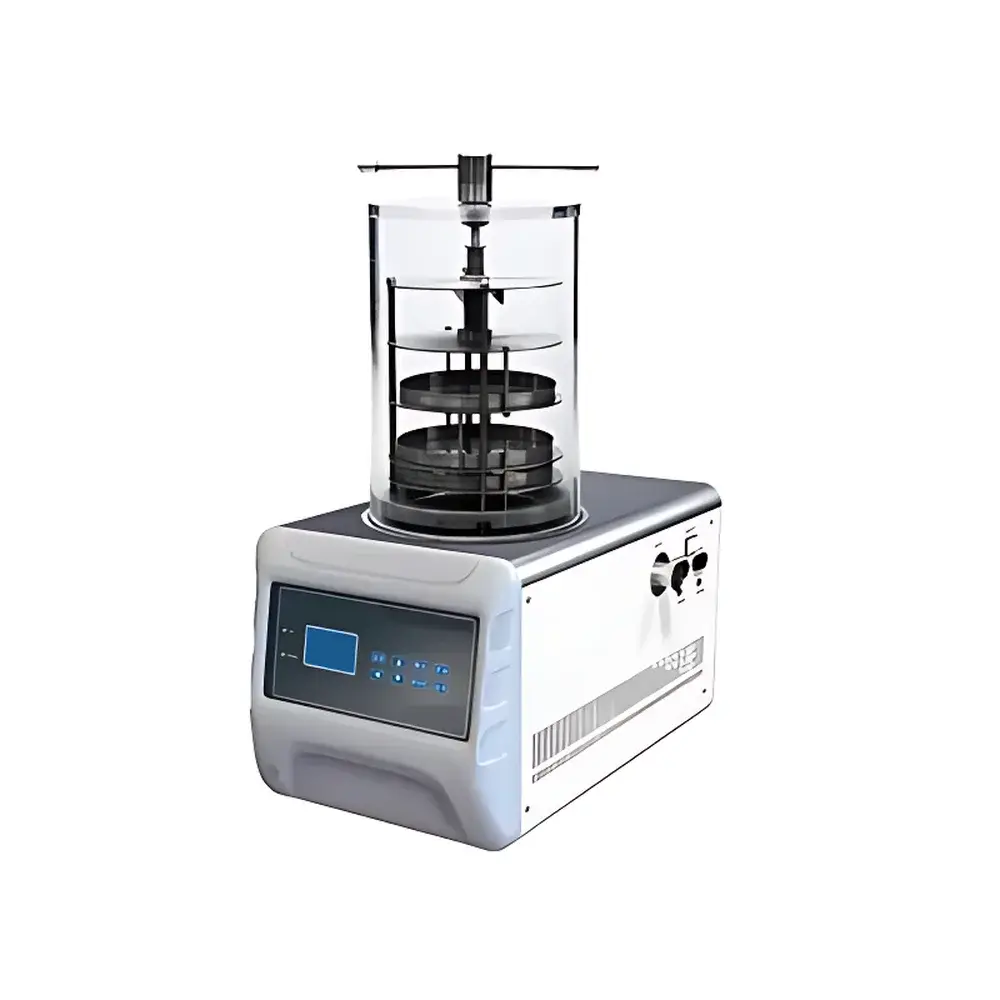
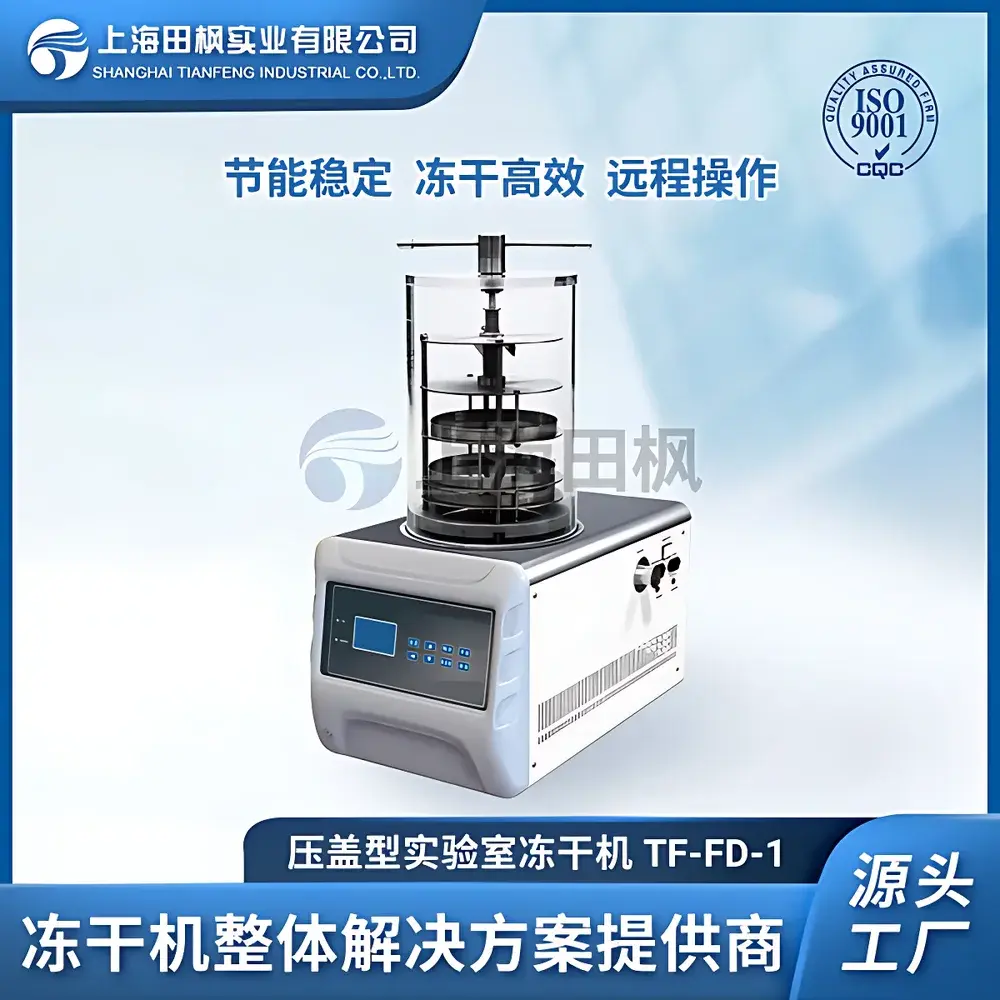
Tianfeng TF-FD-1 Stoppering Freeze Dryer
| Brand | Tianfeng |
|---|---|
| Origin | Shanghai, China |
| Manufacturer Type | Manufacturer |
| Product Category | Domestic |
| Model | TF-FD-1 Stoppering Type |
| Instrument Type | Stoppering Freeze Dryer |
| Application Scope | Laboratory Use |
| Shelf Area | 0.07 m² |
| Ultimate Vacuum | <15 Pa (at no-load) |
| Condenser Capacity | 3 kg/24 h |
| Condenser Temperature | <−50 °C |
| Dimensions (W×H×D) | 370 mm × 650 mm × 360 mm |
| Power Supply | 220 V, 50 Hz |
| Rated Power | 1100 W |
| Chamber Material | 304 Stainless Steel |
| Viewport | Transparent Acrylic Door |
| Control System | Touchscreen LCD with PID Regulation and Real-time Drying Curve Display |
| Optional Accessories | Temperature Data Logger, Eutectic Point Tester, Automatic Stopper Pressing Unit, Inert Gas Purge Valve |
Overview
The Tianfeng TF-FD-1 Stoppering Freeze Dryer is a compact, laboratory-scale lyophilization system engineered for reproducible, process-controlled freeze drying of thermolabile biological standards, fine chemical intermediates, and novel coating formulations. It operates on the fundamental principle of sublimation—where water or solvent is removed from frozen samples under deep vacuum while maintaining temperatures below the eutectic point—thereby preserving structural integrity, bioactivity, and chemical stability. Designed for benchtop use in regulated research environments, the TF-FD-1 integrates an in-situ pre-freezing capability within its stainless steel condenser chamber, eliminating the need for external ultra-low temperature freezers and reducing contamination risk during sample transfer. Its stoppering configuration enables sterile, post-drying vial sealing under vacuum or inert gas (e.g., nitrogen or argon), supporting GMP-aligned workflows for reference standard preparation and small-batch formulation development.
Key Features
- Integrated stoppering mechanism for automated, aseptic vial sealing post-lyophilization—compatible with standard serum vials (Φ180 mm, 3-layer tray)
- Double-stage refrigeration system achieving stable condenser temperatures below −50 °C, optimized for efficient water vapor capture and reduced primary drying time
- Touchscreen HMI with real-time graphical display of shelf temperature, chamber pressure, and drying progress curve; supports user-defined PID parameter tuning
- High-transparency acrylic observation door and internal LED lighting allow continuous visual monitoring of ice morphology, sublimation front progression, and cake structure formation
- 304 stainless steel construction throughout the drying chamber, condenser, and manifold—ensuring corrosion resistance, cleanability, and compliance with ISO 14644-1 Class 5 cleanroom-compatible maintenance protocols
- Optional inert gas purge valve (N₂ or Ar) for oxygen-sensitive samples and residual moisture control during stoppering
- Modular design supports future integration of eutectic point detection probes and electronic batch record (EBR) modules compliant with FDA 21 CFR Part 11 requirements
Sample Compatibility & Compliance
The TF-FD-1 accommodates diverse sample matrices critical to biopharmaceutical reference material qualification, including monoclonal antibody formulations, recombinant enzymes, vaccine candidates, synthetic peptides, polymer-based coatings, and high-purity organic intermediates. Its validated performance envelope meets key international lyophilization benchmarks: it sustains ≤15 Pa ultimate vacuum (no-load), delivers uniform thermal distribution across the 0.07 m² shelf area (±1 °C shelf temperature uniformity using silicone oil heating medium), and achieves consistent residual moisture levels <2% w/w in standard protein formulations per ICH Q5C guidelines. The system conforms to ISO 22042 (freeze-drying equipment—performance testing), supports GLP documentation practices, and is compatible with ASTM F2476-22 (Standard Guide for Lyophilization Process Development) methodology frameworks.
Software & Data Management
Equipped with embedded firmware supporting time-stamped event logging—including vacuum ramp rate, condenser load cycles, shelf temperature setpoints, and pressure transients—the TF-FD-1 provides traceable process data suitable for audit readiness. Optional temperature data loggers record up to 16 channels at configurable intervals (1 s–60 min), exporting CSV files for analysis in MATLAB, JMP, or UNIFAC-based modeling platforms. When paired with Tianfeng’s optional eutectic point tester, the system enables empirical determination of collapse temperature (Tc) and glass transition onset (Tg’), informing rational cycle design per USP and Ph. Eur. 2.9.40. All firmware updates are delivered via secure USB interface; no cloud connectivity is implemented, preserving data sovereignty in regulated labs.
Applications
This system is routinely deployed in analytical reference standard laboratories for preparing certified freeze-dried calibrants used in HPLC, LC-MS, and ELISA assay validation. In fine chemical R&D, it facilitates solvent removal from catalyst-loaded dispersions without thermal degradation of chiral ligands or metal-organic frameworks. For novel coating development, the TF-FD-1 enables controlled removal of volatile co-solvents (e.g., THF, acetone) from aqueous polymer suspensions—preserving nanostructural homogeneity prior to SEM/TEM characterization. Academic users apply it to stabilize CRISPR-Cas ribonucleoprotein complexes, extracellular vesicles, and lyophilized biosensors—where retention of conformational epitopes and enzymatic turnover rates is essential for downstream functional assays.
FAQ
What types of vials are compatible with the TF-FD-1 stoppering function?
Standard 10–20 mL serum vials with butyl rubber stoppers and aluminum crimp seals; custom tooling available for non-standard diameters upon request.
Can the system handle samples containing organic solvents such as acetonitrile or ethanol?
Yes—its condenser temperature <−50 °C and robust trapping surface enable effective capture of low-boiling solvents; however, solvent-specific condenser loading limits should be verified per ASTM E2500-18 Annex A3.
Is the touchscreen interface compliant with 21 CFR Part 11 for electronic records?
The base unit supports audit-trail-enabled operation when configured with optional password-protected user roles and electronic signature modules—full Part 11 compliance requires integration with validated third-party LIMS or MES platforms.
What maintenance intervals are recommended for optimal long-term performance?
Vacuum pump oil replacement every 500 operating hours; condenser coil cleaning quarterly; O-ring inspection and lubrication biannually; full calibration verification annually per ISO/IEC 17025 accredited procedures.
Does Tianfeng provide IQ/OQ documentation packages for laboratory qualification?
Yes—factory-verified Installation Qualification (IQ) and Operational Qualification (OQ) templates are supplied with each unit, aligned with EU GMP Annex 15 and ANSI/AAMI ST79:2017 Annex B frameworks.



