
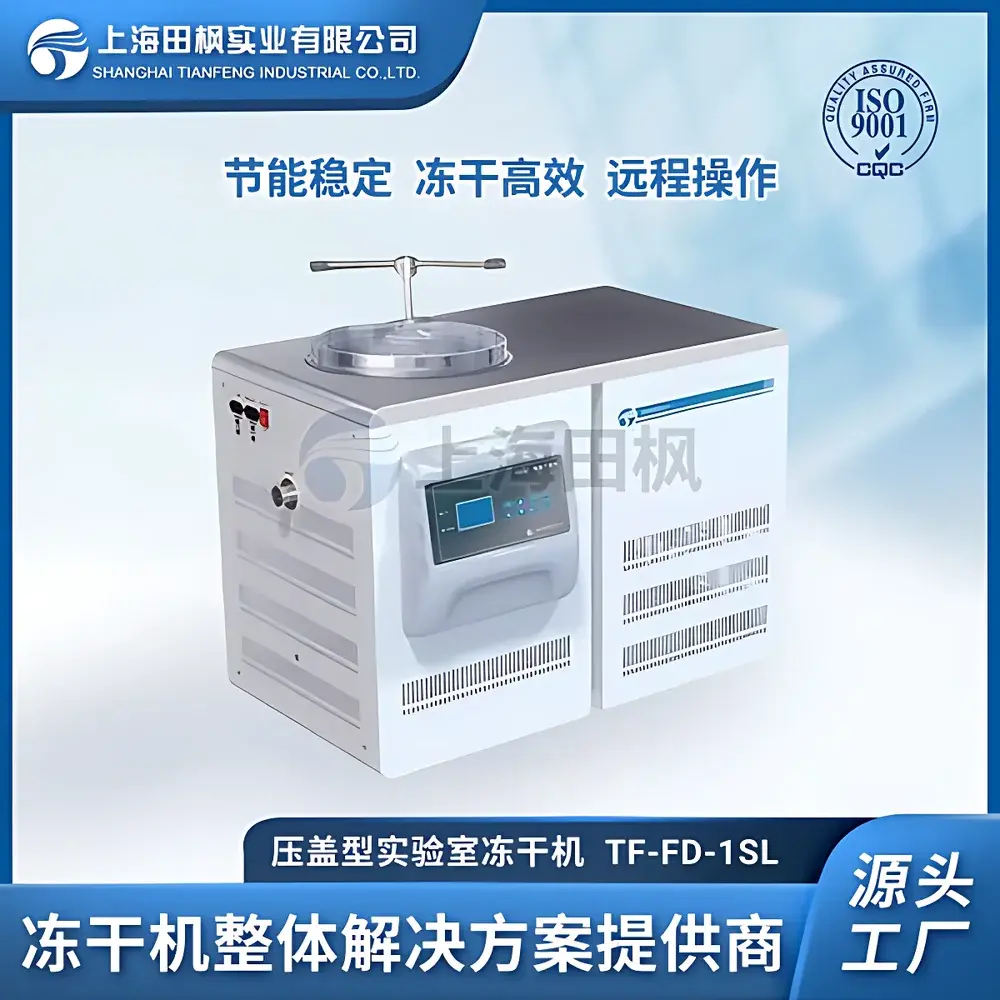
Tianfeng TF-FD-1SL (Stoppering Type) Laboratory Freeze Dryer
| Brand | Tianfeng |
|---|---|
| Origin | Shanghai, China |
| Manufacturer Type | Direct Manufacturer |
| Country of Origin | China |
| Model | TF-FD-1SL (Stoppering Type) |
| Freeze-Drying Area | 0.07 m² |
| Ultimate Vacuum | <15 Pa (at no load) |
| Condenser Temperature | <−80 °C |
| Ice Capacity | 8 kg/24 h |
| Power Consumption | 2200 W |
| Dimensions (W×D×H) | 900 × 600 × 800 mm |
| Shelf Configuration | Φ180 mm × 3 layers |
| Control System | Touchscreen LCD with Real-Time Lyophilization Curve Display (Shelf Temp & Chamber Pressure), PID Temperature Control |
| Construction | 304 Stainless Steel Interior, Transparent Acrylic Door |
| Refrigeration | Dual-Stage Cascade Compressor System |
| Optional Features | In-chamber Stoppering Mechanism, Inert Gas Backfill Valve, Temperature Data Logger, Eutectic Point Tester |
Overview
The Tianfeng TF-FD-1SL is a benchtop, stoppering-type laboratory freeze dryer engineered for precise, reproducible lyophilization of heat-sensitive biologicals—including vaccines, monoclonal antibodies, diagnostic reagents, and cell-based therapeutics. It operates on the fundamental principle of sublimation: frozen aqueous samples are dried under deep vacuum (<15 Pa), enabling water to transition directly from solid (ice) to vapor without passing through the liquid phase. This preserves structural integrity, bioactivity, and reconstitution fidelity—critical for regulatory compliance in pharmaceutical development and QC testing. Unlike conventional drying methods involving elevated temperatures, lyophilization minimizes protein denaturation, oxidation, and volatile loss. The TF-FD-1SL integrates an ultra-low temperature condenser (≤−80 °C) and high-capacity ice-trapping capability (8 kg/24 h), making it suitable not only for aqueous formulations but also for samples containing low-boiling-point organic solvents such as ethanol or acetone—common in formulation screening and analytical reference standard preparation.
Key Features
- Stoppering-compatible chamber design enables in-situ vial sealing post-drying—eliminating secondary handling and reducing contamination risk during aseptic processing workflows.
- Dual-stage cascade refrigeration system delivers stable condenser performance at ≤−80 °C, ensuring efficient vapor capture and consistent primary drying rates across batch sizes.
- Three-tier stainless steel shelves (Φ180 mm each) provide uniform thermal distribution; shelf temperature control via silicone oil circulation maintains ±1 °C accuracy—essential for controlled ramping during process optimization.
- Intuitive 7-inch touchscreen interface displays real-time lyophilization curves (shelf temperature, chamber pressure, condenser temp), supports multi-step PID-controlled heating protocols, and logs all operational parameters with timestamped records.
- Full 304 stainless steel interior and transparent acrylic door allow visual monitoring throughout freezing, primary drying, and secondary drying phases—supporting both method development and training applications.
- Integrated inert gas backfill valve permits nitrogen or argon purging prior to chamber venting, preventing oxidative degradation of oxygen-labile compounds.
- Compliant with ISO 22000–compatible mechanical architecture and designed for integration into GLP/GMP-aligned lab environments—supports optional 21 CFR Part 11-compliant data logging systems with user access controls and electronic audit trails.
Sample Compatibility & Compliance
The TF-FD-1SL accommodates standard serum vials (10–30 mL), scintillation vials, and custom trays up to 0.07 m² total surface area. Its −80 °C condenser and high ice capacity ensure robust performance with high-moisture-load samples (e.g., cell lysates, fermentation broths) and solvent-containing formulations (e.g., PLGA nanoparticle suspensions in dichloromethane/water mixtures). The system meets core requirements outlined in USP , Ph. Eur. 2.9.40, and ISO 13408-1 for sterile product lyophilization validation support. All wetted surfaces are electropolished 304 stainless steel, facilitating cleaning verification per ASTM E3067 and compatibility with common CIP agents. Vacuum integrity is verified per ISO 20517 Annex A, and leak rate remains below 0.1 Pa·m³/s after chamber conditioning.
Software & Data Management
The embedded controller records all critical process variables—including shelf setpoint, actual shelf temperature, chamber pressure, condenser temperature, and elapsed time—at user-configurable intervals (1–60 s). Data exports in CSV format via USB port for offline analysis in MATLAB, Python, or commercial process modeling tools (e.g., Modde, DynoLyze). Optional validated data logger modules provide 21 CFR Part 11 compliance: role-based login, electronic signatures, immutable audit trails, and encrypted storage. Calibration certificates traceable to NIST standards are available upon request for temperature and pressure sensors. Firmware updates are delivered via secure HTTPS portal with version-controlled release notes.
Applications
- Vaccine stabilization: lyophilization of live-attenuated, mRNA-LNP, and viral vector candidates to extend shelf life and reduce cold-chain dependency.
- Biopharmaceutical development: formulation screening of mAbs, fusion proteins, and enzyme replacements under varying annealing and drying rate conditions.
- Diagnostic kit manufacturing: drying of ELISA reagents, lateral flow assay components, and PCR master mixes without activity loss.
- Academic research: preservation of microbial cultures, tissue explants, and extracellular vesicles for long-term biobanking.
- Regulatory submissions: generation of stability-indicating lyophilization cycles compliant with ICH Q5C and Q1A(R2) guidelines.
FAQ
What is the maximum sample volume this unit can process per cycle?
With a freeze-drying area of 0.07 m² and typical loading density of 5–10 mL per vial, the TF-FD-1SL supports up to ~120 standard 10-mL serum vials per batch.
Does the system support automated shelf temperature ramping during primary drying?
Yes—the PID-controlled silicone oil heating system allows pre-programmed multi-step shelf temperature profiles, synchronized with pressure readings to optimize sublimation front progression.
Can the unit be validated for GMP use?
While the base configuration meets mechanical and material specifications for regulated environments, full IQ/OQ/PQ validation requires installation of optional calibrated sensors, audit-trail-enabled software, and documented calibration procedures—available through Tianfeng’s Validation Support Package.
Is remote monitoring supported?
Local Ethernet connectivity enables integration with facility SCADA systems; cloud-based remote viewing (read-only) is available via optional secure gateway module with TLS 1.3 encryption.
What maintenance intervals are recommended?
Vacuum pump oil replacement every 500 operating hours; condenser coil inspection and cleaning quarterly; full system leak test annually—per ISO 13485-recommended preventive maintenance schedule.



