
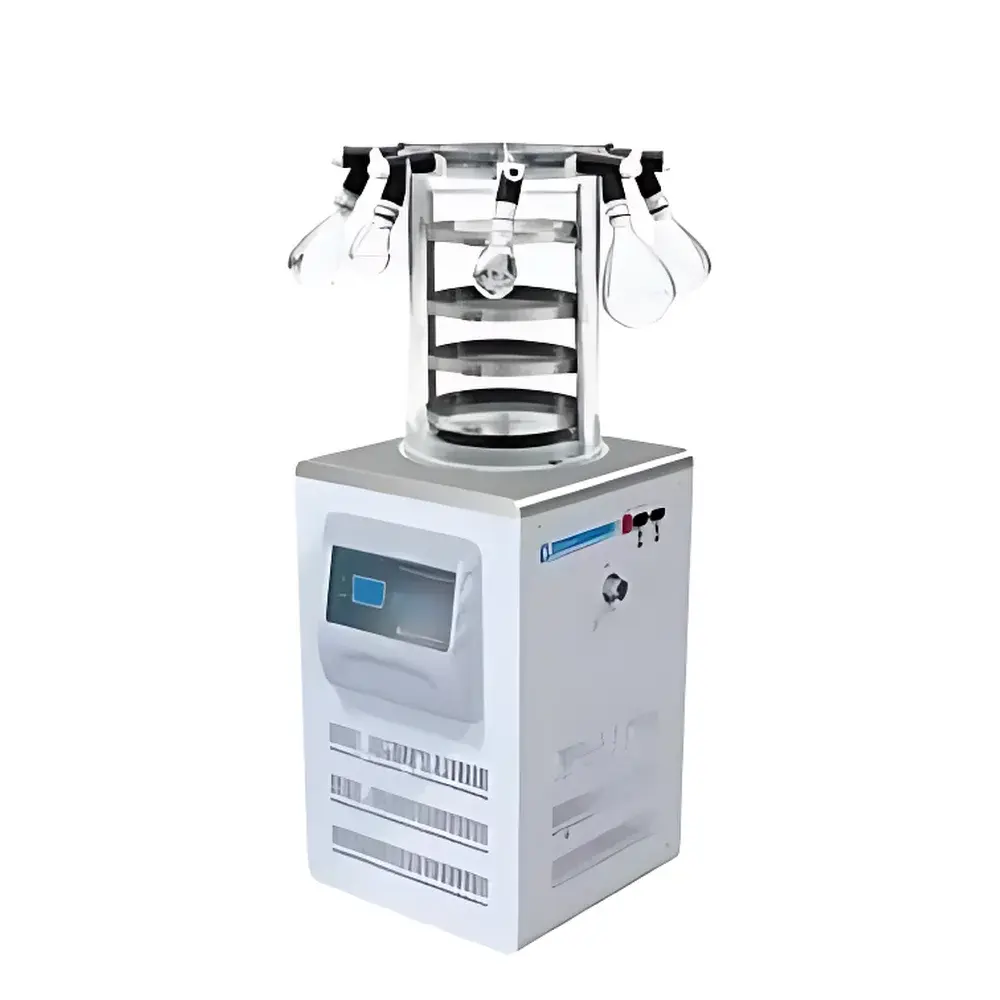
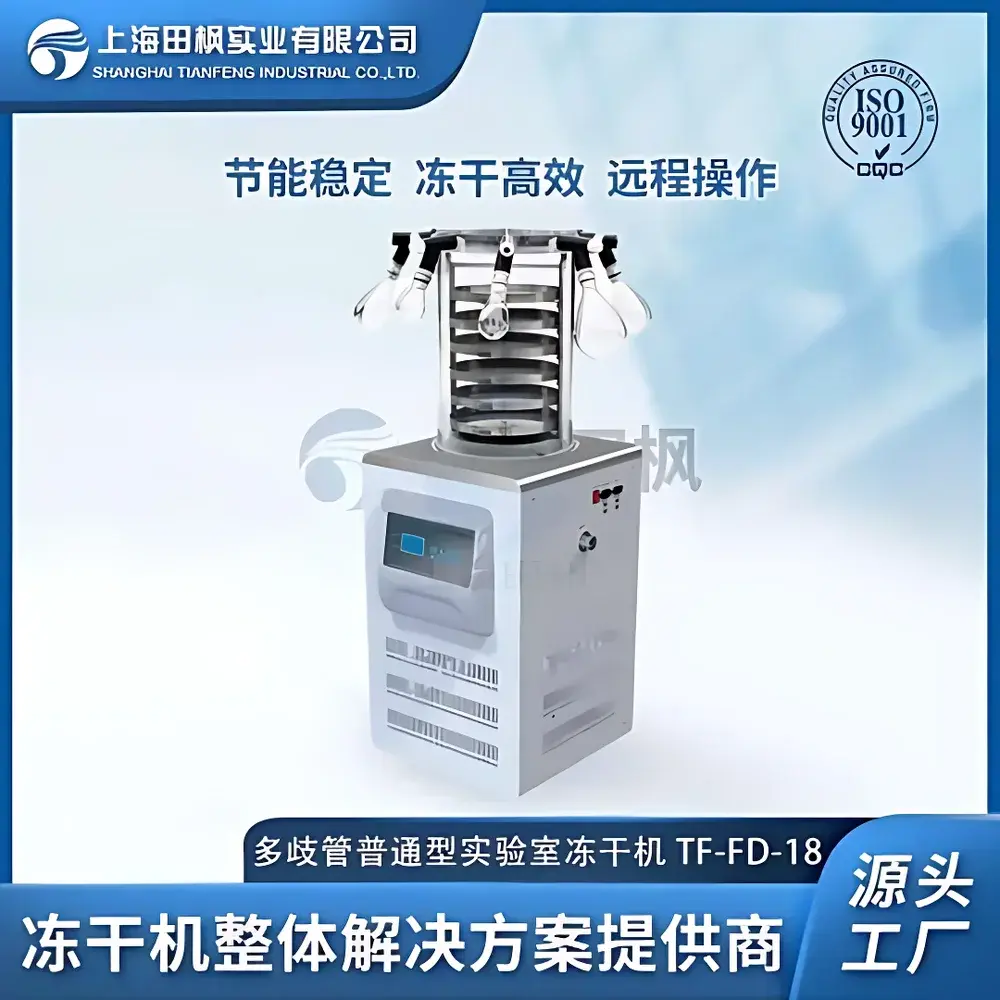
Tianfeng TF-FD-18 (Manifold-Type) Laboratory Freeze Dryer
| Brand | Tianfeng |
|---|---|
| Origin | Shanghai, China |
| Manufacturer Type | Direct Manufacturer |
| Instrument Type | Manifold Freeze Dryer |
| Application | Laboratory-Scale Lyophilization |
| Shelf Area | 0.18 m² |
| Ultimate Vacuum | <15 Pa (at idle) |
| Condenser Temperature | <−60 °C |
| Ice Capacity | 6 kg/24 h |
| Power Consumption | 1500 W |
| Dimensions (H×W×D, excl. chamber) | 960 × 550 × 550 mm |
| Chamber Material | 304 Stainless Steel |
| View Window | High-transparency acrylic door |
| Sample Vials | Compatible with 50–1000 mL flasks (8 positions) |
| Control Interface | Touchscreen LCD with real-time drying curve display |
| Refrigeration System | Air-cooled dual-stage cascade refrigeration |
| Optional Accessories | In-chamber temperature probe, inert gas purge valve, co-lyophilization point tester, data logger compliant with GLP audit trails |
Overview
The Tianfeng TF-FD-18 (Manifold-Type) Laboratory Freeze Dryer is a precision-engineered lyophilization system designed for reproducible, scalable freeze-drying of heat-sensitive biological and pharmaceutical samples under controlled low-temperature vacuum conditions. Based on the principle of sublimation—where ice transitions directly from solid to vapor phase without passing through liquid—the instrument preserves structural integrity, bioactivity, and chemical stability of labile substances including monoclonal antibodies, plasmid DNA, viral vectors, enzyme preparations, and cell lysates. Unlike conventional thermal drying methods, which induce denaturation, oxidation, or collapse due to elevated temperatures and ambient pressure, this system operates primarily below −40 °C during primary drying and maintains chamber pressures consistently below 15 Pa to ensure efficient water vapor removal while minimizing mass transfer resistance. Its manifold configuration enables parallel processing of multiple vials or flasks—ideal for comparative formulation studies, stability testing, or small-batch process development in compliance with ICH Q5C and USP <1211> lyophilization guidelines.
Key Features
- Stainless steel condenser and chamber constructed entirely from electropolished AISI 304 stainless steel—resistant to corrosion, compatible with cleaning validation protocols, and suitable for GMP-aligned environments.
- Air-cooled dual-stage cascade refrigeration system delivering stable condenser temperatures below −60 °C—ensuring high capture efficiency for water and moderate volatility solvents (e.g., acetone, ethanol), critical for organic-aqueous formulations.
- Integrated touchscreen HMI with real-time graphical display of shelf temperature, chamber pressure, condenser temperature, and drying progress curves—enabling precise PID-based control and deviation monitoring per ICH Q8(R2) design space requirements.
- Manifold-style sample interface accommodating up to eight standard conical flasks (50–1000 mL) with independent stopcocks—facilitating simultaneous lyophilization of heterogeneous samples without cross-contamination.
- Optional inert gas inlet valve (N₂ or argon)—supports oxygen-sensitive product handling and residual moisture control during backfilling, aligning with ISO 13485 and FDA 21 CFR Part 11 data integrity expectations when paired with compliant logging software.
- Pre-freezing capability via direct contact with the cold condenser surface—eliminates need for external ultra-low temperature freezers and reduces total cycle time by up to 30% compared to non-in-situ pre-frozen systems.
- High-clarity acrylic viewing port with anti-fog coating—allows continuous visual assessment of ice morphology, cake structure formation, and endpoint detection without compromising vacuum integrity.
Sample Compatibility & Compliance
The TF-FD-18 supports a broad spectrum of sample matrices—including aqueous buffers, protein solutions, bacterial cultures, tissue homogenates, and lyophilized excipient blends—across life science research, QC release testing, and early-phase clinical trial material preparation. Its 0.18 m² effective drying area and 6 kg/24 h ice capacity accommodate typical laboratory batch sizes ranging from 200 mL to 2 L total volume. The system conforms to key international standards governing freeze-drying equipment performance and data reliability: ASTM F2375-22 (Standard Guide for Validation of Freeze Drying Processes), ISO 20957-3 (Medical devices — Freeze dryers — Part 3: Requirements for performance verification), and EU Annex 15 (Qualification and Validation). When equipped with optional calibrated PT100 probes and time-stamped audit trail functionality, it meets ALCOA+ principles for electronic records under FDA 21 CFR Part 11 and supports GLP/GMP-compliant documentation workflows.
Software & Data Management
The embedded controller logs all critical process parameters—including chamber pressure (capacitance manometer), condenser temperature (PT100), shelf temperature (if upgraded), and elapsed time—at user-configurable intervals (1–60 s). Raw data exports in CSV format support post-run analysis in MATLAB, Python, or commercial statistical packages. Optional add-ons include Ethernet-enabled remote monitoring, password-protected user roles (operator, supervisor, administrator), and integration-ready Modbus TCP output for centralized facility SCADA systems. For regulated environments, validated firmware versions are available upon request—complete with installation qualification (IQ), operational qualification (OQ), and performance qualification (PQ) documentation packages aligned with GAMP 5 guidance.
Applications
- Stabilization of monoclonal antibodies, recombinant proteins, and mRNA-LNP formulations prior to long-term storage or shipping.
- Preparation of reference standards and calibration materials for analytical laboratories (e.g., HPLC, ELISA, mass spectrometry).
- Preservation of microbial strains (bacteria, yeasts, fungi) and mammalian cell lines in academic and industrial biobanks.
- Processing of botanical extracts, probiotics, and nutraceuticals where thermal degradation must be avoided.
- Development of lyophilized rapid diagnostic assay components—including lateral flow reagents and dried PCR master mixes.
- Material science applications involving porous scaffold fabrication, aerogel synthesis, and cryo-structured ceramic precursors.
FAQ
What is the maximum recommended sample volume per flask on the manifold?
For optimal drying uniformity and pressure stability, we recommend ≤300 mL per 1000 mL flask and ≤50 mL per 250 mL flask—based on empirical vapor flow modeling and validated endpoint detection across multiple matrix types.
Can the TF-FD-18 handle samples containing acetonitrile or methanol?
Yes—provided concentrations remain below 15% v/v and total solvent load does not exceed 2 kg per 24-hour cycle. Use of the −60 °C condenser significantly improves trapping efficiency over single-stage systems operating at −50 °C.
Is in-chamber shelf temperature control available on this model?
No—the TF-FD-18 (manifold type) lacks heated shelves. For programmable shelf ramping and secondary drying optimization, consider the TF-FD-18S variant, which features electrically heated aluminum plates with ±0.5 °C uniformity across 0–60 °C range.
Does the system include validation documentation?
Factory-installed IQ/OQ documents are provided with each unit. PQ protocols and execution support can be supplied separately upon request, tailored to client-specific SOPs and regulatory jurisdiction (FDA, EMA, PMDA, NMPA).
What maintenance intervals are recommended for the vacuum pump and refrigeration system?
Oil-sealed rotary vane pumps require oil replacement every 500 hours of operation; cascade compressors should undergo annual refrigerant charge verification and filter-drier inspection per manufacturer service bulletins.



