
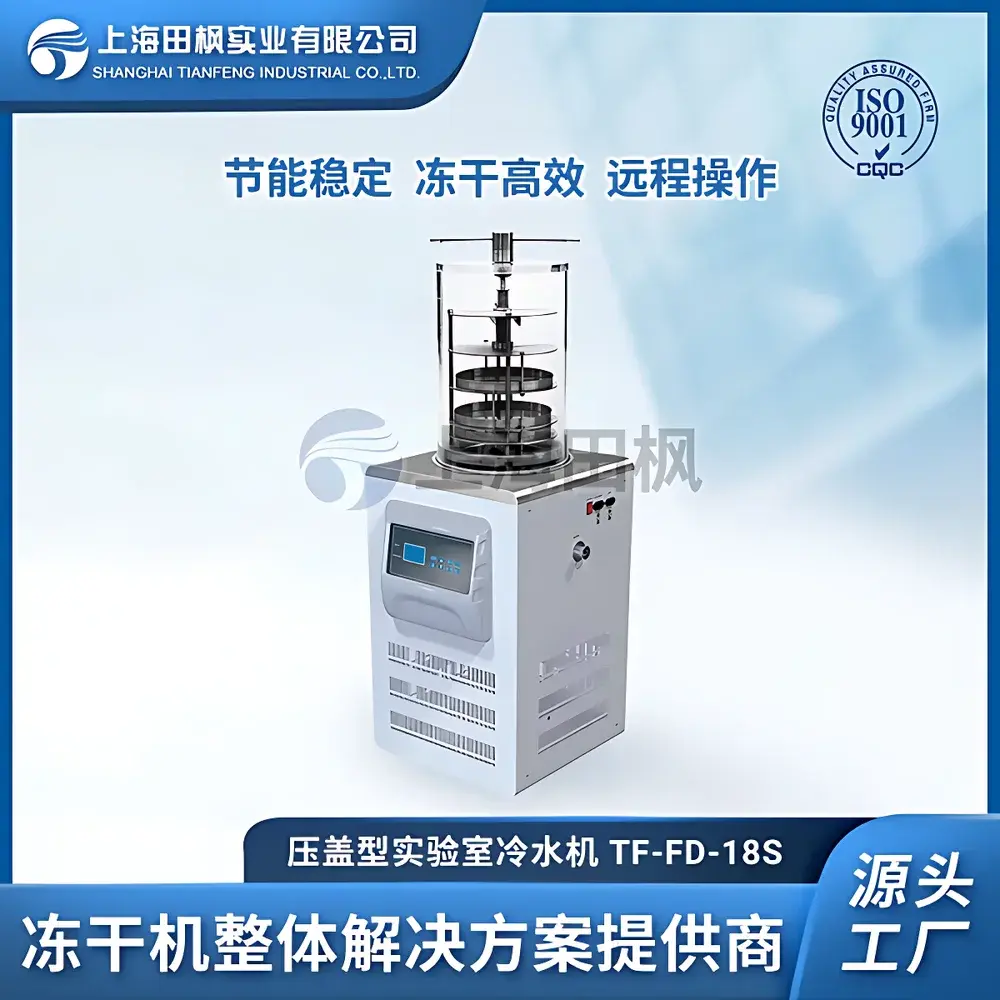
Tianfeng TF-FD-1L Stoppering Freeze Dryer
| Brand | Tianfeng |
|---|---|
| Origin | Shanghai, China |
| Manufacturer Type | Direct Manufacturer |
| Equipment Type | Stoppering (In-situ) Freeze Dryer |
| Application | Laboratory-Scale Lyophilization |
| Shelf Area | 0.07 m² |
| Ultimate Vacuum | <15 Pa (at no-load) |
| Condenser Temperature | ≤ −80 °C |
| Ice Capacity | 3 kg/24 h |
| Power Consumption | 1600 W |
| Dimensions (W×D×H) | 600 × 600 × 900 mm |
| Chamber Material | 304 Stainless Steel |
| Viewport | Transparent Acrylic Door |
| Refrigeration System | Dual-Stage Cascade Compressor |
| Control Interface | Touchscreen LCD with Real-Time Drying Curve Display |
| Compliance | Designed for GLP-compliant workflows |
Overview
The Tianfeng TF-FD-1L Stoppering Freeze Dryer is a compact, in-situ lyophilization system engineered for precision laboratory-scale freeze drying of heat-sensitive biologicals, pharmaceuticals, and research-grade samples. It operates on the fundamental principle of sublimation—removing water from frozen materials under deep vacuum while maintaining temperatures below the eutectic point—thereby preserving structural integrity, bioactivity, and reconstitution fidelity. Unlike conventional thermal drying methods that induce denaturation, oxidation, or collapse, this system enables primary drying at ≤ −80 °C and secondary drying at controlled, low-temperature conditions (<60 °C), ensuring minimal thermal stress. Its integrated stoppering mechanism allows for sterile, post-drying vial sealing under vacuum or inert gas (e.g., nitrogen or argon), eliminating manual handling and reducing contamination risk—critical for preclinical formulation development, stability studies, and small-batch GMP-adjacent preparation.
Key Features
- In-situ pre-freezing & drying: Samples are frozen directly within the condenser chamber, eliminating transfer steps and minimizing thermal shock or ice crystal redistribution.
- Dual-stage cascade refrigeration: Achieves stable condenser temperatures ≤ −80 °C, enabling efficient capture of volatile solvents (e.g., acetone, ethanol, ethyl acetate) commonly used in biopolymer or nanoparticle formulations.
- Stainless steel construction: Entire drying chamber and condenser housing fabricated from electropolished AISI 304 stainless steel—corrosion-resistant, non-porous, and compliant with cleaning validation protocols.
- Optical monitoring capability: Full-height transparent acrylic viewport permits real-time visual assessment of ice morphology, sublimation front progression, and cake structure formation without vacuum break.
- PID-controlled shelf temperature regulation: Although the TF-FD-1L does not feature heated shelves, its condenser temperature stability (±0.5 °C) ensures reproducible primary drying kinetics across batches.
- Intuitive touchscreen interface: Displays real-time vacuum pressure, condenser temperature, and elapsed time; supports customizable drying stage sequencing and alarm thresholds (e.g., vacuum loss, overpressure, high condenser load).
- Gas backfilling port: Integrated inert gas inlet valve enables controlled repressurization with nitrogen or argon—essential for oxygen-sensitive compounds and terminal sterilization workflows.
Sample Compatibility & Compliance
The TF-FD-1L accommodates standard Ø180 mm sample trays across three stacked shelves (total area: 0.07 m²), suitable for vials (10–20 mL), serum bottles, or custom containers. It is routinely deployed for lyophilizing monoclonal antibodies, plasmid DNA, viral vectors, enzyme preparations, probiotic cultures, and botanical extracts. The system meets baseline mechanical and operational requirements aligned with ISO 22042 (freeze dryers for pharmaceutical use) and supports adherence to ICH Q5C (stability testing of biotechnological products). When paired with an optional calibrated temperature logger (e.g., Vaisala viewLynx), it fulfills ALCOA+ data integrity criteria for GLP environments. While not certified for full 21 CFR Part 11 compliance out-of-the-box, its architecture permits integration with validated electronic lab notebook (ELN) systems and audit-trail-enabled recorders.
Software & Data Management
The embedded controller logs timestamped vacuum pressure, condenser temperature, and system status at user-defined intervals (default: 30 s). Raw data exports via USB to CSV format for post-processing in MATLAB, Python (Pandas), or commercial CQV platforms. Optional external data loggers provide independent temperature mapping (shelf surface, product core) and enable correlation of drying rate with residual moisture content (measured separately by Karl Fischer titration). All firmware updates are delivered via secure offline package—no cloud connectivity—to preserve network isolation in regulated labs.
Applications
- Stabilization of thermolabile biologics (e.g., cytokines, growth factors) prior to analytical characterization
- Preparation of reference standards for HPLC, LC-MS, or ELISA assay development
- Rapid prototyping of lyophilized vaccine candidates in academic and contract research settings
- Long-term preservation of microbial strains, cell lines, and tissue lysates for biobanking
- Drying of organic-inorganic hybrid nanomaterials where solvent volatility demands ultra-low condenser temperatures
- Method development for scale-up to pilot or production freeze dryers (e.g., shelf heat transfer coefficient estimation)
FAQ
What is the maximum batch volume supported by the TF-FD-1L?
The unit accommodates up to 1.5 L total liquid volume across three Ø180 mm trays—assuming 5 mm fill depth per tray and accounting for expansion during freezing.
Can the system handle samples containing >5% organic solvent?
Yes. With condenser performance maintained at ≤ −80 °C, it effectively traps acetone, methanol, and acetonitrile at concentrations up to 15% v/v—verified via gravimetric ice capture tests.
Is in-chamber pressure calibration traceable to NIST standards?
The built-in Pirani + capacitance manometer combination provides factory-calibrated readings with ±5% accuracy in the 0.1–100 Pa range; field recalibration requires third-party metrology service.
Does the stoppering function support rubber stopper compression force adjustment?
No. The pneumatic stoppering actuator delivers fixed, validated compression (12–15 N) optimized for standard pharmaceutical-grade butyl stoppers (20 mm diameter); custom tooling is available upon engineering review.
What maintenance intervals are recommended for the dual-compressor system?
Compressor oil inspection every 1,000 operating hours; full refrigerant circuit check and filter dryer replacement every 3 years—or sooner if vacuum decay exceeds 0.5 Pa/min during hold tests.



