
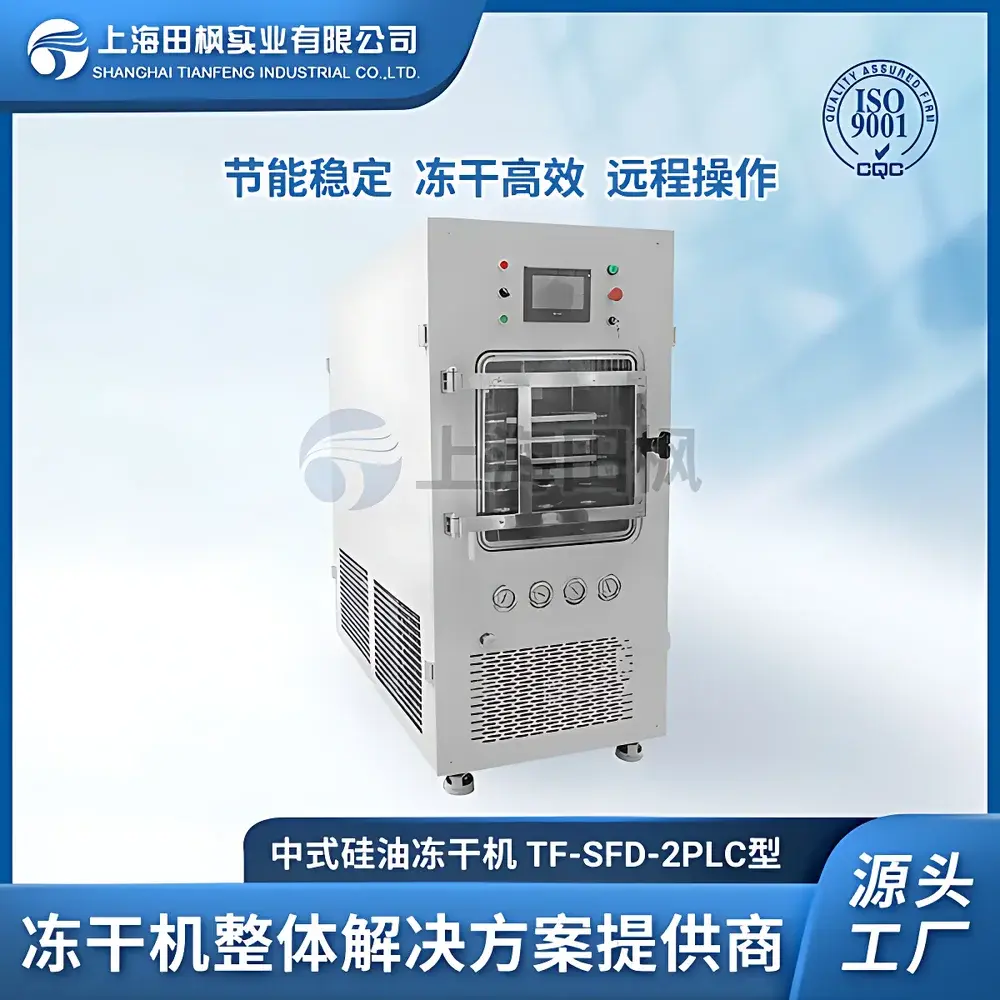
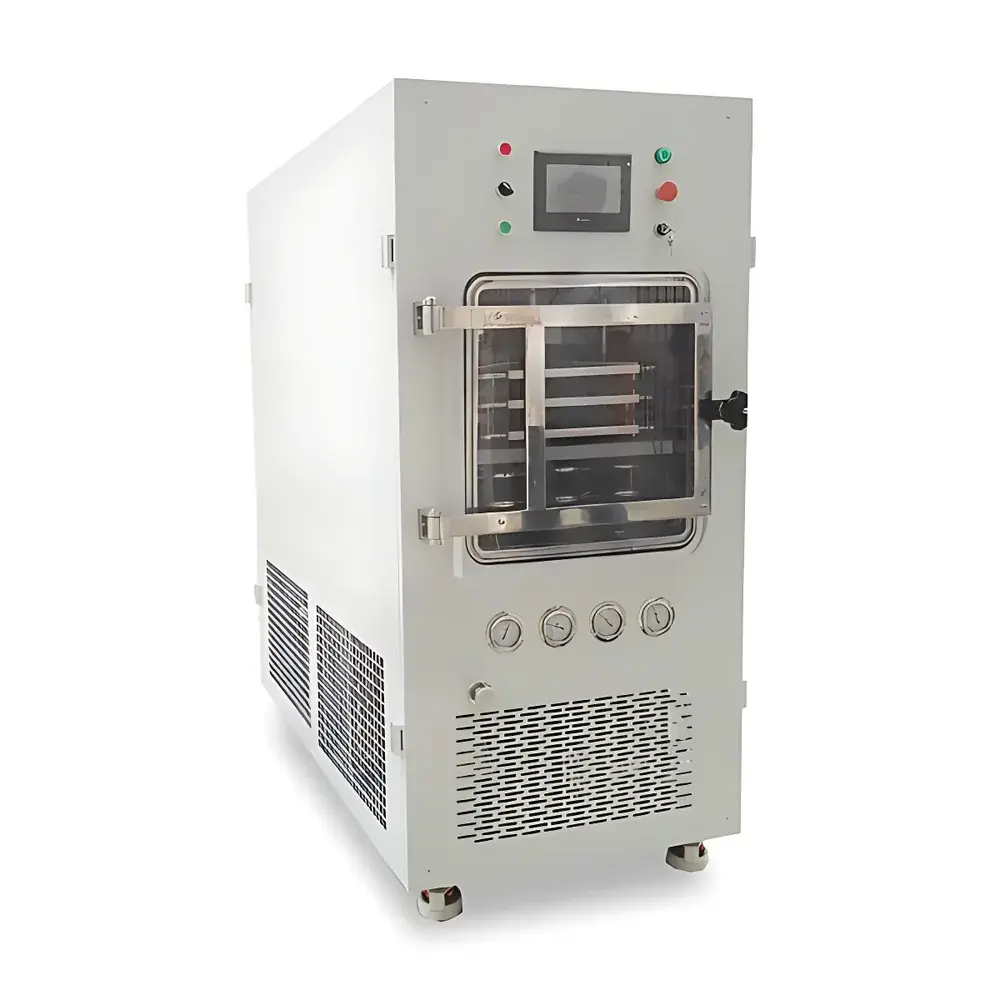
Tianfeng TF-SFD-2 Benchtop Pilot-Scale Freeze Dryer with In-Situ Pre-Freezing
| Brand | Tianfeng |
|---|---|
| Origin | Shanghai, China |
| Manufacturer Type | Direct Manufacturer |
| Region Category | Domestic (China) |
| Model | TF-SFD-2 (Standard Shelf-Type) |
| Instrument Type | Standard Shelf-Type Freeze Dryer |
| Application Scope | Pilot-Scale Production |
| Lyophilization Area | 0.2 m² |
| Ultimate Vacuum | ≤5 Pa |
| Condenser Capacity | 3 kg/24 h |
| Condenser Temperature | ≤−70 °C |
| Main Unit Dimensions | 800 × 1000 × 1700 mm |
| Shelf Configuration | 2+1 shelves |
| Shelf Dimensions (W×L) | 280 × 360 mm |
| Shelf Spacing | 70 mm |
| Shelf Temp Range | −50 to +80 °C |
| Loading Capacity (Φ16 mm vials) | 770 pcs/batch |
| Loading Capacity (Φ20 mm vials) | 400 pcs/batch |
| Max Liquid Load | 3 L/batch |
| Refrigeration System | Cascade Refrigeration |
| Heat Transfer Medium | Silicone Oil (±1 °C uniformity) |
| Chamber Material | 304 Stainless Steel |
| Door | High-Transparency Acrylic Viewing Window |
| Control Interface | Touchscreen LCD with Real-Time Drying Curve & PID Regulation |
| Optional Accessories | Temperature Data Logger, Eutectic Point Tester, Automatic Stoppering System, Inert Gas Purge Valve |
| Power Supply | 3 kW |
| Net Weight | 350 kg |
| Compliance | Designed for GLP-compliant environments |
Overview
The Tianfeng TF-SFD-2 is a pilot-scale, in-situ freeze dryer engineered for reproducible, scalable lyophilization under controlled thermal and vacuum conditions. It operates on the fundamental principle of sublimation—removing water from frozen samples under deep vacuum while maintaining product integrity below the eutectic temperature. Unlike benchtop units intended solely for research, the TF-SFD-2 bridges laboratory development and early-stage process validation, supporting consistent batch processing across pharmaceutical, biotechnological, and academic applications. Its integrated shelf-based freezing system eliminates manual transfer between pre-freezing and drying chambers, minimizing contamination risk and thermal shock—critical for thermolabile biologics such as monoclonal antibodies, viral vectors, and live attenuated vaccines. The unit complies with core design expectations outlined in ISO 22042:2017 (freeze-drying equipment performance requirements) and aligns with upstream process development frameworks used in QbD (Quality by Design) workflows.
Key Features
- In-situ pre-freezing capability: Shelves cool to −70 °C prior to primary drying, enabling precise control over ice nucleation and crystal morphology—essential for preserving protein conformation and cellular viability.
- Cascade refrigeration system: Dual-stage compressor architecture achieves stable condenser temperatures ≤−70 °C, ensuring efficient vapor capture during high-moisture loads without performance decay over extended cycles.
- Silicone oil-heated/cooled shelves: ±1 °C temperature uniformity across all shelves guarantees homogeneous drying kinetics and minimizes batch-to-batch variability in residual moisture content.
- Full 304 stainless steel interior: Corrosion-resistant chamber and condenser housing meet ASME BPE surface finish standards (Ra ≤ 0.8 µm), facilitating cleaning validation and reducing bioburden retention risk.
- Real-time process monitoring: 7-inch capacitive touchscreen displays dynamic drying curves (shelf temp, chamber pressure, condenser temp), with configurable PID parameters and alarm thresholds for deviation detection.
- High-transparency acrylic door: Enables visual assessment of cake structure, collapse onset, and rehydration behavior without compromising vacuum integrity or introducing external particulates.
- Inert gas purge port: Integrated valve supports nitrogen or argon backfilling post-drying to prevent oxidation of sensitive APIs and extend shelf life of sterile lyophilized powders.
Sample Compatibility & Compliance
The TF-SFD-2 accommodates standard pharmaceutical containers—including 16 mm and 20 mm serum vials, trays up to 3 L volume, and custom molds—within its 0.2 m² effective drying area. Its −50 °C to +80 °C shelf range supports both low-temperature stabilization of unstable proteins and secondary drying of small-molecule formulations requiring elevated temperatures. The system is routinely deployed in facilities operating under cGMP Annex 1 (EU) and USP guidelines for sterile processing. When paired with validated temperature mapping protocols and calibrated data loggers, it satisfies audit requirements for FDA 21 CFR Part 11 compliance, including electronic signature enforcement, audit trail generation, and user-access tiering. All wetted surfaces are electropolished and passivated per ASTM A967, supporting cleaning verification per ICH Q5C and Q5D.
Software & Data Management
The embedded control firmware records time-stamped process variables at user-defined intervals (default: 10 s), exporting CSV-formatted datasets compatible with JMP, MATLAB, and industry-standard PAT (Process Analytical Technology) platforms. Optional data logger modules provide encrypted, tamper-evident storage with configurable trigger points for critical event annotation (e.g., pressure spikes, shelf temp excursions). Firmware supports export of IQ/OQ documentation templates aligned with ISPE GAMP 5 classification (Category 3 system), and includes built-in calibration verification routines for thermocouples and Pirani gauges. Remote monitoring via Ethernet is supported through Modbus TCP protocol, enabling integration into centralized MES or SCADA systems for multi-unit fleet management.
Applications
- Pharmaceutical development: Optimization of cycle parameters for parenteral formulations, including lyophilized monoclonal antibodies, peptide therapeutics, and mRNA-LNP complexes.
- Vaccine manufacturing: Stabilization of live virus vaccines, bacterial lysates, and adjuvanted antigen preparations requiring strict cold-chain preservation.
- Diagnostic reagent production: Preservation of enzyme conjugates, immunoassay calibrators, and molecular probes without activity loss.
- Biobanking & regenerative medicine: Long-term cryopreservation of stem cells, tissue scaffolds, and decellularized extracellular matrices.
- Food science research: Structural analysis of freeze-dried fruits, probiotics, and functional ingredients where porosity, reconstitution time, and volatile retention are key metrics.
FAQ
What is the maximum batch size supported by the TF-SFD-2?
The unit handles up to 770 vials (Φ16 mm) or 400 vials (Φ20 mm) per batch, with a total liquid loading capacity of 3 L.
Does the system support automated stoppering?
Yes—an optional automatic stoppering module is available for integration with aluminum-sealed vials under controlled vacuum or inert atmosphere.
Can the eutectic point of a formulation be determined on this unit?
A dedicated eutectic point tester is offered as an accessory, enabling real-time resistance measurement during controlled shelf ramping.
Is the condenser temperature verified independently of shelf sensors?
Yes—dual Pt100 sensors monitor condenser surface and vapor phase temperatures separately, with independent calibration certificates traceable to NIST standards.
How is cleaning validation supported?
The fully welded 304 SS interior, absence of dead legs, and smooth internal radii (R ≥ 3 mm) comply with ASME BPE hygienic design criteria, simplifying rinse sampling and swab recovery studies.



