
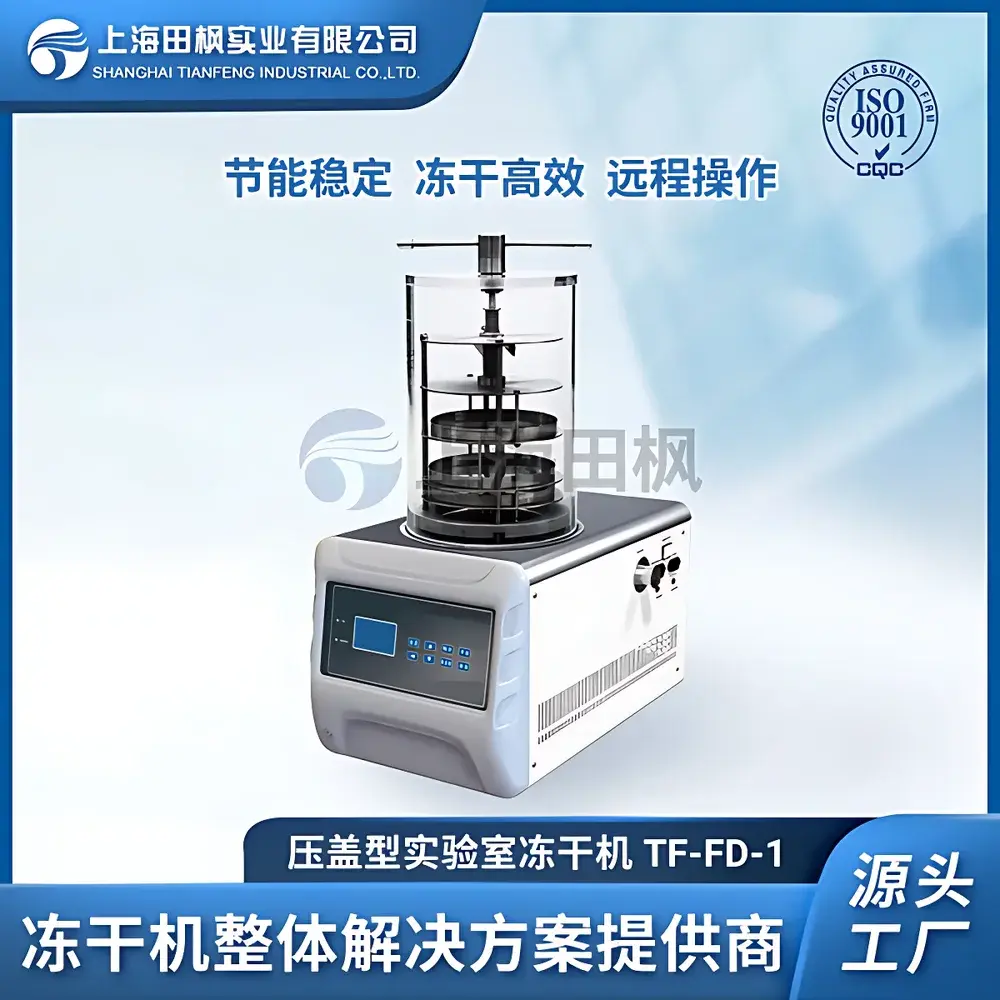
Tianfeng TF-FD-1 Benchtop Lyophilizer with Stoppering Function
| Brand | Tianfeng |
|---|---|
| Origin | Shanghai, China |
| Manufacturer Type | Direct Manufacturer |
| Equipment Type | Stoppering Freeze Dryer |
| Application Scope | Laboratory Use |
| Shelf Area | 0.07 m² |
| Ultimate Vacuum | <15 Pa (at no-load) |
| Condenser Temperature | <−50 °C |
| Ice Capacity | 3 kg/24 h |
| Dimensions (W×H×D) | 370 mm × 650 mm × 360 mm |
| Power Consumption | 1100 W |
| Electrical Supply | 220 V, 50 Hz |
| Chamber Material | 304 Stainless Steel |
| Control Interface | Touchscreen LCD with Real-Time Drying Curve Display |
| Refrigeration System | Dual-Stage Cascade Compressor |
| Pre-freezing Method | In-situ Shelf Pre-freezing |
| Optional Accessories | Temperature Data Logger, Co-lyophilization Point Tester, Inert Gas Purge Valve, Automatic Stopper Actuator |
Overview
The Tianfeng TF-FD-1 is a compact, in-situ pre-freezing benchtop lyophilizer engineered for precision freeze-drying of thermolabile biological and pharmaceutical formulations under controlled low-temperature and high-vacuum conditions. It operates on the fundamental principle of sublimation—where ice transitions directly from solid to vapor phase without passing through liquid state—under vacuum pressures below 15 Pa and condenser temperatures maintained at ≤ −50 °C. This process preserves structural integrity, enzymatic activity, and immunogenicity of sensitive compounds such as probiotic cultures, herbal extracts (e.g., traditional Chinese medicine formulations), cosmetic actives (e.g., collagen peptides, hyaluronic acid in facial mask matrices), and microbial biologics. Unlike conventional thermal drying methods that induce denaturation, oxidation, or collapse of porous architecture, the TF-FD-1 enables formation of a stable, highly porous scaffold—retaining original morphology, reconstitution kinetics, and bioactivity upon rehydration. Its design complies with core principles outlined in ISO 22042:2021 (freeze-drying equipment performance requirements) and supports method development aligned with ICH Q5C (stability testing of biotechnological/biological products) and USP (sterile processing and lyophilization).
Key Features
- In-situ shelf pre-freezing capability eliminates manual transfer between freezer and chamber—reducing contamination risk and ensuring consistent nucleation behavior across samples.
- Dual-stage cascade refrigeration system delivers rapid cooldown and sustained condensing efficiency, enabling reliable capture of volatile solvents (e.g., ethanol, acetone) commonly used in TCM extract preparation.
- Three-layer stainless steel shelves (Φ180 mm each) provide uniform heat transfer and mechanical stability; surface temperature uniformity ≤ ±1 °C using silicone oil as thermal medium.
- Intuitive 7-inch touchscreen interface displays real-time drying curves (shelf temperature, chamber pressure, condenser temperature), with PID-controlled ramp/soak profiles for primary and secondary drying stages.
- High-transparency acrylic door with integrated observation window allows visual monitoring of cake formation, collapse events, or sublimation front progression without breaking vacuum.
- Equipped with inert gas purge valve (N₂ or argon compatible) for oxygen-sensitive formulations; optional auto-stoppering actuator ensures sterile closure of vials post-drying per cGMP Annex 1 guidelines.
- All-welded 304 stainless steel interior resists corrosion from organic acids, plant alkaloids, and fermentation byproducts—facilitating GMP-compliant cleaning validation.
Sample Compatibility & Compliance
The TF-FD-1 accommodates diverse sample formats including glass vials (10–30 mL), serum bottles, and custom trays—ideal for small-batch R&D of probiotic powders, botanical injectables, functional skincare lyo-cakes, and diagnostic reagents. Its validated shelf area of 0.07 m² supports batch sizes up to 120 × 2 mL vials or equivalent surface loading. The system meets essential regulatory prerequisites for laboratory-scale process qualification: vacuum integrity verified per ASTM E493-22, condenser efficiency tested against ISO 13485:2016 Annex C requirements for medical device sterilization support equipment, and electrical safety certified to IEC 61010-1. While not a Class A cleanroom system, its sealed architecture and optional data logging enable alignment with GLP documentation standards (OECD 1998) and preliminary FDA 21 CFR Part 11 readiness when paired with audit-trail-enabled software.
Software & Data Management
The embedded controller logs time-stamped parameters (pressure, shelf temp, condenser temp, elapsed time) at user-defined intervals (1–60 sec). Exportable CSV files support trend analysis in Excel or MATLAB for critical quality attribute (CQA) correlation—e.g., residual moisture vs. drying time, or collapse temperature vs. formulation composition. Optional external temperature data loggers (±0.5 °C accuracy) can monitor product core temperature via calibrated Pt100 probes, satisfying ICH Q8(R2) design space verification needs. All firmware updates are performed offline via USB—ensuring cybersecurity compliance without network exposure. No cloud connectivity is included, preserving data sovereignty for regulated academic or contract research organizations.
Applications
- Stabilization of live bacterial strains (Lactobacillus, Bifidobacterium) for oral probiotic dosage forms—maintaining ≥ 90% viability after reconstitution.
- Lyophilization of hydrophilic herbal concentrates (e.g., glycyrrhizin, ginsenosides) without Maillard browning or polysaccharide caramelization.
- Production of sterile, needle-free facial mask sheets with preserved growth factors and antioxidant enzymes (SOD, catalase).
- Preparation of reference standards for HPLC and LC-MS analysis—minimizing analyte degradation during solvent removal.
- Method scouting for scale-up to pilot-scale freeze dryers (e.g., TF-FD-18 or TF-FD-27 series) using identical critical process parameters (CPPs).
FAQ
What types of solvents can be safely dried using the TF-FD-1?
The −50 °C condenser effectively traps water, methanol, and ethanol. For higher-volatility solvents (e.g., acetone, acetonitrile), use lower shelf temperatures (< −40 °C) and reduce loading volume to prevent condenser overload.
Is in-situ pre-freezing sufficient for eutectic mixtures?
Yes—when combined with optional co-lyophilization point detection, the system identifies optimal nucleation temperature to avoid phase separation in multi-component TCM extracts.
Can this unit meet GMP documentation requirements?
It supports ALCOA+ data integrity principles when used with validated accessories (e.g., calibrated loggers, electronic signatures); full 21 CFR Part 11 compliance requires third-party software integration.
What maintenance intervals are recommended?
Oil changes every 2,000 operating hours; vacuum pump oil replacement every 500 hours; condenser coil inspection quarterly; O-ring lubrication semiannually.
Does the system include lyophilization cycle development support?
Yes—Tianfeng provides application notes for common matrices (probiotics, herbal decoctions, enzyme solutions) and assists in defining primary drying endpoints via pressure rise test (PRT) methodology.



