
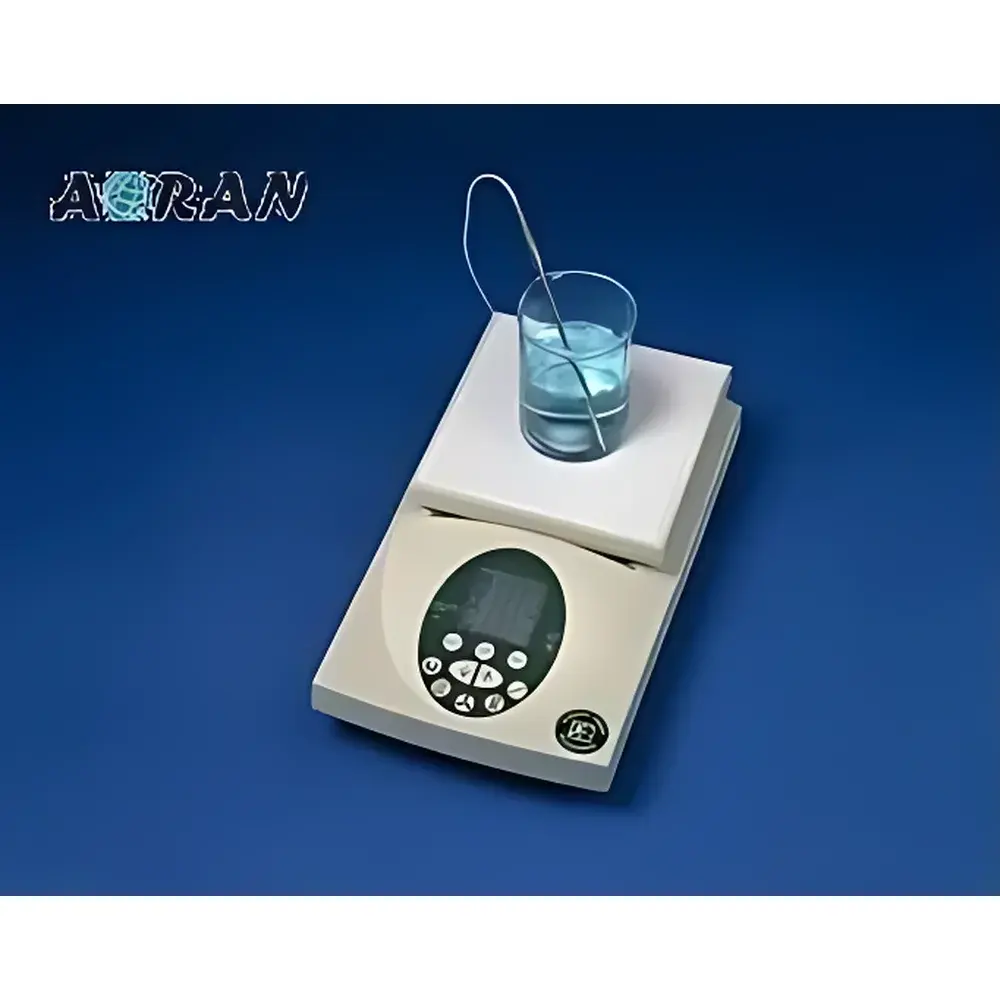
Torrey Pines HS Series Programmable Magnetic Stirring Hotplates
| Brand | Torrey Pines |
|---|---|
| Origin | USA |
| Model(s) | HS40A, HS50A, HS51A |
| Max Stirring Volume | 10 L |
| Speed Range | 100–1500 rpm |
| Temperature Range | 25–450 °C |
| Temp Accuracy | ±1% of setpoint |
| Programmable Stages | Up to 10 stages per program |
| Program Memory | 10 programs |
| Timer Range | 00:00:01–99:59:59 |
| Heating Plate Material | Ceramic or Anodized Aluminum |
| Safety Certifications | UL, CSA, CE |
| Control Type | Digital PID with Multi-Stage Ramp-Soak Programming |
Overview
The Torrey Pines HS Series Programmable Magnetic Stirring Hotplates are precision-engineered benchtop instruments designed for reproducible, thermally stable mixing and heating in analytical, synthetic, and quality control laboratories. These hotplates integrate high-performance magnetic stirring with programmable thermal control based on digital PID algorithms—ensuring rapid, uniform heating and precise temperature maintenance across diverse sample volumes and viscosities. Unlike basic analog units, the HS Series employs closed-loop feedback to actively suppress thermal overshoot and minimize drift, making it suitable for applications requiring strict thermal compliance—including ASTM E2913 (standard practice for thermal stability testing), USP <1058> (analytical instrument qualification), and GLP/GMP environments where traceable, auditable heating profiles are essential.
Key Features
- High-temperature capability up to 450 °C with ±1% accuracy across the full operating range (25–450 °C), validated per IEC 61000-4-30 for thermal stability under load.
- Multi-stage ramp-soak programming: Up to 10 user-defined temperature/time segments per program, supporting complex thermal protocols such as solvent reflux initiation, polymerization preheating, or catalyst activation sequences.
- Dual-material heating plates: Optional ceramic (chemically inert, high emissivity) or anodized aluminum (rapid thermal response, lightweight) surfaces—both engineered for mechanical durability and consistent heat distribution.
- Stirring performance: Sustained torque delivery from 100–1500 rpm with automatic speed compensation during viscosity changes, enabling stable agitation of solutions up to 10 L (water-equivalent).
- Integrated safety architecture: Over-temperature cutoff, plate surface temperature monitoring, and auto-shutdown upon lid removal or prolonged idle state—certified to UL 61010-1, CSA C22.2 No. 61010-1, and EN 61010-1 (CE).
- Extended timer functionality: Precise countdown from 1 second to 99 hours, 59 minutes, 59 seconds—programmable independently of thermal cycles for unattended endpoint termination.
Sample Compatibility & Compliance
The HS Series accommodates standard laboratory glassware (e.g., beakers, flasks, reaction vessels) up to 150 mm in diameter. Its flat, low-profile plate design ensures optimal contact and minimal edge cooling. The ceramic variant resists aggressive reagents including concentrated acids (HNO₃, H₂SO₄), halogenated solvents, and strong alkalis—validated per ISO 8502-9 for surface corrosion resistance. All models comply with electromagnetic compatibility (EMC) requirements under FCC Part 15 Class B and EU Directive 2014/30/EU. For regulated environments, audit trails for program execution (including start time, setpoints, actual temperatures, and completion status) can be exported via RS-232 interface for FDA 21 CFR Part 11–compliant documentation.
Software & Data Management
While standalone operation is fully functional via front-panel keypad and LED display, optional PC connectivity enables remote configuration and data logging using Torrey Pines’ proprietary LabLink™ software (Windows-compatible). This application supports real-time graphing of temperature/stirring profiles, export of CSV-formatted logs, and batch archiving aligned with ALCOA+ principles (Attributable, Legible, Contemporaneous, Original, Accurate, Complete, Consistent, Enduring, Available). Firmware updates are delivered via signed .hex files to maintain cryptographic integrity—critical for laboratories undergoing ISO/IEC 17025 accreditation or internal QA audits.
Applications
- Synthesis workflows requiring controlled heating during Grignard reactions, esterifications, or Suzuki couplings.
- QC dissolution testing per USP <711> where precise bath temperature and agitation consistency directly impact release rate calculations.
- Material science labs performing thermal aging studies on composites or coatings under ISO 11357-3 conditions.
- Environmental labs executing EPA Method 3050B acid digestions with programmable ramp-to-boil sequences.
- Biotechnology settings for buffer equilibration prior to chromatography runs—where temperature-induced pH shifts must be minimized.
FAQ
What safety certifications do the HS Series hotplates hold?
All models carry UL 61010-1, CSA C22.2 No. 61010-1, and CE marking per the Low Voltage and EMC Directives.
Can the unit maintain temperature stability when stirring viscous samples?
Yes—the PID controller continuously adjusts power output based on real-time sensor feedback, maintaining ±1% accuracy even with dynamic thermal loads from high-viscosity media.
Is firmware update capability available?
Yes, field-upgradable firmware is supported via RS-232 and LabLink™ software, with version-controlled release notes and SHA-256 checksum verification.
Does the program memory retain settings after power loss?
Yes—non-volatile EEPROM preserves all 10 stored programs and user preferences indefinitely without battery backup.
Are replacement heating plates available separately?
Yes, both ceramic and anodized aluminum plates are offered as service parts with standardized mounting interfaces for quick field replacement.



