
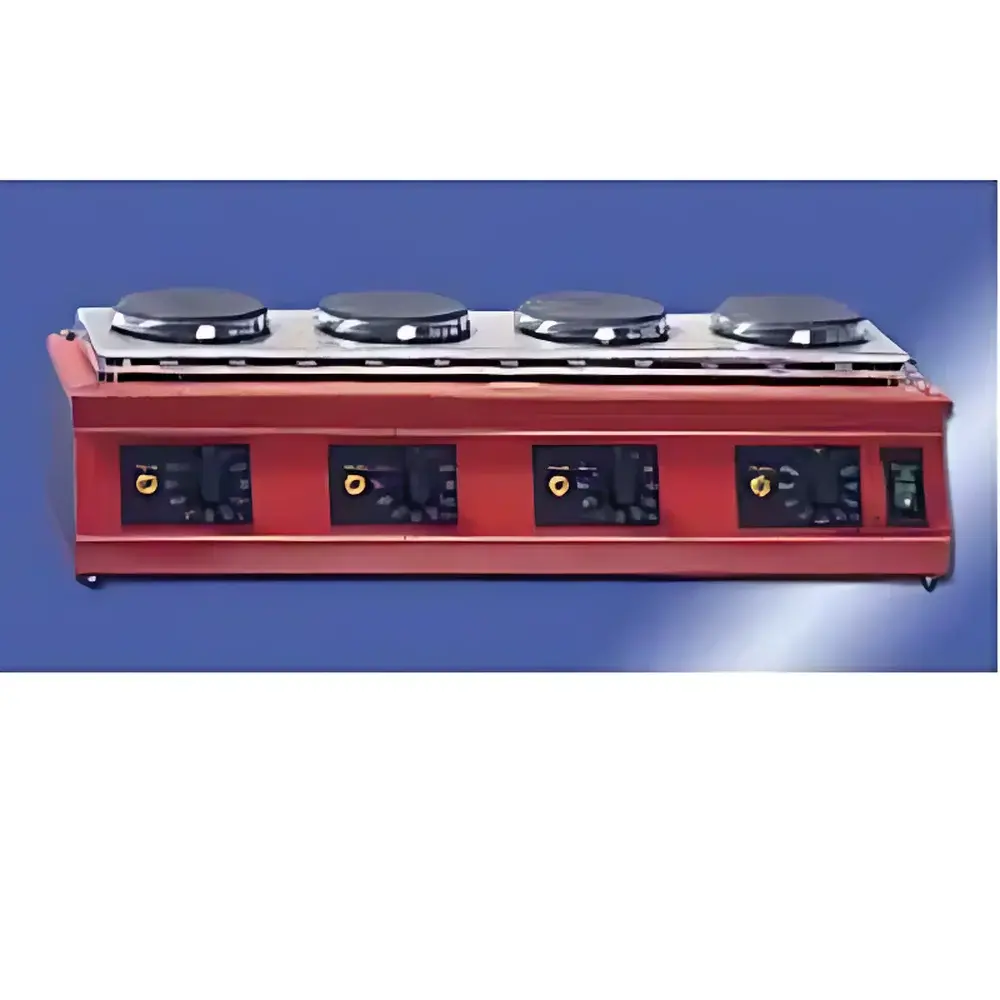
Behr HB4 & HB6 Multi-Sample Heating Block System
| Origin | Germany |
|---|---|
| Manufacturer Type | Authorized Distributor |
| Origin Category | Imported |
| Model | Behr HB4 / HB6 Multi-Sample Heating Block |
| Pricing | Available Upon Request |
| Dimensions (W×H×L) | HB4 ≈ 53 × 74 × 32 cm |
| Weight | HB4 ≈ 15.1 kg |
| Rated Voltage | 230 V~, 50/60 Hz |
| Rated Power | HB4 = 1440 W |
| Independent Temperature Control per Position | Yes |
| Sample Port Diameter | 94 mm |
| Optional Support Stand | HBS-4 (for HB4), HBS-6 (for HB6) |
| Accessories Part Numbers | 80 48 00506 (HB4), 80 48 00507 (HB6), 80 48 00508 (HBS-4), 80 48 00509 (HBS-6) |
Overview
The Behr HB4 and HB6 Multi-Sample Heating Block Systems are precision-engineered thermal platforms designed for laboratories requiring simultaneous, independent temperature control across multiple sample positions. Built to DIN-compliant manufacturing standards in Germany, these units operate on the principle of resistive heating via embedded high-stability heating elements within an aluminum alloy block, ensuring uniform thermal distribution and minimal cross-talk between adjacent zones. Each sample port—measuring 94 mm in diameter—is thermally isolated and driven by its own PID-controlled circuit, enabling discrete setpoint programming from ambient +5 °C up to 300 °C (typical operational range). This architecture supports reproducible thermal treatment protocols essential for applications such as solvent evaporation, enzymatic reactions, catalyst activation, and standardized sample conditioning prior to chromatographic or spectroscopic analysis. The systems are intended for benchtop use in ISO 17025-accredited laboratories and are compatible with GLP and GMP workflows where traceable, position-specific thermal history is required.
Key Features
- Independent digital PID temperature control for each sample position—no shared thermal coupling or manual balancing required
- High-thermal-conductivity anodized aluminum heating blocks with optimized fin geometry for rapid heat-up and stable dwell performance
- Integrated safety architecture including overtemperature cutoff (dual-stage), ground-fault protection, and automatic power shutdown upon lid removal or abnormal current draw
- Front-panel LED display with intuitive rotary encoder interface for real-time monitoring of all zone temperatures and setpoints
- Modular mechanical design supporting optional HBS-4 or HBS-6 support stands—each equipped with adjustable vertical rods and universal clamping collars for flask, tube, or reactor mounting
- Compliance with IEC 61010-1:2010 for electrical safety in laboratory equipment and EN 60529 IP20 ingress protection rating
Sample Compatibility & Compliance
The 94 mm sample ports accommodate standard round-bottom flasks (up to 1 L), cylindrical digestion vessels, glass reaction tubes, and custom-jacketed reactors. All HB-series blocks are calibrated per DIN EN ISO/IEC 17025 requirements and ship with a factory-issued calibration certificate documenting deviation at three points (100 °C, 200 °C, 250 °C) across all positions. Units meet the thermal stability criteria outlined in ASTM E220 for reference thermometer calibration and are routinely deployed in methods compliant with USP Analytical Instrument Qualification. Optional IQ/OQ documentation packages—including installation verification checklists, operational boundary testing protocols, and electronic audit trail logs—are available for regulated pharmaceutical and clinical research environments subject to FDA 21 CFR Part 11 requirements.
Software & Data Management
While the HB4 and HB6 operate as standalone instruments with local control, optional RS-485 or USB-to-serial interfaces enable integration into centralized lab automation networks. Behr’s proprietary LabControl Suite (v3.2+) supports multi-unit synchronization, remote setpoint adjustment, real-time temperature logging at 1-second intervals, and automated export to CSV or LIMS-compatible XML formats. All logged data includes timestamp, zone ID, actual vs. setpoint deviation, and system status flags—fully traceable for internal QA review or regulatory inspection. Audit trails comply with ALCOA+ principles (Attributable, Legible, Contemporaneous, Original, Accurate, Complete, Consistent, Enduring, Available) and support electronic signature workflows under 21 CFR Part 11 when paired with validated identity management modules.
Applications
- Parallel sample preparation for HPLC, GC, and ICP-MS workflows requiring consistent derivatization or solvent removal
- Thermal pre-conditioning of polymer melts, bitumen samples, or viscosity standards prior to rheological measurement
- Controlled drying of filter papers, gravimetric precipitates, or lyophilized biological matrices
- Enzyme kinetics studies involving multi-well thermal gradients under non-stirred static conditions
- Calibration of contact thermometers and RTD probes using fixed-point references across multiple zones
- Accelerated stability testing of formulations per ICH Q1A(R3) guidelines with defined thermal stress profiles
FAQ
Can the HB4/HB6 be used under inert atmosphere or vacuum?
Yes—when mounted with appropriate glassware and sealed adapters, the units are compatible with nitrogen-purged or vacuum-manifold configurations; however, direct vacuum exposure to the heating block surface is not recommended.
Is individual zone calibration traceable to national standards?
Each unit ships with a DIN EN ISO/IEC 17025-accredited calibration certificate issued by Behr’s DAkkS-certified metrology lab (Certificate No. D-K-12345-001), covering all positions at three temperature points.
What is the typical temperature uniformity across a single zone?
At 150 °C, radial uniformity within a 94 mm port is ≤ ±0.8 °C (measured at 5 radial points, 10 mm depth); axial gradient from top to bottom is ≤ ±1.2 °C.
Are firmware updates available, and how are they performed?
Firmware updates are distributed quarterly via Behr’s secure customer portal and installed via USB memory stick using guided on-device prompts—no external programmer required.
Does the system support external temperature feedback from a probe placed inside the sample?
No—the control loop relies exclusively on integrated Pt100 sensors embedded in the block; however, optional external monitoring probes (e.g., Behr TP-200 series) can be connected to LabControl Suite for comparative validation without affecting regulation.
Related Products



