
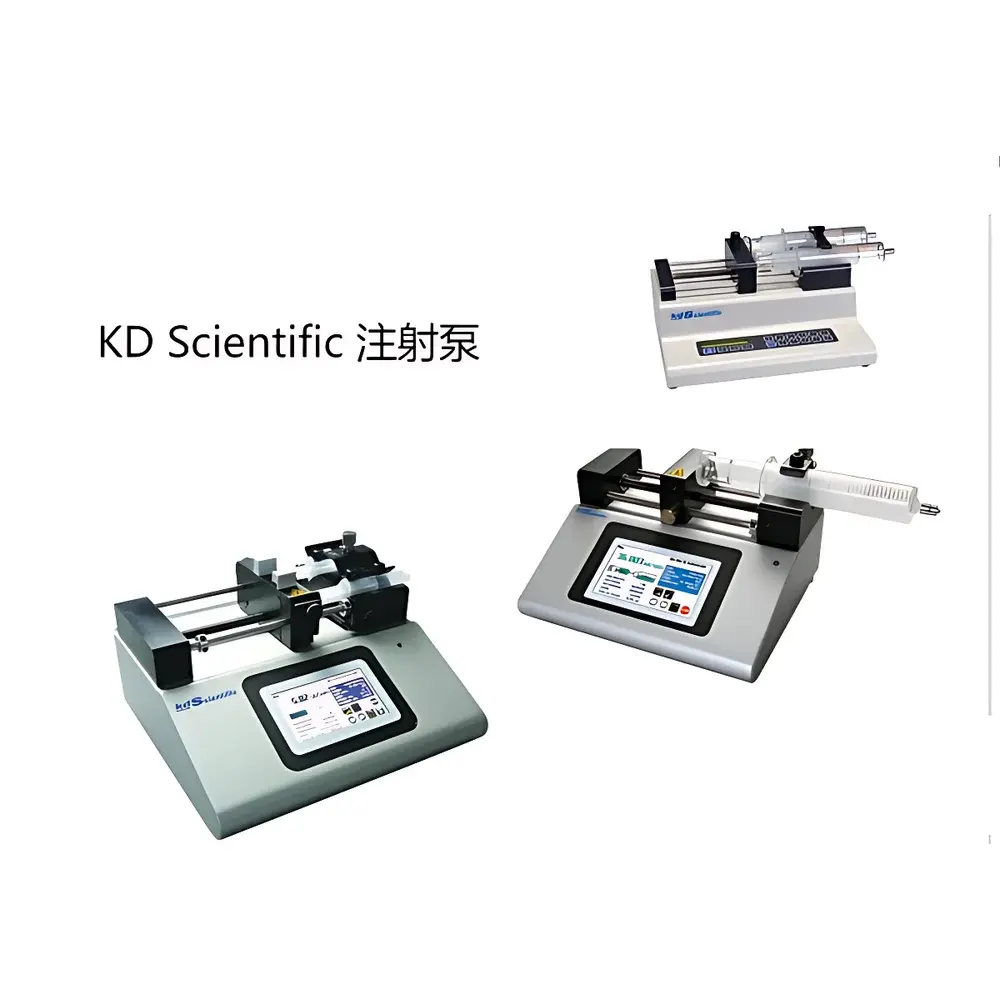
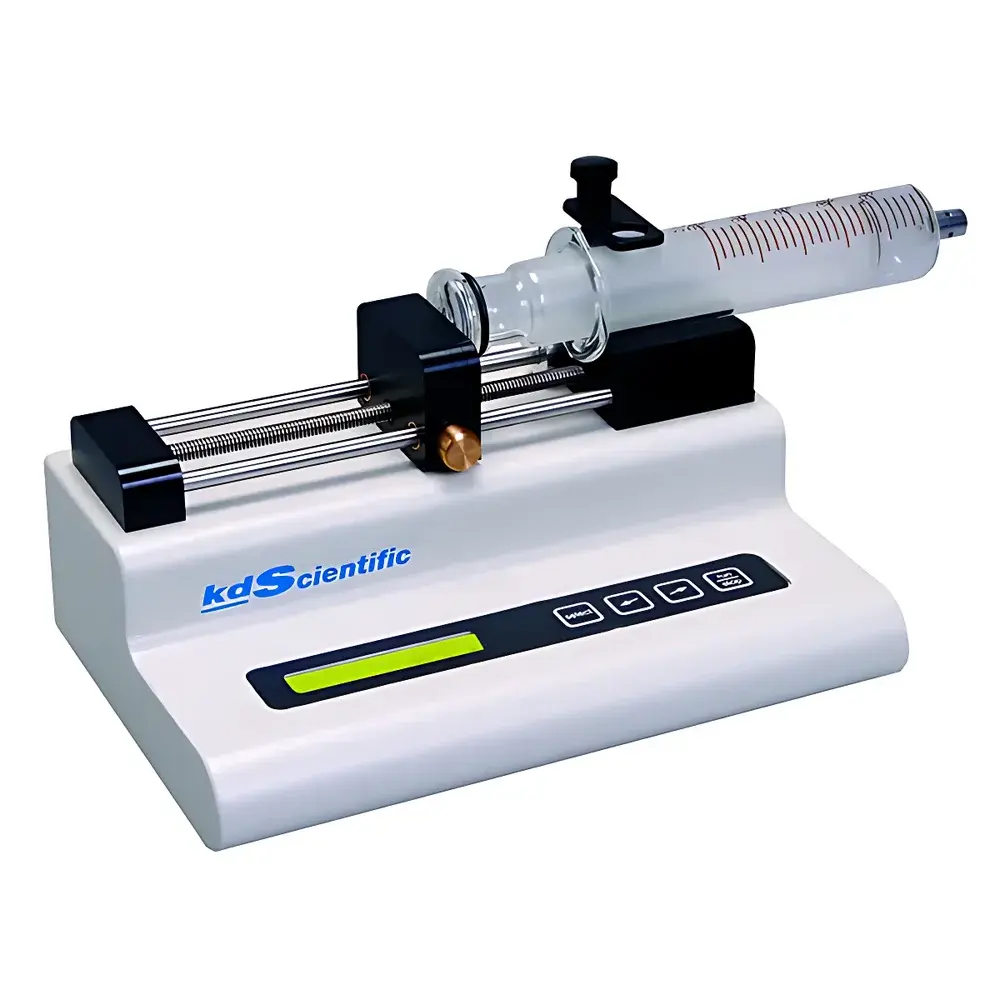
KD Scientific KDS Legacy Syringe Pump
| Brand | KD Scientific |
|---|---|
| Origin | USA |
| Model | KDS Legacy Series (Single/Dual/Multi-Channel) |
| Flow Rate | 0.001 µL/h |
| Accuracy | <1% |
| Repeatability | ±1% |
| Compliance | CE-certified |
| Drive Force | Up to 18 kg (40 lb) |
| Syringe Capacity Range | 10 µL – 140 mL |
| Control Interface | Front-panel menu, PC (RS232/USB), footswitch, and external valve triggers |
Overview
The KD Scientific KDS Legacy Syringe Pump is a precision-engineered fluid delivery system designed for demanding laboratory and industrial applications requiring ultra-low flow rates, high volumetric accuracy, and pulseless infusion or withdrawal. Built upon decades of microfluidic actuation expertise, the KDS Legacy platform employs a stepper motor–driven lead-screw mechanism coupled with optical encoder feedback to ensure closed-loop positional control of the syringe plunger. This architecture eliminates flow pulsation inherent in peristaltic or diaphragm-based systems—making it especially suitable for electrophysiology, microdialysis, HPLC sample introduction, nanoliter-scale drug dosing, and long-duration perfusion experiments where flow stability directly impacts data integrity. As a legacy product line developed prior to KD Scientific’s 2004 acquisition by Harvard Bioscience, Inc. (NASDAQ: HBIO), the KDS Legacy series retains its original firmware architecture and mechanical design, offering proven reliability across thousands of peer-reviewed publications in journals such as Nature Neuroscience, Journal of Chromatography A, and Lab on a Chip.
Key Features
- Pulseless, continuous fluid delivery enabled by precision-machined lead-screw actuation and real-time plunger position monitoring
- Wide syringe compatibility—from 10 µL glass capillaries to 140 mL polypropylene barrels—with automatic stroke calibration based on selected syringe geometry
- Front-panel menu interface with intuitive navigation; no software installation required for basic operation
- Multi-mode control support: local keypad, RS232/USB serial communication (SCPI-compliant), footswitch activation, and TTL-triggered valve synchronization
- Non-volatile parameter memory: all user-defined settings—including volume, rate, direction, and acceleration profiles—are retained after power cycling
- Real-time display of elapsed volume, remaining volume, and instantaneous flow rate with automatic stop upon target volume completion
- Robust mechanical construction rated for continuous duty cycles; single-channel models deliver up to 9 kg (20 lb) linear force, multi-channel variants up to 18 kg (40 lb)
Sample Compatibility & Compliance
The KDS Legacy series supports standard Luer-lock and small-bore syringes manufactured from glass, polypropylene, or PTFE-lined materials. It accommodates syringe inner diameters ranging from 0.5 mm to 25 mm, enabling use with low-volume microsyringes (e.g., Hamilton 10 µL) as well as large-capacity reservoirs (e.g., BD 140 mL). All models comply with CE marking requirements under Directive 2014/30/EU (EMC) and 2014/35/EU (LVD), confirming electromagnetic compatibility and electrical safety for laboratory environments. While not explicitly validated for GMP manufacturing, the pump’s deterministic control logic, traceable calibration routines, and audit-ready operational logs align with GLP documentation practices. For regulated workflows, optional third-party IQ/OQ protocols are available to support FDA 21 CFR Part 11 compliance when integrated with validated data acquisition software.
Software & Data Management
The KDS Legacy operates natively via ASCII-based SCPI commands over RS232 or USB virtual COM port, allowing seamless integration with LabVIEW, MATLAB, Python (pySerial), or custom C++ applications. Harvard Bioscience provides the legacy KDS Control Software (v3.x), which enables synchronized multi-pump sequencing, time-stamped event logging, and export of CSV-formatted runtime data including timestamp, commanded rate, actual position, and error flags. All firmware versions retain backward compatibility with original configuration files, ensuring reproducibility across instrument generations. No cloud connectivity or proprietary drivers are required—operation remains fully offline and deterministic, minimizing cybersecurity exposure in sensitive research networks.
Applications
- Neuroscience: Continuous intracerebral microinfusion in awake, freely moving rodent models
- Analytical chemistry: Low-flow gradient elution in nano-LC and capillary electrophoresis
- Cell biology: Precise media exchange in microfluidic organ-on-chip platforms
- Materials science: Controlled deposition of polymer solutions during electrospinning or inkjet printing R&D
- Pharmacology: Subcutaneous or intravenous bolus-and-infusion regimens in preclinical PK/PD studies
- Environmental testing: Calibration of gas-phase analyzers using liquid standards delivered via permeation tubes
FAQ
Is the KDS Legacy compatible with third-party syringes?
Yes—any Luer-lock or Luer-slip syringe with a rigid barrel and plunger rod meeting ISO 594-1/2 specifications can be mounted, provided its outer diameter falls within the supported range (6–25 mm).
What is the minimum programmable increment for flow rate?
The smallest resolvable rate step is 0.001 µL/h, achievable on KDS200, KDS210, KDS250, KDS260, KDS270, and KDS220/230 models.
Does the pump support bidirectional operation (infuse and withdraw)?
Dual- and multi-channel models (KDS120, KDS210, KDS260, KDS270, KDS230) provide full reversible drive capability with independent rate control per channel.
Can multiple KDS Legacy pumps be synchronized?
Yes—via master/slave TTL triggering or coordinated SCPI command sequences issued through a common host PC, enabling phase-aligned start/stop and ramp transitions across up to ten channels.
Is firmware upgrade support still available?
Harvard Bioscience maintains archival firmware binaries and technical bulletins for all KDS Legacy models; however, no new feature development is planned, consistent with end-of-life maintenance policies for legacy instrumentation.



