
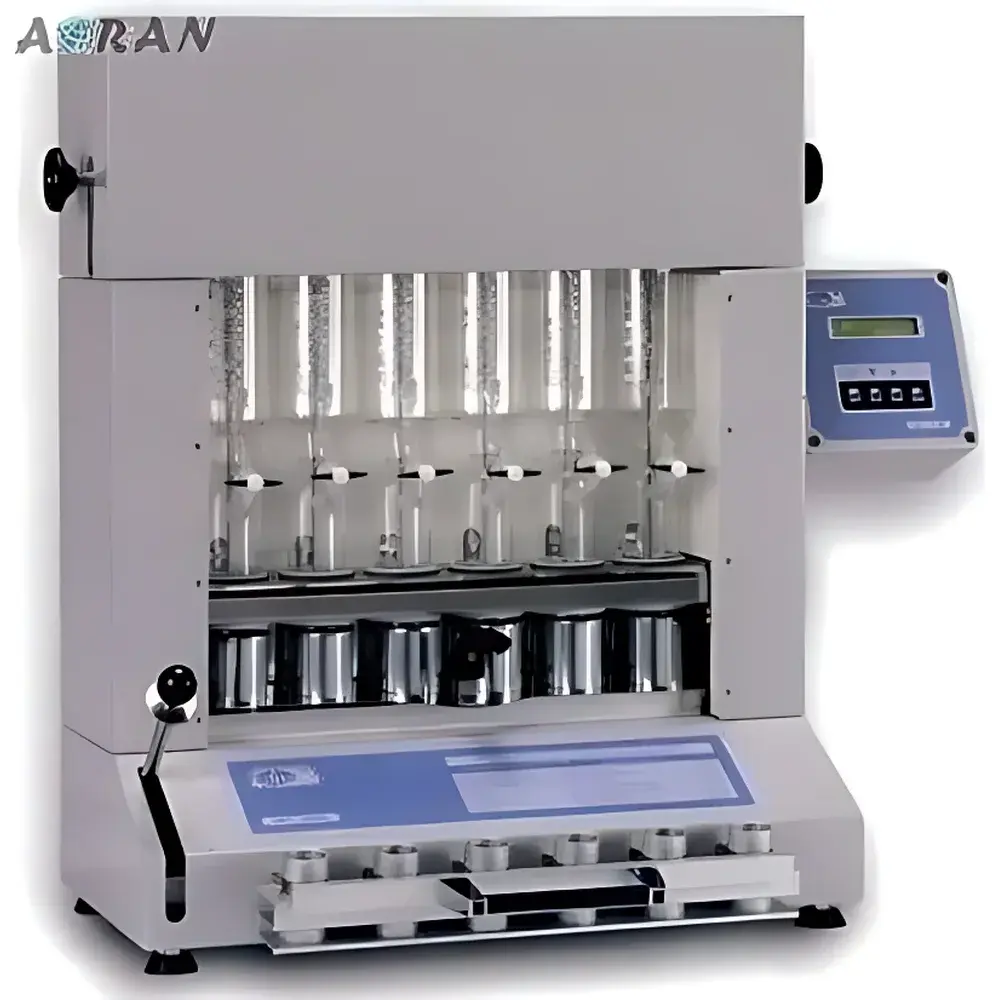
Selecta Det-gras N Fat Extraction System
| Brand | Selecta |
|---|---|
| Origin | Spain |
| Model | Det-gras N |
| Temperature Range | 90–240 °C |
| Number of Extraction Channels | 6 |
| Solvent Recovery Rate | 60–80% |
| Maximum Solvent Volume per Channel | 50 mL |
| Programmable Methods | 16 |
| Extraction Time Range | 0–99 min |
| Display | Dual-line LCD |
| Control Interface | 4-button keypad |
| Compatible Solvents | Petroleum Ether, Diethyl Ether, n-Hexane, Acetone, Acetonitrile |
| Solvent Adapters | 2 sets included |
| Heating Method | Electric, Uniform Resistive Heating |
| Safety Features | Overtemperature Protection |
| Construction | Steel Frame with Epoxy Resin Chemical-Resistant Coating |
| Extraction Vessels | Glass or Cellulose Filter Cartridges |
Overview
The Selecta Det-gras N Fat Extraction System is a fully automated, six-channel benchtop instrument engineered for quantitative fat determination in solid and semi-solid matrices using the classical Soxhlet extraction principle. It operates on continuous reflux extraction thermodynamics—where solvent vapor condenses and percolates repeatedly through a sample contained in a thimble, enabling exhaustive lipid dissolution and recovery. Unlike manual Soxhlet setups, the Det-gras N integrates precise thermal control, programmable cycle timing, and solvent recycling to deliver reproducible results aligned with standardized methodologies including AOAC 920.39, ISO 1444, and USDA Grains and Forage Analytical Procedures. Designed for routine QC laboratories in food, feed, aquaculture, and agricultural research, the system delivers consistent extraction efficiency while reducing operator dependency and method variability.
Key Features
- Six independent extraction channels enable parallel processing of up to six samples without cross-contamination or thermal interference.
- Precise electric heating system with ±1 °C temperature stability across the full 90–240 °C operating range—critical for optimizing solvent boiling point and extraction kinetics.
- Integrated solvent recovery circuit achieves 60–80% condensate return efficiency, minimizing reagent consumption and waste generation in compliance with ISO 14001 laboratory environmental management guidelines.
- Chemically inert epoxy-coated steel chassis resists corrosion from halogenated and aliphatic solvents, ensuring long-term structural integrity in high-throughput environments.
- Dual-line LCD display and intuitive 4-button interface support rapid method selection, real-time parameter monitoring (temperature, elapsed time, active program), and immediate adjustment without software dependency.
- Pre-programmed storage for 16 user-defined methods—including solvent-specific ramp profiles, hold durations, and cooling delays—supports audit-ready traceability under GLP and ISO/IEC 17025 requirements.
- Overtemperature cut-off protection activates automatically at preset safety thresholds, meeting IEC 61010-1 electrical safety standards for laboratory equipment.
Sample Compatibility & Compliance
The Det-gras N accommodates standard glass or cellulose filter cartridges (diameter: 25–33 mm), compatible with homogenized, dried, and defatted matrices such as meat tissue, fish meal, cereal grains, pet food, dairy powders, and botanical extracts. Its design conforms to recognized fat analysis protocols: AOAC Official Method 920.39 (crude fat in animal feed), ISO 1444:2000 (animal feeding stuffs), and USP residual solvent guidance when paired with appropriate GC validation. All solvent handling components are rated for use with petroleum ether (bp 40–60 °C), diethyl ether (bp 34.6 °C), n-hexane (bp 69 °C), acetone (bp 56 °C), and acetonitrile (bp 82 °C), with dedicated adapters provided for low- and high-boiling-point solvent configurations.
Software & Data Management
While the Det-gras N operates as a standalone hardware platform without proprietary PC software, its embedded firmware supports full method traceability via on-device logging. Each run records timestamp, selected program ID, setpoint temperature, actual measured temperature (averaged over 30-second intervals), total extraction duration, and completion status. Export is facilitated via manual transcription or optional RS-232 interface (available upon request) for integration into LIMS or ELN systems compliant with FDA 21 CFR Part 11—provided digital signature and audit trail functionality are implemented at the host level. Calibration certificates and factory test reports are supplied with each unit to support ISO/IEC 17025 accreditation documentation.
Applications
- Routine crude fat quantification in commercial feed mills and veterinary nutrition labs per AOAC and FEDIAF standards.
- Quality control of edible oils, processed meats, and snack foods during production line release testing.
- Fat content validation in aquaculture feed formulations to ensure optimal energy density for species-specific growth models.
- Research-scale lipid profiling in plant seed analysis, where reproducibility across multiple genotypes is essential.
- Regulatory compliance testing for labeling accuracy under EU Regulation (EU) No 1169/2011 and FDA Nutrition Facts requirements.
FAQ
What extraction principle does the Det-gras N employ?
It implements the Soxhlet reflux extraction principle, combining cyclic solvent condensation, percolation, and siphoning to achieve exhaustive fat dissolution with minimal manual intervention.
Is the system compatible with EPA or ASTM methods?
Yes—its operational parameters align with ASTM D2974 (moisture, ash, and organic matter in peat and other organic soils) and EPA Method 3541 (Soxhlet extraction for semivolatile organics), subject to lab-specific validation.
Can the Det-gras N be used for moisture or ash analysis?
No—it is purpose-built for fat extraction only; separate gravimetric or furnace-based instrumentation is required for moisture or ash determination.
What maintenance is required for long-term reliability?
Routine cleaning of condenser jackets and solvent reservoirs with compatible solvents, annual verification of temperature sensor calibration, and periodic inspection of gasket integrity are recommended per manufacturer’s service schedule.
Does the unit include solvent disposal guidance?
Yes—the user manual provides solvent-specific handling, containment, and waste segregation recommendations consistent with CLP Regulation (EC) No 1272/2008 and local hazardous waste ordinances.



