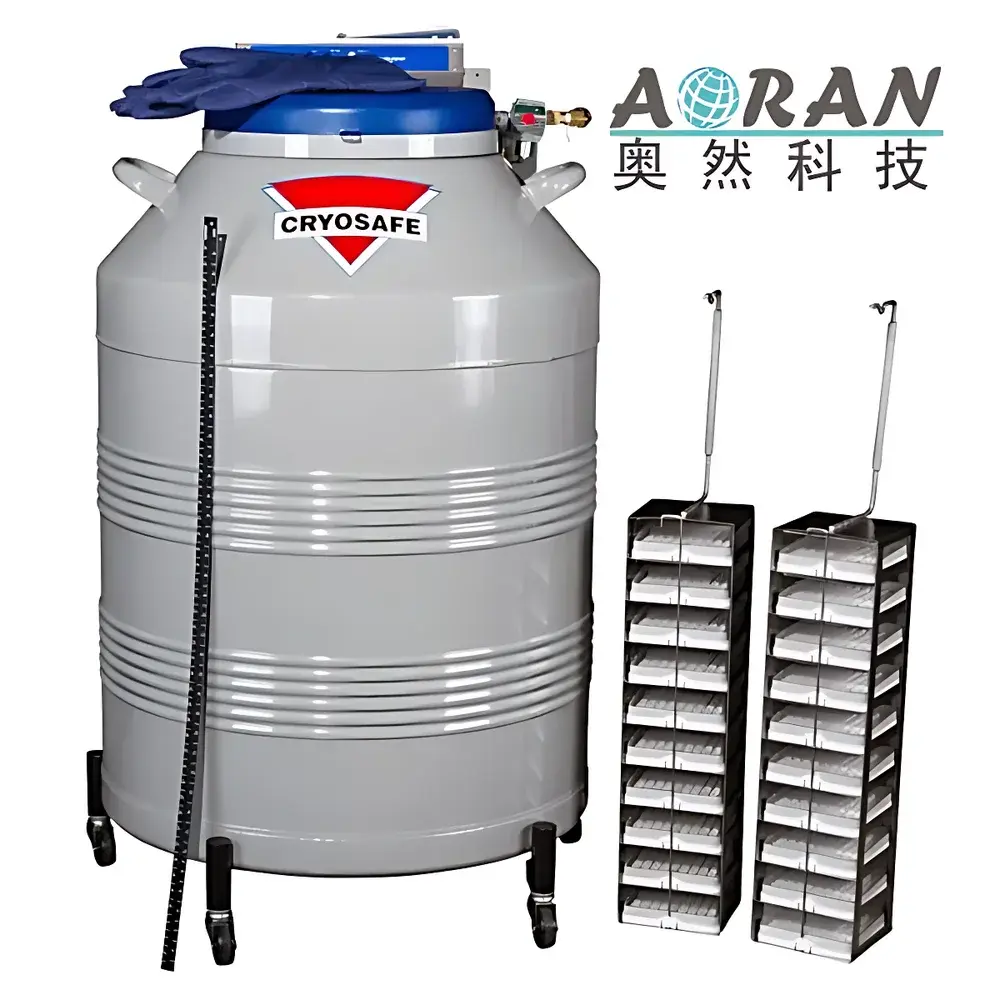
Cryosafe T-cryo Auto-Fill Liquid Nitrogen Storage System
| Brand | Cryosafe |
|---|---|
| Origin | USA |
| Model | T-cryo |
| Type | Auto-fill Biological LN₂ Storage Tank |
| Capacity | 165 L |
| Evaporation Rate | 0.84 L/day |
| Hold Time | 194 days (typical) |
| Sample Capacity | 7,000 × 2 mL vials |
| Vapor Phase Temp | −135 °C |
| Liquid Phase Temp | −185 °C |
| Neck Opening Diameter | 216 mm |
| Height | 991 mm |
| Outer Diameter | 683 mm |
| Empty Weight | 55 kg |
| Full Weight | 186.4 kg |
| Shipping Weight | 114 kg |
| Standard Configuration Includes | Main tank, Auto-Tend auto-fill system, cryogenic racks, castor-mounted base, and supply hose |
Overview
The Cryosafe T-cryo Auto-Fill Liquid Nitrogen Storage System is an engineered solution for long-term, ultra-low-temperature biological sample preservation in research and clinical laboratories. Designed around a high-efficiency vacuum-insulated double-walled stainless steel dewar architecture, the T-cryo operates in both vapor-phase (−135 °C) and liquid-phase (−185 °C) modes—enabling flexible storage strategies aligned with biospecimen integrity requirements. Its core innovation lies in the integrated Auto-Tend system: a closed-loop, pressure-regulated nitrogen replenishment mechanism that continuously monitors internal liquid level via capacitive sensing and triggers automated refilling from an external LN₂ source when thresholds are breached. This eliminates manual top-offs, mitigates thermal shock during access, and ensures stable temperature gradients across the entire storage volume—critical for sensitive cell lines, stem cells, oocytes, and genomic libraries.
Key Features
- Auto-Tend intelligent fill control: Real-time liquid nitrogen level monitoring with programmable setpoints, pneumatic valve actuation, and fail-safe pressure regulation.
- Dual-mode thermal management: Optimized vapor-phase storage minimizes cross-contamination risk while maintaining −135 °C uniformity; liquid-phase mode delivers maximum thermal stability at −185 °C.
- Low-evaporation design: Advanced multilayer superinsulation and optimized neck geometry reduce average evaporation to 0.84 L/day under ISO 23530-compliant ambient conditions (20 °C, 50% RH, minimal door cycling).
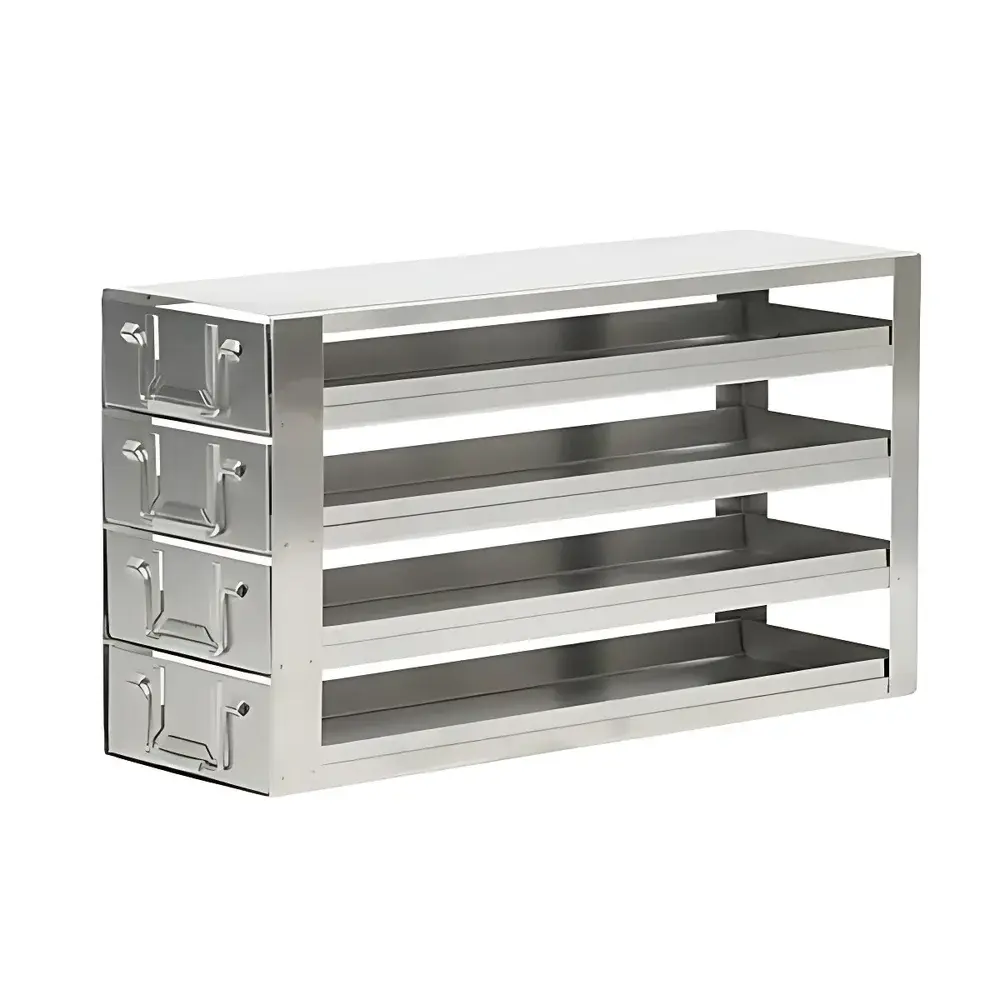
- Scalable sample organization: Supports up to 70 standard 10×10 cryoboxes (7,000 × 2 mL vials) on seven adjustable stainless-steel racks, each accommodating ten boxes per tier.
- Safety-integrated interface: Visual/audible low-level alarms, remote notification capability via dry-contact relay output, and mechanical safety lockout preventing access during active fill cycles.
- Lab-ready mobility: Castor-mounted base (T-CAT7) or full-height wheeled trolley (T-CAT7-PS/T-CAT7-CS) enables safe relocation without disassembly; includes reinforced braided LN₂ transfer hose rated to −196 °C.
Sample Compatibility & Compliance
The T-cryo accommodates standard ANSI/SLAS-formatted cryovials (0.5–5.0 mL), cryoboxes (plastic or paper), and cryostraws used in reproductive medicine and biobanking. All internal components comply with USP for extractables profiling and meet ISO 13485:2016 material biocompatibility requirements. The Auto-Tend system supports GLP/GMP-aligned operational traceability through optional event logging (start/stop timestamps, fill duration, volume dispensed) and integrates with laboratory infrastructure via 4–20 mA analog output or Modbus RTU for centralized environmental monitoring systems. While not FDA-cleared as a medical device, the system conforms to ASTM F2697-22 for cryogenic storage equipment performance validation and supports audit readiness for CAP, CLIA, and ISO 20387 biobank accreditation.
Software & Data Management
The T-cryo operates autonomously without embedded firmware or cloud connectivity; its control logic resides in a hardened industrial PLC with non-volatile memory. Optional data acquisition modules (sold separately) enable integration with LabVantage, STARLIMS, or custom LIMS platforms via RS-485 or Ethernet/IP. Event logs—including fill events, alarm triggers, and manual override actions—are timestamped to millisecond precision and stored locally for ≥30 days. Audit trails satisfy 21 CFR Part 11 requirements when paired with validated electronic signature workflows and role-based access controls implemented at the host system level.
Applications
- Long-term archival of primary human tissues, PBMCs, and induced pluripotent stem cells (iPSCs) under vapor-phase conditions compliant with ISBER Best Practices.
- Clinical embryo and sperm banking where consistent −135 °C exposure prevents ice recrystallization during extended storage.
- High-throughput biorepositories requiring uninterrupted cold chain continuity across shift changes and weekends.
- Pharmaceutical stability studies involving cryopreserved reference standards and assay reagents.
- Academic core facilities serving multiple PIs with variable usage patterns—Auto-Tend eliminates staffing dependency for routine LN₂ maintenance.
FAQ
What is the difference between vapor-phase and liquid-phase storage in the T-cryo?
Vapor-phase operation maintains samples above the liquid surface within a thermally stratified cold gas column at −135 °C, reducing contamination risk and enabling safer handling. Liquid-phase immersion achieves −185 °C but requires strict adherence to biosafety protocols for pathogen containment.
Can the Auto-Tend system be disabled for manual operation?
Yes—the system includes a physical bypass switch and configurable software lockout to permit fully manual fill procedures during maintenance or validation runs.
Is the T-cryo compatible with liquid nitrogen delivery from bulk tanks or dewars?
It interfaces with standard CGA-580 connectors and accepts inlet pressures from 10–100 psi; compatibility with common bulk supply manifolds (e.g., Chart, Linde, Air Products) is verified per manufacturer specifications.
How often does the system require calibration or preventive maintenance?
Capacitive level sensors are factory-calibrated and require no field recalibration. Annual inspection of O-rings, valve actuators, and vacuum integrity (via helium leak testing) is recommended per ISO 23530 Annex B.
Does the T-cryo support remote monitoring via network protocols?
Native Ethernet or Wi-Fi capability is not included; however, third-party I/O gateways (e.g., Advantech ADAM-6000 series) can bridge the 4–20 mA or dry-contact outputs into SNMP or MQTT-enabled infrastructure.