
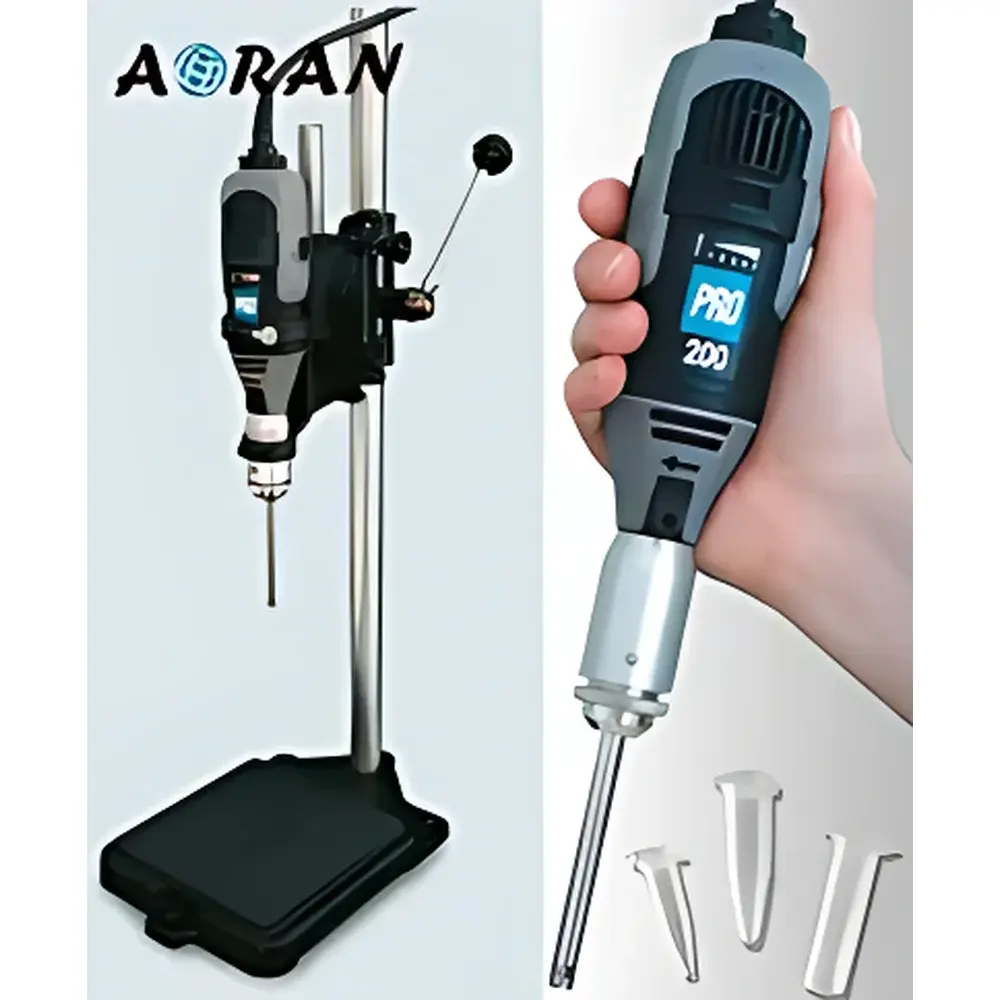
PRO PRO200 Handheld and Benchtop Dual-Mode Rotational Homogenizer
| Brand | PRO |
|---|---|
| Origin | USA |
| Model | PRO200 |
| Instrument Type | Probe-type Rotor-Stator Homogenizer |
| Dimensions (W×D×H) | 54 × 203 × 44 mm |
| Weight | 0.5 kg |
| Speed Range | 5,000–30,000 rpm |
| Power | 125 W |
| Sample Volume Capacity | 0.03–1,000 mL (dependent on rotor selection) |
| Speed Control | Analog continuous adjustment |
| Rotor Interface | Quick-connect system compatible with ≥12 standardized stainless steel rotors |
Overview
The PRO PRO200 is a dual-mode rotational homogenizer engineered for precision mechanical disruption of biological, chemical, and pharmaceutical samples in both handheld and benchtop configurations. It operates on the rotor-stator principle—where high-speed rotation of a precisely fitted probe (rotor) within a concentric stationary sleeve (stator) generates intense shear forces, cavitation, and turbulent flow to achieve efficient cell lysis, emulsification, dispersion, and homogenization. Designed for laboratories requiring flexibility across sample throughput scales—from microliter-volume tissue biopsies to liter-scale suspension preparations—the PRO200 delivers consistent energy input across its full 5,000–30,000 rpm operational range. Its compact footprint (54 × 203 × 44 mm) and lightweight construction (0.5 kg) support ergonomic handheld use, while optional benchtop mounting enables reproducible, hands-free operation under controlled conditions.
Key Features
- High-torque 125 W motor ensures stable speed maintenance under variable load conditions, critical for viscous or particulate-laden samples.
- Analog speed control provides smooth, stepless adjustment with immediate response—eliminating digital latency and enabling real-time optimization during sensitive protocols.
- Quick-connect rotor interface supports rapid, tool-free exchange of ≥12 standardized stainless steel probes—including flat-tip (5 × 75 mm), serrated-tip (7 × 95 mm), and Multi-Gen 7 series configurations—each certified for autoclaving (121°C, 20 min), dry heat sterilization (180°C), flame sterilization, and chemical disinfection (e.g., 70% ethanol, sodium hypochlorite).
- Optional sealed homogenizing chambers minimize aerosol generation and prevent cross-contamination, supporting biosafety Level 2 (BSL-2) compliance and GLP-aligned workflows.
- Benchtop adapter kit enables fixed-angle or vertical positioning; when paired with the PRO200 stand and Multi-Gen 7XL rotor set (12 rotors per pack), it supports parallel processing of up to seven samples without rotor reuse—reducing carryover risk in quantitative PCR, proteomics, or microbiological assays.
Sample Compatibility & Compliance
The PRO200 accommodates diverse sample matrices including mammalian tissues, bacterial pellets, plant extracts, polymer dispersions, and colloidal suspensions. Its rotor-stator architecture is validated for applications requiring ISO 13320-compliant particle size reduction, ASTM D4084-22–based emulsion stability assessment, and USP sterility test preparation. All stainless steel components meet ASTM F899 standards for surgical-grade alloys. The device itself carries CE marking per Directive 2014/30/EU (EMC) and 2014/35/EU (LVD), and complies with IEC 61010-1:2010 safety requirements for laboratory equipment. When operated with traceable calibration records and logged rotor usage history, it supports audit readiness for FDA 21 CFR Part 11–governed environments.
Software & Data Management
While the PRO200 operates via analog control without embedded firmware, its design facilitates integration into regulated data ecosystems. Users may pair it with external RPM loggers or digital tachometers compliant with NIST-traceable calibration standards. For GxP environments, SOPs can mandate manual entry of speed, duration, rotor ID, and sample ID into ELN systems (e.g., LabArchives, Benchling) with electronic signatures. Optional benchtop stands include mounting points for time-lapse cameras or IoT-enabled sensors—enabling metadata-rich workflow documentation aligned with ALCOA+ principles (Attributable, Legible, Contemporaneous, Original, Accurate, Complete, Consistent, Enduring, Available).
Applications
- Pre-analytical sample preparation for DNA/RNA extraction, protein solubilization, and organelle isolation.
- Routine QC homogenization of pharmaceutical suspensions prior to HPLC or dissolution testing.
- Food microbiology: uniform dispersion of foodborne pathogens in enrichment broths per ISO 6579-1:2017.
- Nanomaterial synthesis: stabilization of metal oxide nanoparticles in aqueous media via controlled shear-induced deagglomeration.
- Environmental analysis: extraction of microplastics from sediment matrices using enzymatic-mechanical lysis protocols.
FAQ
Is the PRO200 suitable for sterile processing in a laminar flow hood?
Yes—when equipped with flame-sterilizable or autoclavable rotors and used with a sealed homogenizing chamber, the PRO200 meets ISO 14644-1 Class 5 cleanroom compatibility requirements for aseptic sample handling.
Can rotor wear be monitored quantitatively?
Stainless steel rotors exhibit minimal dimensional drift under routine use; however, visual inspection for pitting or edge deformation—and periodic verification of tip-to-sleeve clearance using calibrated feeler gauges—is recommended per manufacturer’s maintenance schedule.
Does the PRO200 support regulatory-compliant audit trails?
As an analog-controlled instrument, it does not generate native electronic logs—but when integrated with validated external timing devices and documented in controlled SOPs, it satisfies FDA and EMA expectations for instrument qualification under Annex 11 and ICH Q9 frameworks.



