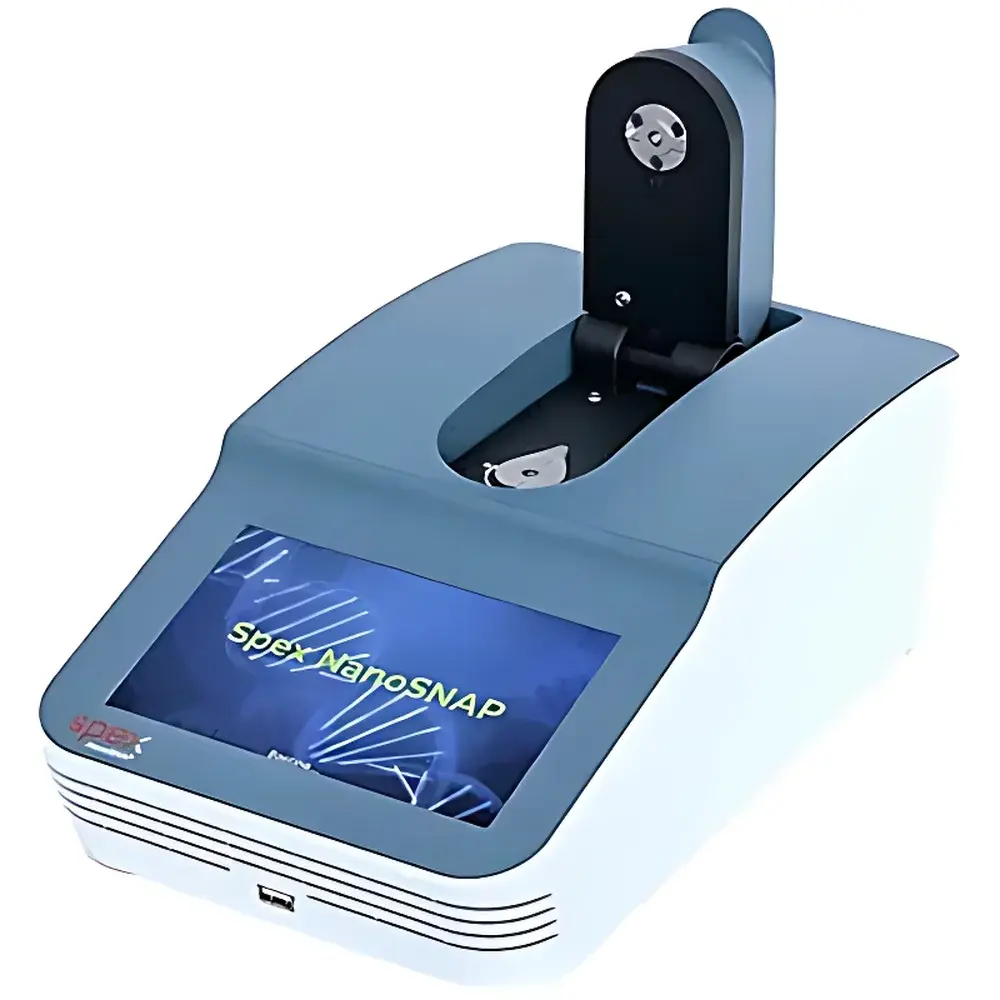
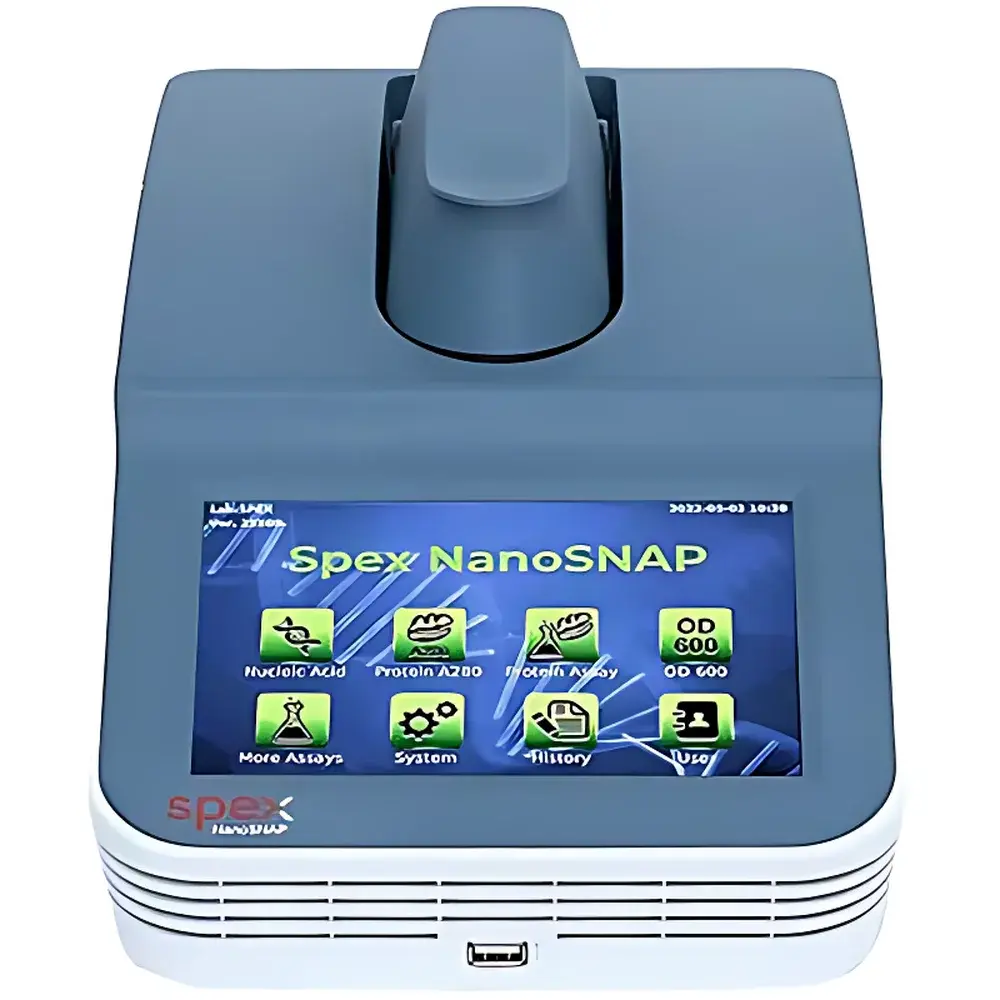
SPEX NanoSNAP Ultra-Micro Spectrophotometer
| Brand | SPEX SamplePrep |
|---|---|
| Origin | Taiwan |
| Model | NanoSNAP |
| Detection Time | 3 s |
| Wavelength Accuracy | ±1 nm |
| LOD (dsDNA) | 2 ng/µL |
| LOD (BSA) | 0.06 mg/mL |
| Sample Volume | 1 µL |
| Sample Types | Nucleic Acids, Proteins |
| Spectral Range | 190–1000 nm |
| Bandwidth (FWHM) | 1.5 nm @ 253.7 nm |
| Stray Light | <0.5% T @ 220 nm & 340 nm (NaNO₂) |
| Absorbance Range | 0.04–400 A |
| Photometric Accuracy | ±3.0% @ 0.75 A, 300 nm |
| Photometric Precision | ±0.0015 A (0.5 mm path) |
| Light Source | Pulsed Xenon Lamp |
| Detector | 2048-element CMOS array |
| Pathlength Options | 0.5 mm / 0.05 mm (dual fixed) |
| Display | 7" capacitive touchscreen, Linux OS |
| Internal Storage | 32 GB |
| Interface | USB port for data export |
| Built-in Applications | dsDNA, ssDNA, RNA quantification |
Overview
The SPEX NanoSNAP Ultra-Micro Spectrophotometer is a benchtop, cuvette-free UV-Vis spectrophotometer engineered for rapid, precise quantification and purity assessment of nucleic acids and proteins in life science laboratories. It operates on the principle of fixed-pathlength absorbance spectroscopy—utilizing dual optical pathlengths (0.5 mm and 0.05 mm) to extend dynamic range without manual dilution or pathlength adjustment. By measuring absorbance across a broad spectral range (190–1000 nm) with a high-stability pulsed xenon lamp and a 2048-element CMOS linear array detector, the instrument delivers high-fidelity spectra with sub-nanometer wavelength resolution and robust photometric linearity. Its design eliminates the need for traditional quartz cuvettes, reducing contamination risk and consumable costs while enabling reliable analysis of as little as 1 µL of undiluted sample—critical for precious clinical isolates, CRISPR editing intermediates, single-cell lysates, and low-yield purification fractions.
Key Features
- Dual fixed-pathlength optics (0.5 mm and 0.05 mm) enabling direct quantification from 2 ng/µL to 20,000 ng/µL dsDNA and 0.06 mg/mL to 600 mg/mL BSA—no dilution required
- Full-spectrum acquisition in <3 seconds per measurement, with real-time baseline correction and automatic peak identification
- Hydrophobic stainless-steel sample stage combined with fused-silica optical window ensures consistent droplet retention and minimal surface adsorption
- Integrated LED-assisted illumination system for visual confirmation of sample deposition and meniscus formation
- 7-inch capacitive touchscreen running embedded Linux OS—intuitive interface with no external PC dependency
- Onboard calculation modules compliant with standard molecular biology conventions: A₂₆₀/A₂₈₀ and A₂₆₀/A₂₃₀ ratios, extinction coefficient-based concentration derivation, and nucleic acid integrity flags
- 32 GB internal flash memory with timestamped audit trails and USB 2.0 export support for raw absorbance data (.csv) and processed reports
Sample Compatibility & Compliance
The NanoSNAP supports native, unmodified nucleic acid and protein samples—including genomic DNA, plasmid preps, in vitro transcription products, synthetic oligonucleotides, purified antibodies, and recombinant enzymes—without buffer exchange or desalting. Its optical architecture accommodates common low-volume buffers (e.g., TE, nuclease-free water, PBS, and Tris-HCl), provided absorbance contributions from buffer components fall within instrument linearity limits. The system meets fundamental requirements for GLP-compliant workflows: all measurements are timestamped, user-identifiable, and stored with full spectral metadata. While not certified for FDA 21 CFR Part 11 out-of-the-box, its data structure supports integration into validated LIMS environments via standardized CSV export, and its photometric performance aligns with ISO 8579-1:2021 (spectrophotometer verification) and ASTM E275-22 (UV-Vis method validation guidelines).
Software & Data Management
The embedded software provides a dedicated application suite for routine nucleic acid and protein workflows: dsDNA/ssDNA/RNA quantification using sequence-agnostic extinction coefficients; OD₆₀₀ cell density estimation; direct UV protein assay at 280 nm; and colorimetric methods (Bradford, BCA, Lowry) with built-in calibration curve fitting. All applications enforce parameter validation (e.g., A₂₆₀ saturation detection, outlier rejection based on spectral shape deviation) and generate PDF-ready reports with embedded spectra, ratio diagnostics, and concentration uncertainty estimates derived from photometric precision specifications. Raw spectral data (wavelength vs. absorbance) is retained in machine-readable format for downstream analysis in Python, R, or third-party bioinformatics platforms.
Applications
- High-throughput QC of next-generation sequencing libraries prior to pooling and loading
- Routine verification of CRISPR guide RNA integrity and Cas9 complex formation
- Quantification of exosome-associated RNA isolated from biofluids (plasma, CSF, saliva)
- Monitoring protein expression yield during E. coli or mammalian transient transfection
- Verification of enzymatic digestion completeness (e.g., restriction digest, DNase I treatment)
- Assessment of RNA degradation status via 230/260/280 spectral profile analysis
- Supporting ISO/IEC 17025-accredited testing labs performing nucleic acid quantification as part of method validation protocols
FAQ
Does the NanoSNAP require calibration with NIST-traceable standards?
Yes—initial factory calibration uses NIST-traceable holmium oxide and didymium filters for wavelength verification, and potassium dichromate solutions for photometric accuracy. Users may perform optional periodic verification using supplied reference standards.
Can the instrument measure turbid or viscous samples such as lysates or glycerol-containing buffers?
Turbidity introduces scattering artifacts that compromise absorbance linearity; we recommend centrifugation or filtration prior to measurement. Glycerol concentrations >10% v/v may affect droplet geometry and should be diluted to ≤5% if pathlength-dependent quantification is required.
Is spectral data export compatible with third-party analysis tools like GraphPad Prism or Python’s SciPy?
Yes—CSV exports contain wavelength (nm) and absorbance (A) columns with header metadata, enabling direct ingestion into MATLAB, Python (pandas/numpy), R, or commercial graphing software without format conversion.
How does the dual-pathlength design improve measurement reliability compared to variable-pathlength systems?
Fixed pathlengths eliminate mechanical hysteresis and alignment drift associated with motorized stages. The 0.05 mm pathlength extends lower detection limits without compromising upper-range linearity, while the 0.5 mm pathlength maintains signal-to-noise ratio for concentrated samples—both paths are optically characterized and corrected in firmware.
What maintenance is required to ensure long-term photometric stability?
No routine lamp replacement is needed—the pulsed xenon source has a rated lifetime exceeding 10⁹ flashes. Annual verification of wavelength accuracy and photometric linearity using supplied check standards is recommended for regulated environments.
Related Products