
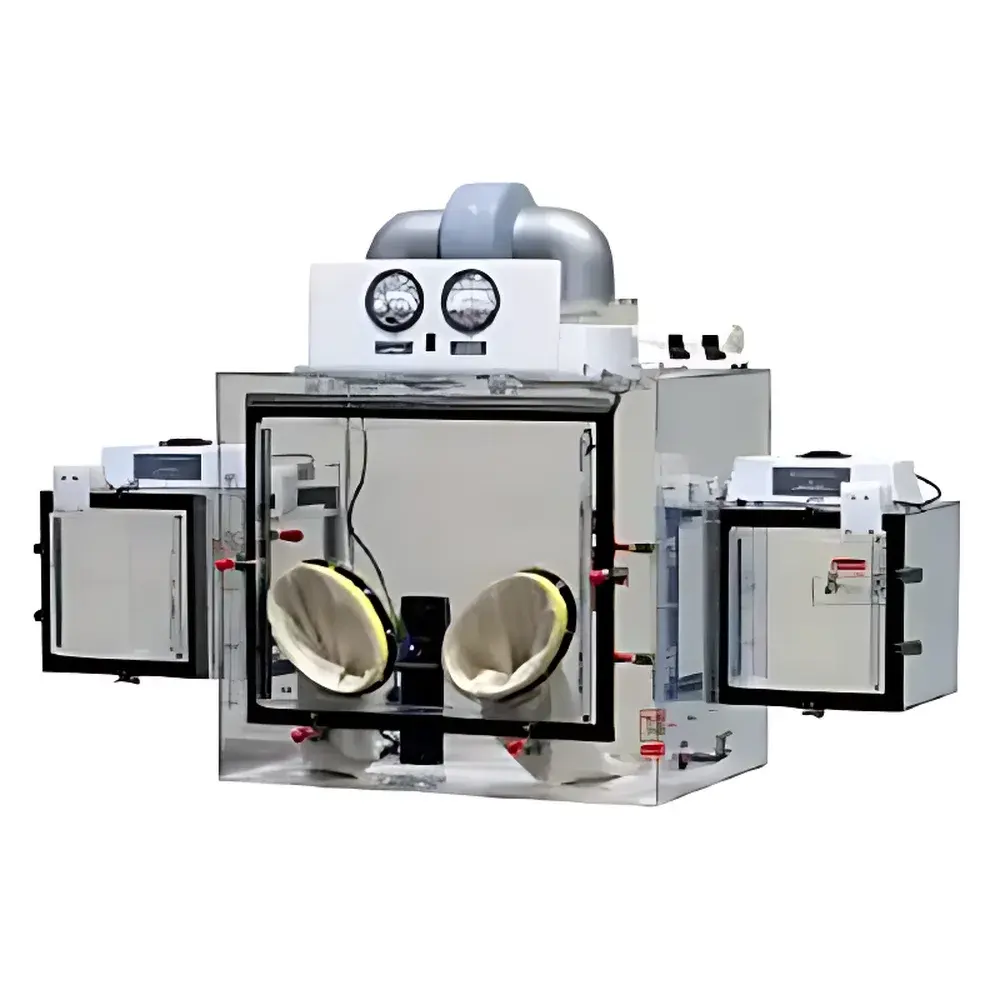
Plas-Labs 840-PH-10 Dust Control Glove Box
| Brand | Plas-Labs |
|---|---|
| Origin | USA |
| Model | 840-PH-10 |
| Cabinet Material | Acrylic (10 mm thick) |
| Dimensions (L×W×H) | 876 × 610 × 762 mm |
| Cabinet Volume | 407 L |
| Transfer Chamber Volume | 47 L |
| Glove Quantity | 1 pair |
| Relative Humidity | 9.4% RH |
| Filtration | Dual-stage HEPA recirculation system |
| Compliance | ISO 14644-7 Class 1 (Leakage rate ≤ 5×10⁻⁴) |
Overview
The Plas-Labs 840-PH-10 Dust Control Glove Box is an engineered containment solution designed for handling low-to-moderate hazard particulate materials in laboratory and pilot-scale production environments. Unlike inert-atmosphere glove boxes, this unit operates under ambient air conditions with a closed-loop, dual-stage HEPA filtration system to maintain ISO 14644-7 Class 1 cleanroom-equivalent internal particle concentration (≤35 particles/m³ for ≥0.5 µm). Its primary function is physical containment—not chemical or oxygen exclusion—making it ideal for powder weighing, micronization, dry blending, and cytotoxic compound manipulation where operator protection from inhalable dust is critical. The cabinet utilizes laminar airflow principles within the recirculation path, with differential pressure monitoring ensuring consistent inward flow at all access points. Structural integrity is maintained via 10 mm thick optical-grade acrylic panels bonded to a rigid white acrylic base, offering >92% visible light transmission and resistance to static charge accumulation.
Key Features
- Robust 10 mm thick acrylic construction with seamless bonding and UV-stabilized formulation for long-term clarity and impact resistance
- Hinged front access door with integrated elliptical polypropylene glove ports and mechanical latch system for positive closure verification
- White Hypalon® gloves (chemically resistant, low-permeability elastomer) mounted on standardized flanges for rapid replacement and leak-tight sealing
- Dual-stage HEPA filtration (≥99.99% @ 0.3 µm) with manual isolation ball valve in filter housing for safe maintenance and validation
- Integrated differential pressure gauge with fan on/off control enabling real-time verification of negative pressure differential across the cabinet boundary
- Two removable, high-transparency acrylic transfer chambers (17″ W × 13″ D × 13″ H) featuring magnetic interlocked doors and ISO-compliant gasketing
- Built-in ionizing blower (#800–AS/SPI) mounted beneath the work surface to neutralize electrostatic charges on powders and surfaces
- Single concealed 120 VAC GFCI outlet with internal cable routing; no external conduit required
- Factory-certified leakage test report provided per ISO 14644-7 Annex B, confirming maximum allowable leakage fraction (Tf ≤ 5×10⁻⁴)
Sample Compatibility & Compliance
The 840-PH-10 accommodates dry, non-volatile, non-corrosive particulates including pharmaceutical APIs, metal oxides, ceramic precursors, and polymer powders. It is not rated for solvent vapors, pyrophoric substances, or biological aerosols. All materials in direct contact with the process environment—including gloves, gaskets, and interior surfaces—comply with USP for plastic packaging components. The system meets ISO 14644-7 requirements for containment performance classification and supports GLP documentation workflows through traceable leakage certification and configurable operational logs. While not intrinsically rated for explosion-proof use, its static-dissipative design and ionization module reduce ignition risk during handling of combustible dusts per NFPA 77 guidance.
Software & Data Management
This model operates as a standalone mechanical containment platform without embedded microprocessors or digital controllers. All operational parameters—including fan status, pressure differential, and transfer chamber door state—are monitored via analog instrumentation. For regulated environments, users may integrate external data loggers (e.g., Vaisala HMP7 series) with the differential pressure port and humidity sensor output (9.4% RH baseline verified at 23°C/50% RH ambient) to generate 21 CFR Part 11-compliant audit trails. Calibration certificates for the pressure gauge and leakage test report are supplied with each unit and archived in the manufacturer’s quality management system (QMS) per ISO 9001:2015.
Applications
- USP and compliant handling of hazardous drug powders during compounding and packaging
- ISO 13485-aligned device manufacturing where particulate shedding must be isolated from cleanroom corridors
- Material science labs processing nanoscale ceramics or battery electrode materials requiring sub-10% RH environments
- Quality control laboratories performing sieve analysis, loss-on-drying, or bulk density measurements on hygroscopic powders
- Academic research facilities conducting inhalation toxicology pre-screening with controlled aerosol generation
FAQ
Does the 840-PH-10 support inert gas purging?
No. This model is specifically configured for ambient-air recirculation with HEPA filtration and does not include gas inlet/outlet valves, purge controls, or O₂/H₂O sensors.
Can the transfer chambers be used independently of the main cabinet?
Yes—the two square transfer modules are fully self-contained with independent magnetic latches and gasketed seals, allowing for validated material handoff between separate work areas.
Is the ionizer compatible with conductive or dissipative flooring requirements?
The #800–AS/SPI ionizer is ESD Association S20.20 compliant and includes grounding provisions; integration with facility grounding grids is required for full electrostatic control efficacy.
What maintenance intervals are recommended for the HEPA filters?
Filter replacement frequency depends on particulate load; Plas-Labs recommends differential pressure monitoring and scheduled replacement every 6–12 months, validated via post-change leakage testing per ISO 14644-3.
Does the unit meet FDA expectations for containment validation in pharmaceutical manufacturing?
Yes—when operated per SOP and supported by documented leakage testing, pressure decay studies, and operator gowning protocols, it satisfies FDA’s Process Validation Guidance (2011) and ICH Q5C recommendations for physical barrier systems.



