
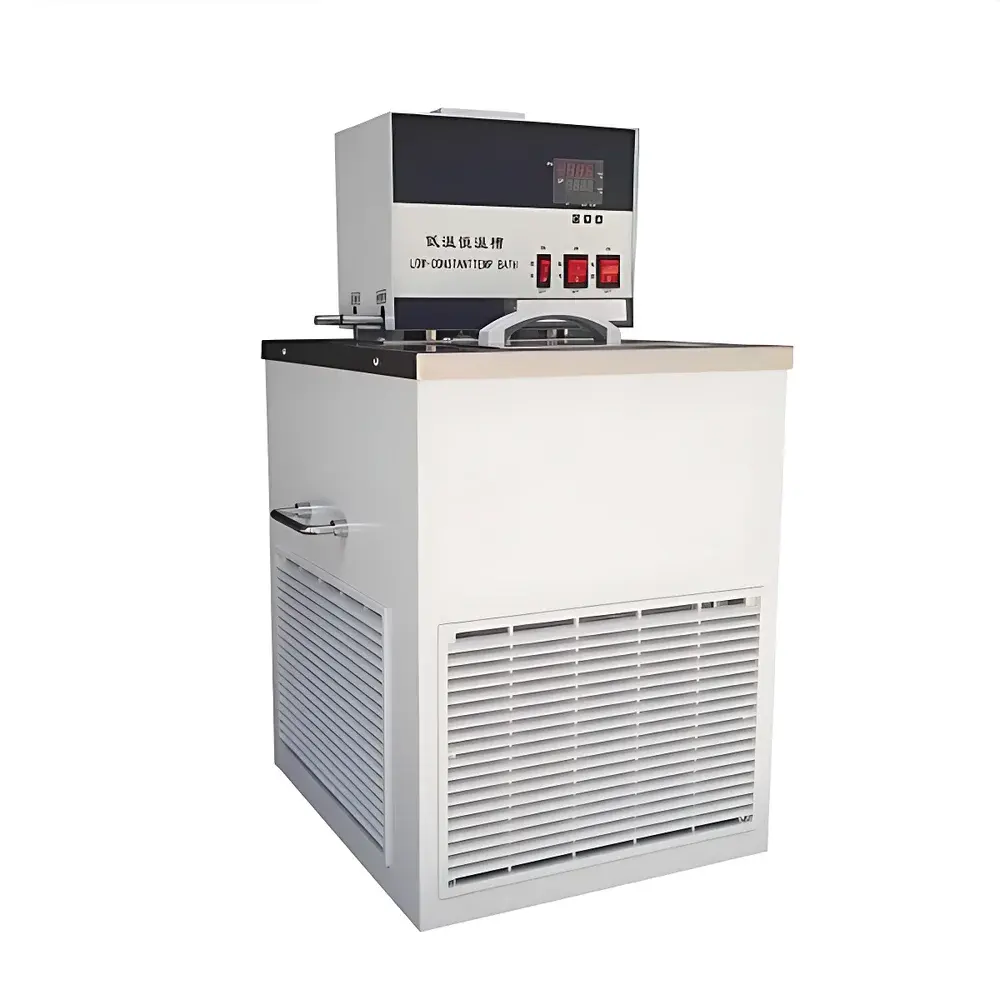
Tianfeng TF-DC-0510 Advanced Low-Temperature Circulating Bath
| Brand | Tianfeng |
|---|---|
| Origin | Shanghai, China |
| Manufacturer Type | Direct Manufacturer |
| Instrument Type | Circulating Constant-Temperature Bath |
| Circulation Mode | Internal & Optional External Circulation |
| Temperature Control | Refrigeration & Heating Dual-Mode |
| Bath Volume | 10 L |
| Temperature Range | −5 °C to 100 °C |
| Temperature Stability | ±0.05 °C (at 25 °C, water or ethanol) |
| Display Resolution | 0.1 °C |
| Control Algorithm | Self-Tuning PID via Microprocessor |
| Temperature Sensor | Imported Pt100 Platinum Resistance Thermometer |
| Refrigeration System | Hermetically Sealed Compressor |
| Pump Flow Rate | 8 L/min (internal), up to 10 L/min (external with optional upgrade) |
| Construction | 304 Stainless Steel Inner Chamber & Deck |
| Power Supply | 220 VAC ±10%, 50 Hz |
| Total Power Consumption | 2.2 kW |
| Dimensions (W×D×H) | 340 × 405 × 670 mm |
| Safety Features | Dry-run protection, over-temperature alarm, sensor break detection, low-level liquid alarm (optional) |
Overview
The Tianfeng TF-DC-0510 Advanced Low-Temperature Circulating Bath is a precision-engineered thermal control platform designed for laboratory environments requiring stable, programmable, and reproducible temperature conditions across a broad operational range (−5 °C to 100 °C). Built upon a dual-mode thermoelectric-compressor hybrid architecture—though primarily compressor-driven for rapid thermal response—the system delivers high-fidelity temperature regulation through a microprocessor-controlled self-tuning PID algorithm. Its core function is to maintain a uniform, low-drift thermal environment within its 10-liter stainless steel bath chamber, while simultaneously supporting external temperature control via optional recirculation loops. This capability enables the instrument to serve both as a primary thermal source (e.g., for sample immersion) and as a secondary temperature controller (e.g., for jacketed reactors, spectroscopic cells, or rheometers). The bath’s thermal stability of ±0.05 °C at 25 °C—validated using certified Pt100 sensors and traceable calibration protocols—meets stringent requirements for applications governed by ISO/IEC 17025, ASTM E2877 (for thermal stability in analytical instrumentation), and GLP-compliant validation workflows.
Key Features
- Precision temperature control enabled by imported Pt100 platinum resistance sensors and a self-tuning PID microprocessor controller, ensuring minimal overshoot and fast settling times.
- Hermetically sealed, low-noise refrigeration compressor paired with optimized heat exchanger geometry for efficient cooling down to −5 °C and heating up to 100 °C.
- 304 stainless steel inner chamber and deck—corrosion-resistant, non-reactive, and compatible with aqueous, alcoholic, and low-viscosity organic media (e.g., ethylene glycol/water mixtures).
- Dual-display interface: separate digital readouts for setpoint temperature and real-time bath temperature, with 0.1 °C resolution and intuitive status indicators.
- Integrated internal circulation pump (8 L/min flow rate) with optional external circulation port—enabling closed-loop temperature control of auxiliary equipment such as rotary evaporators, viscometers, or reaction calorimeters.
- Comprehensive safety architecture including over-temperature cut-off, dry-run detection, sensor fault indication, and optional low-level liquid alarm (hardware-integrated).
- Ergonomic design with foldable side handles; compact footprint (340 × 405 × 670 mm) suitable for benchtop integration in regulated laboratory spaces.
Sample Compatibility & Compliance
The TF-DC-0510 accommodates a wide variety of sample configurations—from open-bath immersion of probes, cuvettes, and reference standards to closed-loop external circulation with jacketed vessels or flow cells. Its 304 stainless steel construction ensures chemical compatibility with common laboratory solvents, buffers, and heat-transfer fluids (e.g., water, 30% ethylene glycol, silicone oils up to 100 °C). The unit complies with IEC 61010-1:2010 for electrical safety in laboratory equipment and meets EMC requirements per EN 61326-1. When configured with optional RS485 Modbus RTU communication, it supports audit-trail-capable data logging aligned with FDA 21 CFR Part 11 Annex 11 principles—facilitating IQ/OQ/PQ documentation for GMP and pharmaceutical QC labs. Temperature stability performance is validated per ISO 17025 clause 5.4.6.2 for calibration laboratories utilizing reference thermometers traceable to NIST or CNAS-accredited standards.
Software & Data Management
While the base TF-DC-0510 operates via standalone front-panel control, optional digital interfaces extend its integration capabilities. An RS232 or RS485 port (Modbus RTU protocol) allows bidirectional communication with SCADA systems, LIMS, or custom LabVIEW/Python-based monitoring platforms. Optional firmware upgrades support up to 30-segment programmable temperature ramps—enabling automated aging tests, thermal cycling protocols, or multi-step enzymatic assays. Real-time temperature logging (with timestamp and setpoint tracking) can be exported to CSV for post-analysis. For users requiring external process control, the optional extended PT100 probe enables independent feedback from the target system—allowing the bath to dynamically adjust output based on actual load temperature rather than bath setpoint alone. All configuration changes are logged with user ID and timestamp when audit mode is enabled.
Applications
The TF-DC-0510 serves as a foundational thermal management tool across multiple technical domains. In analytical chemistry, it provides stable thermal conditioning for viscometers (ASTM D445), refractometers (ASTM D1218), polarimeters, and ICP-MS sample introduction systems. In life sciences, it maintains precise temperatures for enzyme kinetics studies, cell culture incubation accessories, and cold-trap condensation in rotary evaporation (per USP environmental controls). Materials researchers use it to stabilize laser sources, CCD detectors, and XRD sample stages—where thermal drift directly impacts signal-to-noise ratio and peak resolution. Industrial QA/QC labs deploy it for accelerated aging of polymers (ISO 4892-2), thermal validation of packaging materials, and calibration of thermocouples and RTDs. Its external circulation mode is routinely applied to control jacketed bioreactors, synthesis reactors, and distillation condensers—supporting cGMP-aligned process development workflows.
FAQ
What is the difference between internal and external temperature control modes?
Internal mode regulates the bath fluid temperature directly. External mode uses an optional extended Pt100 probe placed in the target system (e.g., reactor jacket) to close the control loop—ensuring the external load reaches and holds the desired temperature, independent of bath fluid dynamics.
Can this bath be used with flammable solvents?
Yes—when operated below the flash point of the selected medium and with proper ventilation. Avoid chlorinated solvents due to potential corrosion of copper components in the refrigeration circuit.
Is the temperature stability specification valid across the full range?
The ±0.05 °C stability is specified at 25 °C using water or ethanol. At temperature extremes (e.g., −5 °C or 100 °C), stability typically degrades to ±0.1 °C due to increased thermal gradients and reduced sensor linearity—consistent with ISO 17025 guidance on uncertainty propagation.
Does the unit support validation documentation for regulated environments?
Yes—factory calibration certificates (traceable to national standards), IQ/OQ templates, and electronic audit logs (with optional firmware) are available upon request to support 21 CFR Part 11 and EU Annex 11 compliance.
What maintenance is required to sustain long-term accuracy?
Biannual cleaning of condenser coils and periodic verification of Pt100 sensor drift using a calibrated reference thermometer are recommended. Full recalibration is advised every 12 months or after any major mechanical impact or refrigerant service.



