
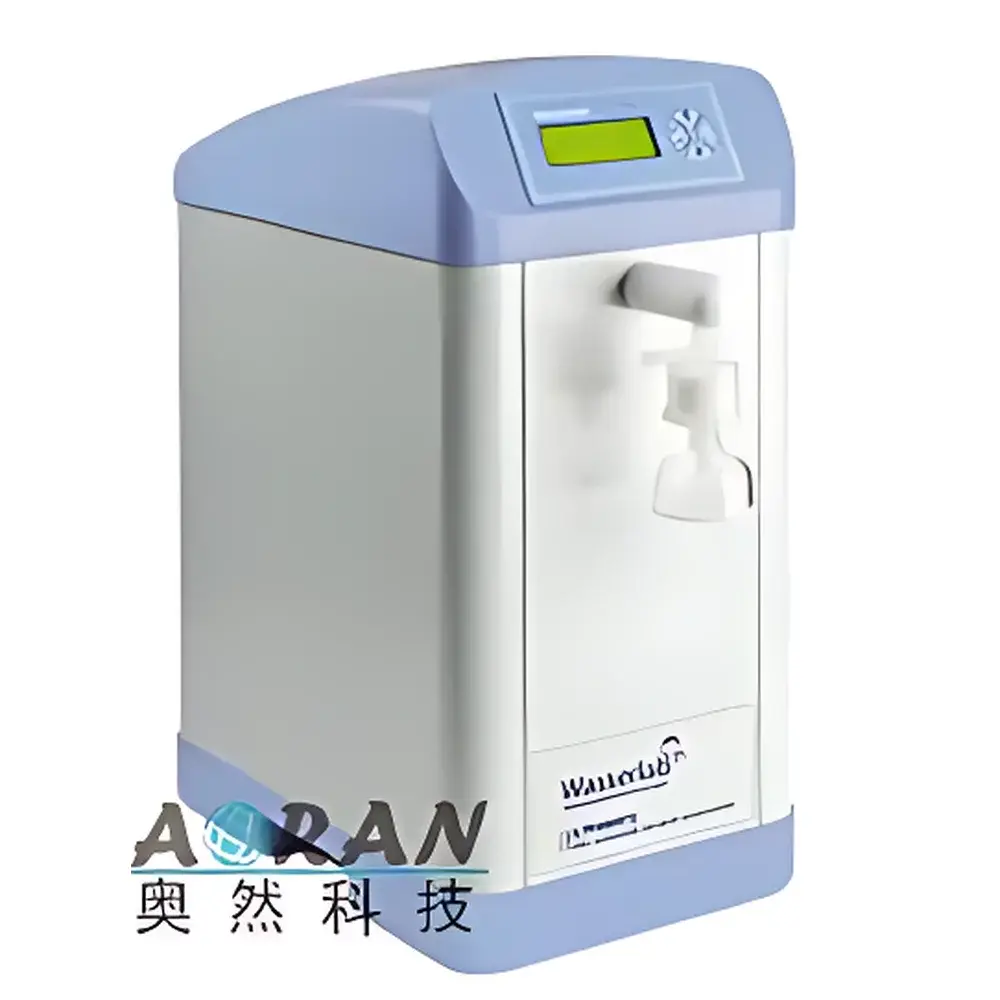
Wasserlab ULTRAMATIC GR Economical Ultra-Pure Water System
| Brand | Wasserlab |
|---|---|
| Origin | Spain |
| Model | ULTRAMATIC GR |
| Output Water Grade | Type I (ASTM D1193-20) |
| Resistivity | 18.2 MΩ·cm at 25 °C |
| TOC | <10 ppb |
| Bacterial Count | <1 CFU/mL |
| Flow Rate | 1.1 L/min |
| Final Filtration | 0.22 µm PES membrane |
| Power Supply | 110–220 VAC, 50–60 Hz |
| Dimensions (H×W×D) | 52 × 25 × 48 cm |
| Weight | 12 kg |
| Feed Water Requirements | Conductivity ≤20 µS/cm, Pressure 1–6 bar, Temp ≤30 °C |
| User Interface | Membrane keypad with LCD display |
| UV Lamp | Integrated 185/254 nm dual-wavelength lamp |
| Real-time Monitoring | Resistivity, temperature, operating hours, filter status, alarm triggers |
Overview
The Wasserlab ULTRAMATIC GR is an entry-level, CE-compliant ultra-pure water system engineered for laboratories requiring consistent Type I water (per ASTM D1193-20 and ISO 3696:1987 Class 1) without the complexity or cost of fully automated platforms. It employs a multi-stage purification architecture—comprising activated carbon prefiltration, reverse osmosis (RO), ion exchange resin polishing, and dual-wavelength (185/254 nm) ultraviolet oxidation—to achieve resistivity ≥18.2 MΩ·cm at 25 °C and total organic carbon (TOC) levels below 10 ppb. The system operates on a closed-loop recirculation principle with continuous UV exposure and terminal 0.22 µm polyethersulfone (PES) filtration to suppress microbial regrowth and ensure end-point sterility. Designed for benchtop deployment in QC labs, academic research settings, and routine analytical workflows—including HPLC mobile phase preparation, buffer formulation, and trace elemental analysis—the ULTRAMATIC GR delivers reproducible water quality under GLP-aligned operational discipline.
Key Features
- Integrated dual-wavelength UV lamp (185 nm for TOC photo-oxidation; 254 nm for microbial inactivation) with real-time status monitoring
- 0.22 µm sterile-grade PES final filter mounted directly at the dispensing outlet, minimizing post-purification contamination risk
- LCD interface with membrane keypad for intuitive manual operation—no software installation or network configuration required
- Comprehensive parameter logging: real-time resistivity, water temperature, cumulative operating hours, and consumable service timers
- Multi-level alarm system with visual and audible alerts for out-of-spec resistivity, low feed pressure, high inlet conductivity, or expired consumables
- Temperature-compensated resistivity measurement (per IEC 60746-2) ensuring accuracy across ambient lab conditions (15–30 °C)
- Compact footprint (52 × 25 × 48 cm) and lightweight design (12 kg) enabling flexible placement in space-constrained environments
Sample Compatibility & Compliance
The ULTRAMATIC GR produces water meeting or exceeding the specifications for Type I reagent water defined in ASTM D1193-20, ISO 3696:1987 Class 1, and CLSI EP22-A2 guidelines for clinical laboratory water. Its output supports critical applications where ionic purity, low organics, and microbial control are non-negotiable—including ICP-MS calibration, cell culture media preparation (when paired with optional endotoxin-retentive filters), and electrophysiology saline solutions. While the base configuration does not include endotoxin or particle counters, its 0.22 µm terminal filtration and UV-mediated bioburden reduction align with USP recommendations for purified water used in non-sterile pharmaceutical manufacturing. All wetted materials comply with FDA 21 CFR 177.2420 and EU Regulation (EC) No 1935/2004 for food-contact safety.
Software & Data Management
The ULTRAMATIC GR operates as a standalone instrument with no embedded operating system or remote connectivity. Data integrity is maintained via hardware-based event logging: all resistivity readings, temperature values, alarm triggers, and filter replacement timestamps are stored in non-volatile memory and displayed on-demand via the LCD interface. Service history—including GR purification module, UV lamp, and 0.22 µm filter change dates—is tracked using dedicated countdown timers, supporting internal audit readiness and preventive maintenance scheduling. Though not Part 11 compliant by default, the system’s deterministic behavior, immutable timestamped logs, and manual record-keeping capability enable straightforward integration into GxP environments when documented per site-specific SOPs.
Applications
- HPLC and UHPLC mobile phase and blank preparation
- Atomic absorption spectroscopy (AAS) and inductively coupled plasma (ICP) diluent preparation
- Molecular biology applications including PCR reagent preparation and electrophoresis buffer formulation
- Calibration of conductivity and pH meters requiring high-resistivity rinse water
- General analytical chemistry lab use where ASTM Type I water is mandated but high-throughput automation is unnecessary
FAQ
What feed water quality is required for optimal performance?
The ULTRAMATIC GR requires pretreated municipal or RO feed water with conductivity ≤20 µS/cm, pressure between 1–6 bar, and temperature ≤30 °C. Hardness >200 ppm or free chlorine >0.5 mg/L may reduce RO membrane lifespan.
Can the system be connected to a wall-mounted dispenser or reservoir?
No—the ULTRAMATIC GR is designed exclusively for direct point-of-use dispensing. It lacks a built-in pump or pressurized storage tank and does not support external distribution loops.
How often must consumables be replaced?
GR purification modules require replacement every 6–12 months depending on feed water quality; UV lamps every 12 months; and the 0.22 µm terminal filter every 3–6 months or after 1,000 L of dispensed water, whichever occurs first.
Is temperature compensation enabled by default?
Yes—resistivity measurements are automatically compensated to 25 °C using integrated NTC thermistor feedback, conforming to IEC 60746-2 standards.
Does the unit meet regulatory requirements for pharmaceutical QC labs?
It satisfies core water quality specifications in USP , Ph. Eur. 2.2.45, and JP 17 for purified water; however, validation documentation, IQ/OQ protocols, and additional particle/endotoxin testing must be performed per facility-specific regulatory strategy.



