
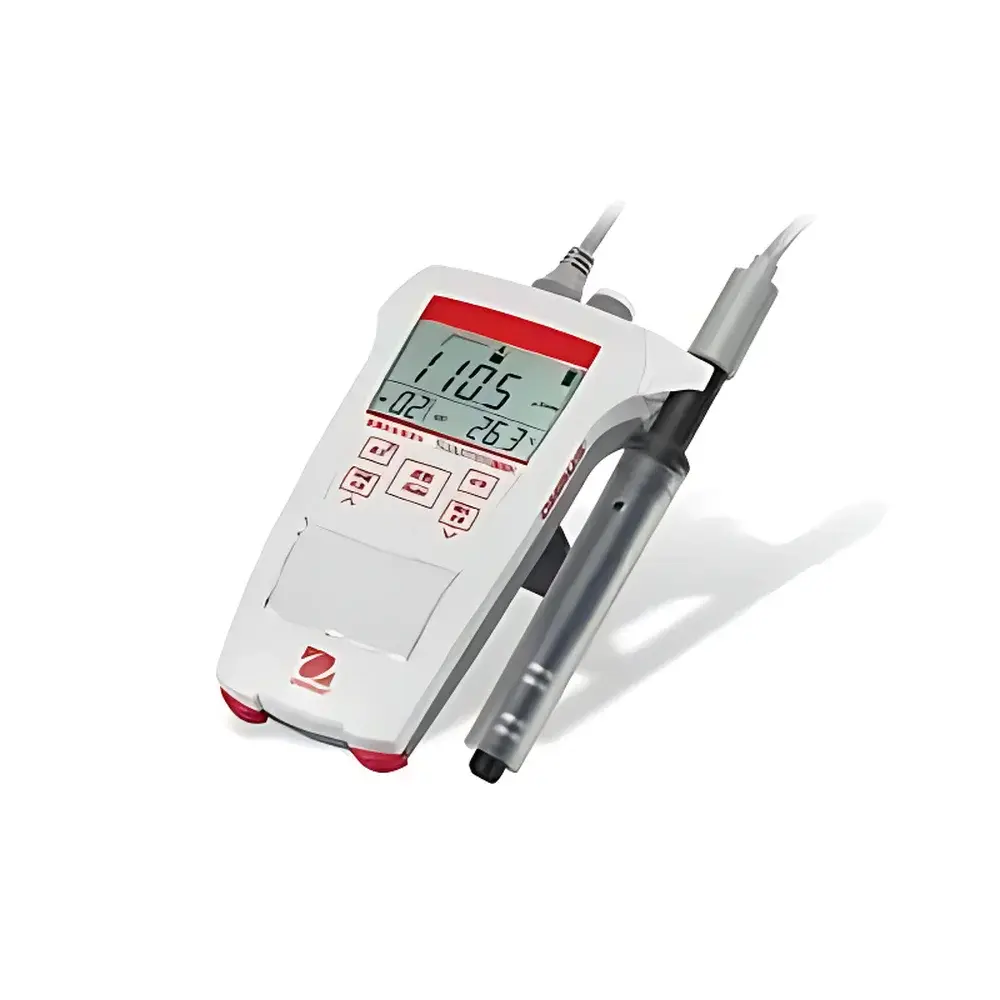
OHAUS STARTER 300C Portable Conductivity and pH Meter
| Brand | OHAUS |
|---|---|
| Model | STARTER 300C |
| Type | Portable Multiparameter Electrochemical Analyzer |
| Conductivity Range | 0.00 µS/cm to 199.9 mS/cm |
| TDS Range | 0.1 mg/L to 199.9 g/L |
| Resistivity Range | 0 to 100 MΩ·cm |
| Salinity Range | 0 to 100 ppt |
| Temperature Range | −5 °C to 105 °C |
| pH Accuracy | ±0.01 pH |
| pH Resolution | 0.01 pH |
| Temp. Accuracy | ±0.3 °C (calibrated) |
| Temp. Compensation | Linear, adjustable from 0.00%/°C to 100.00%/°C |
| Reference Temp. | 20 °C or 25 °C |
| Calibration | 1-point pH |
| Data Storage | 30 measurement records |
| Power | 4 × AAA batteries (>250 h battery life) |
| Dimensions | 90 W × 170 D × 35 H mm |
| Weight | 0.16 kg (without batteries) |
| Display | LCD with icon-based status indicators |
| Enclosure | ABS housing |
| Ingress Protection | IP54 |
| Electrode Interface | Mini-DIN connector for integrated temperature compensation |
Overview
The OHAUS STARTER 300C is a rugged, handheld multiparameter electrochemical analyzer engineered for field-deployable and routine laboratory conductivity, pH, TDS, resistivity, and salinity measurements. Built on a dual-sensor architecture—integrating a four-ring conductivity cell with automatic temperature compensation—the instrument eliminates the need for manual electrode switching across conductivity ranges, thereby reducing calibration drift and operator error. Its measurement principle follows standardized conductometric analysis per ASTM D1125 and ISO 7888, with linear temperature compensation algorithms aligned to industry-accepted reference temperatures (20 °C and 25 °C). Designed for compliance-critical environments including environmental monitoring, wastewater treatment, aquaculture, and educational labs, the STARTER 300C delivers traceable, reproducible results without requiring external software or PC connectivity during operation.
Key Features
- Integrated four-ring conductivity probe: Enables seamless measurement across six decades of conductivity (0.00 µS/cm to 199.9 mS/cm) without range-switching or electrode substitution.
- Intuitive icon-driven LCD interface: Visual indicators for endpoint detection (auto/manual), battery status, calibration mode, and electrode health eliminate interpretation ambiguity.
- Configurable linear temperature compensation: Compensation coefficient adjustable from 0.00% to 100.00% per °C, supporting diverse sample matrices—including high-ionic-strength brines and low-conductivity ultrapure water.
- Ergonomic portable form factor: Textured anti-slip casing, compact footprint (90 × 170 × 35 mm), and single-hand operability ensure stability during outdoor or mobile sampling.
- Power-optimized firmware: Automatic shutdown after 10 minutes of inactivity extends battery life beyond 250 hours using standard AAA cells—critical for extended field campaigns.
- IP54-rated enclosure: Dust-resistant and protected against water splashes from any direction, suitable for use in humid laboratories, greenhouses, and outdoor sampling sites.
Sample Compatibility & Compliance
The STARTER 300C supports aqueous samples across broad physicochemical conditions: from deionized water (0.00 µS/cm) to saturated brine (≥199 mS/cm), and from cryogenic cooling baths (−5 °C) to pasteurization-grade hot process streams (105 °C). Its four-ring electrode design minimizes polarization effects and ensures stable readings in viscous or particulate-laden solutions where two-electrode systems exhibit drift. The instrument complies with key regulatory frameworks governing field instrumentation: its calibration traceability aligns with ISO/IEC 17025 requirements for in-house verification, while data integrity features—including timestamped 30-record internal memory and non-volatile storage—support GLP documentation workflows. Though not 21 CFR Part 11–certified out-of-the-box, audit-ready calibration logs and user-defined electrode constants facilitate integration into GMP-aligned QA/QC protocols.
Software & Data Management
Data handling is optimized for offline usability: all 30 stored measurements include parameter type, numeric value, temperature reading, date/time stamp, and electrode constant used. No proprietary drivers or cloud sync are required—users export records manually via visual inspection or replicate entries into LIMS-compatible spreadsheets. The device stores three factory-preset pH calibration points (pH 4.01, 7.00, 10.01) and allows one-point field recalibration with user-defined buffers. Electrode constant verification is supported through solution-based K-factor checks, enabling lab managers to validate sensor performance prior to critical sampling events. Firmware does not support firmware updates in the field, ensuring configuration stability across deployments.
Applications
- Environmental fieldwork: Rapid assessment of stream conductivity, TDS, and salinity gradients for EPA Method 120.1–compliant watershed surveys.
- Aquaculture and hydroponics: Real-time monitoring of nutrient solution ionic strength and osmotic balance to prevent crop stress or fish mortality.
- Pharmaceutical water systems: Verification of purified water (PW) and water-for-injection (WFI) conductivity against USP limits at point-of-use locations.
- Education and vocational training: Pedagogical platform for teaching fundamental electrochemical principles—including Kohlrausch’s law, cell constant derivation, and temperature-dependent ion mobility.
- Food & beverage QC: Batch-wise verification of brine concentration in pickling, fermentation, and canning operations per AOAC 973.43 guidelines.
FAQ
Does the STARTER 300C support two-point pH calibration?
No—it is configured for single-point pH calibration only, with three preloaded standard buffer values for rapid setup.
Can the four-ring conductivity cell be used for resistivity measurements below 1 MΩ·cm?
Yes—resistivity is calculated inversely from conductivity and displayed concurrently; accuracy remains within ±0.5% F.S. across the full 0–100 MΩ·cm range.
Is the temperature sensor interchangeable or built-in?
The temperature sensor is integrated into the four-ring conductivity probe via a Pt1000 thermistor, eliminating separate thermocouple handling and ensuring simultaneous, co-located measurement.
What is the minimum detectable conductivity with this instrument?
The lower limit is 0.00 µS/cm, with resolution dynamically adapting to range—0.01 µS/cm in ultra-low ranges and 0.1 mS/cm at high conductivity extremes.
How is electrode constant verified or adjusted?
Users enter the certified K-factor (e.g., 0.1, 1.0, or 10 cm⁻¹) directly via keypad; the instrument applies it in real time to all conductivity calculations, supporting NIST-traceable probe validation.





