
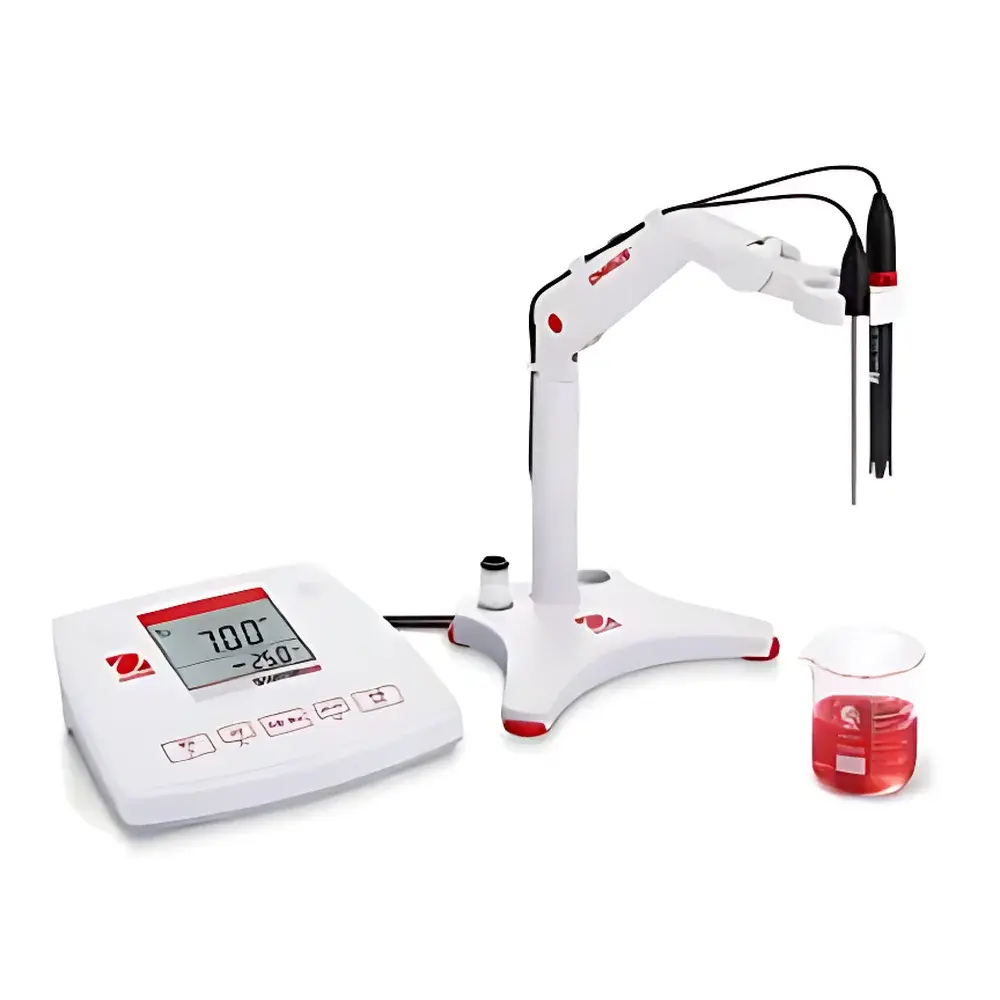
Ohaus STARTER 2100 Benchtop pH Meter
| Brand | Ohaus |
|---|---|
| Origin | USA |
| Model | STARTER 2100 |
| Instrument Type | Benchtop |
| Parameter Types | Multi-parameter |
| Measurement Range | 0.00–14.00 pH |
| Resolution | 0.01 pH |
| Accuracy | ±0.01 pH |
| Calibration Buffer Recognition | Automatic (International Standard Buffers) |
| Temperature Compensation | Automatic & Manual |
| Power Supply | 110–240 V AC, 50/60 Hz / 12 V DC |
| Housing Material | ABS |
| Display | LCD |
Overview
The Ohaus STARTER 2100 Benchtop pH Meter is a rigorously engineered electrochemical measurement system designed for routine pH monitoring and quality control in academic laboratories, pharmaceutical QC environments, and industrial process support settings. Built upon potentiometric measurement principles—where the potential difference between a glass pH electrode and a reference electrode is converted into a pH value—the STARTER 2100 delivers stable, repeatable readings across the full aqueous pH scale (0.00–14.00). Its architecture adheres to fundamental electrochemical standards, including Nernstian response linearity and temperature-dependent slope compensation. The instrument operates at 0.01 pH resolution and maintains ±0.01 pH accuracy under standard calibration conditions, meeting the performance criteria required for ISO/IEC 17025-compliant testing workflows and GLP-regulated documentation.
Key Features
- Automatic buffer recognition for standard international pH calibration solutions (pH 4.01, 7.00, and 10.01), minimizing user error during multi-point calibration
- Dual-mode temperature compensation: automatic compensation via optional STTEMP30 thermistor probe or manual input for ambient or sample-specific temperature values
- Modular benchtop design with integrated independent mounting stand—enabling flexible placement on lab benches, fume hoods, or mobile carts without external clamping hardware
- Robust ABS polymer housing rated for chemical splash resistance and long-term mechanical stability in shared-lab environments
- Backlit LCD display with intuitive icon-driven interface; supports simultaneous readout of pH, temperature, mV, and electrode status indicators
- Universal power compatibility (110–240 V AC, 50/60 Hz) with optional 12 V DC operation for battery-backed or field-deployable configurations
Sample Compatibility & Compliance
The STARTER 2100 is validated for aqueous and mildly buffered liquid samples within standard laboratory operating ranges (5–45 °C). It interfaces seamlessly with Ohaus ST210 combination pH electrodes—designed for general-purpose use with low-drift glass membranes and double-junction reference systems to mitigate contamination in complex matrices. While not certified for hazardous area use (e.g., ATEX or IECEx), the meter complies with IEC 61010-1 safety standards for electrical equipment used in laboratory environments. Its calibration traceability aligns with ASTM E70 and ISO 3696 Grade 3 water specifications when using certified buffer powders (included in pro and pro-F kits). For regulated environments, audit-ready calibration logs can be manually documented per FDA 21 CFR Part 11 guidance, though electronic data capture requires external logging tools.
Software & Data Management
The STARTER 2100 operates as a standalone instrument without proprietary software dependency. All calibration events, measurement timestamps, and electrode diagnostics are retained in non-volatile memory and viewable directly on-device. While it lacks USB or Bluetooth connectivity, its stable analog output (mV mode) enables integration with third-party data acquisition systems (e.g., LabVIEW or custom SCADA platforms) via standard BNC or mini-DIN interfaces. Calibration history—including date, buffer IDs, slope (%), and offset (mV)—is displayed for immediate verification prior to sample analysis. This design prioritizes operational simplicity and regulatory transparency over cloud-based telemetry, supporting labs requiring minimal IT infrastructure or strict data sovereignty policies.
Applications
- Academic teaching labs: Demonstrating acid-base equilibria, titration endpoints, and Nernst equation applications
- Pharmaceutical QC: Monitoring pH of excipient solutions, dissolution media (USP ), and final product formulations
- Food & beverage testing: Verifying pH compliance in acidic products (e.g., juices, fermented dairy, pickled goods) per FDA 21 CFR 114
- Environmental water analysis: Field-preliminary screening of surface water, wastewater effluents, and soil leachates (when paired with ruggedized electrodes)
- Chemical manufacturing: In-process control of reaction mixtures, neutralization batches, and cleaning-in-place (CIP) rinse validation
FAQ
Does the STARTER 2100 support GLP-compliant calibration records?
No built-in electronic signature or audit trail function is provided; however, all calibration parameters are visible on-screen and may be transcribed manually into lab notebooks or LIMS systems compliant with ISO/IEC 17025 documentation requirements.
Can the meter store multiple calibration curves?
It retains only the most recent calibration set (up to 3-point) in active memory; previous calibrations must be re-performed or externally archived.
Is the ST210 electrode suitable for non-aqueous solvents?
No—the ST210 is optimized for aqueous electrolytes; use of organic solvents may damage the reference junction or cause irreversible glass membrane dehydration.
What is the expected electrode lifetime under normal lab use?
With proper storage (in 3 M KCl solution), regular cleaning, and avoidance of proteinaceous or sulfide-rich samples, the ST210 typically maintains specification performance for 12–18 months.
Does the STARTER 2100 meet USP requirements for pH measurement?
Yes—its 0.01 pH resolution, ±0.01 pH accuracy, and automatic temperature compensation satisfy the instrumental criteria outlined in USP General Chapter , provided electrodes are calibrated daily and verified with traceable standards.
Related Products




