Ohaus CP Series Analytical and Precision Balances
| Brand | Ohaus |
|---|---|
| Origin | USA |
| Model | CP Series |
| Balance Type | Analytical Balance / Precision Balance |
| Capacity | 200–500 g (Analytical) |
| Readability | 0.0001 g (0.1 mg) for analytical models |
| Calibration | Internal (auto-calibrating) or External (with certified weights) |
| Repeatability | < ±0.0001 g (analytical) |
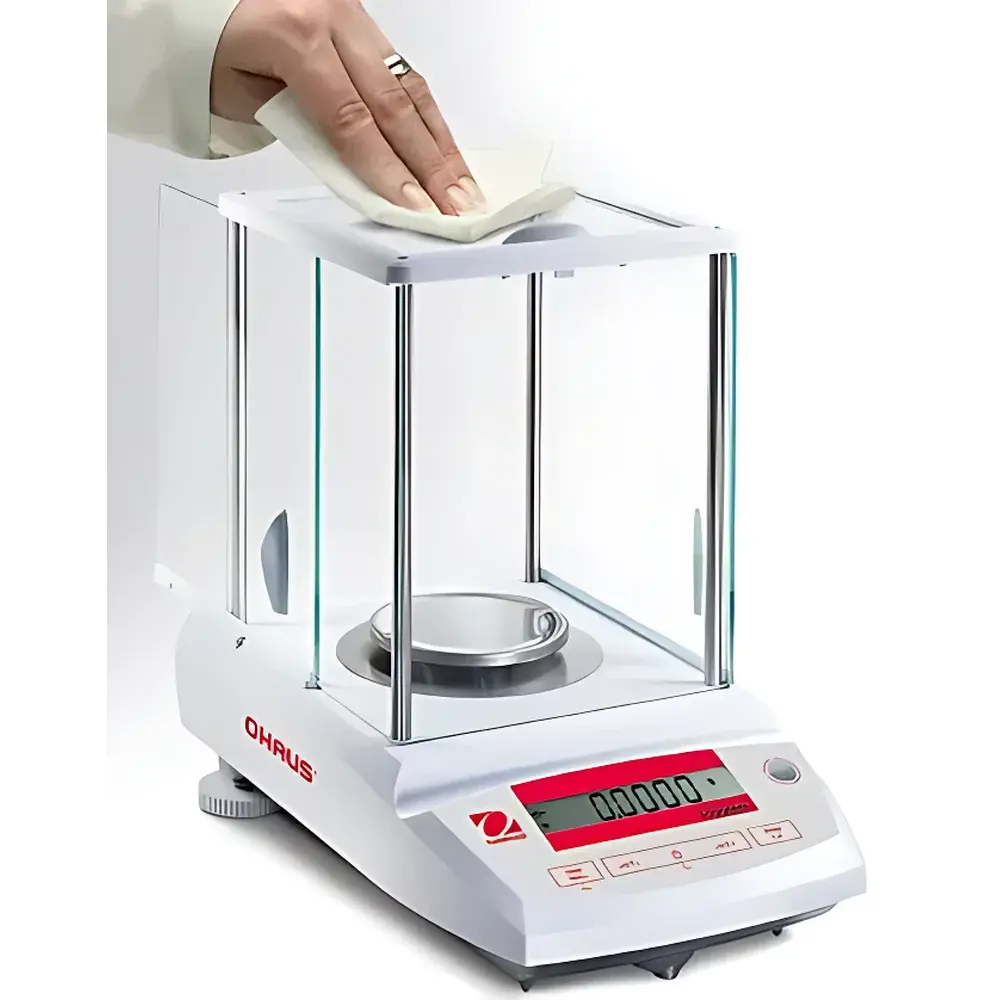
| Construction | Stainless steel pan, ABS housing, metal base, full-glass draft shield with three sliding doors |
| Display | High-contrast LCD |
| Interface | RS232 standard |
| Power | Integrated AC adapter |
Overview
The Ohaus CP Series Analytical and Precision Balances are engineered for laboratories requiring high reproducibility, regulatory compliance, and long-term stability in mass measurement. Designed and manufactured in the United States, these balances operate on electromagnetic force compensation (EMFC) technology — the industry-standard principle for analytical weighing — delivering traceable, temperature-compensated results across a wide range of environmental conditions. The CP Series encompasses two functional tiers: analytical balances (0.1 mg readability, capacities up to 520 g) optimized for QC testing, formulation, and sample preparation in pharmaceutical, academic, and materials science labs; and precision balances (1–10 mg readability, capacities up to 3100 g) suited for routine industrial weighing, bulk material handling, and packaging verification. All models comply with international metrological requirements under OIML R76 and NIST Handbook 44, and support GLP/GMP workflows through audit-trail-ready calibration logging and user-access control features.
Key Features
- Metal base with vibration-damping geometry and integrated leveling feet with front-mounted bubble level for rapid setup and mechanical stability
- Full-glass draft shield with three independently sliding transparent doors — designed to minimize air turbulence while enabling unobstructed access during sample placement and retrieval
- Removable stainless steel weighing pan and modular panel guard — facilitating thorough cleaning and contamination control in regulated environments
- Electrostatic-dissipative side and top sliding doors — mitigating charge-induced drift during low-mass measurements of powders or polymers
- High-contrast monochrome LCD with adjustable backlight — legible under varied ambient lighting, including laminar flow hoods and glove boxes
- Internal motorized calibration system (on CP-C models) with temperature-triggered recalibration — ensuring continuous accuracy without manual intervention
- RS232 serial interface as standard — compatible with LIMS, ELN, and SPC software platforms for automated data capture and 21 CFR Part 11–compliant record retention
Sample Compatibility & Compliance
The CP Series accommodates diverse sample types — from volatile organic compounds and hygroscopic powders to dense metal alloys and packaged reference standards — thanks to its sealed EMFC sensor architecture and draft shield design that minimizes convective interference. Analytical models (e.g., CP124C, CP224C) meet ASTM E898–22 and USP requirements for repeatability and sensitivity testing. Precision variants (e.g., CP2202C, CP4202C) satisfy ISO 9001:2015 clause 7.6 and ISO/IEC 17025:2017 clause 6.4.1 for equipment suitability. All units ship with factory calibration certificates traceable to NIST, and optional UKAS-accredited calibration services are available. The internal calibration function complies with ISO/IEC 17025’s requirement for periodic verification between external calibrations.
Software & Data Management
Ohaus CP balances integrate seamlessly into laboratory digital infrastructure via native RS232 protocol. No proprietary drivers are required: ASCII-based output enables direct ingestion into Excel, LabWare LIMS, Thermo Fisher SampleManager, or custom Python/Node.js data pipelines. Each balance supports configurable data formatting (e.g., weight + timestamp + operator ID), auto-printing to serial label printers, and error-code logging for troubleshooting. When used with Ohaus’s optional Explorer Pro software (sold separately), users gain access to advanced features including multi-point linearity validation, calibration history dashboards, and electronic signature-enabled calibration reports — all structured to align with FDA 21 CFR Part 11 Annex 11 and EU GMP Annex 11 expectations for data integrity.
Applications
- Pharmaceutical: Active pharmaceutical ingredient (API) dispensing, tablet weight uniformity testing per USP , and dissolution sample preparation
- Academic Research: Gravimetric analysis in analytical chemistry, catalyst loading in catalysis studies, and micro-sample preparation for SEM/TEM
- Quality Control: Raw material verification against COA specifications, fill-weight checks in food & beverage production, and density determination via pycnometry
- Materials Science: Powder blending homogeneity assessment, polymer additive dosing, and electrode coating mass validation in battery R&D
- Environmental Labs: Filter weighing for particulate matter (PM2.5/PM10) analysis per EPA Method IO-4.2 and ISO 12103-1
FAQ
What is the difference between internal and external calibration in the CP Series?
Internal calibration uses a built-in motorized weight and temperature-sensing circuit to perform automatic, repeatable adjustments without user intervention. External calibration requires manual placement of certified reference weights and is typically performed during initial installation or after relocation.
Can the CP Series be connected to a networked LIMS system?
Yes — via RS232-to-Ethernet converters or serial servers, CP balances transmit real-time weight data to networked LIMS platforms. Configuration requires setting baud rate (9600 default), parity (none), and stop bits (1) in both the balance menu and host system.
Is the draft shield removable for cleaning?
The full-glass draft shield is fully detachable without tools. All glass panels and sliding mechanisms are designed for autoclave-compatible cleaning protocols in cleanroom environments.
Does the CP Series support GLP-compliant audit trails?
While the balance itself does not store user-specific audit logs internally, it outputs timestamped, operator-ID-tagged data streams via RS232 — enabling full traceability when integrated with compliant ELN or LIMS software that enforces electronic signatures and change control.
What maintenance intervals are recommended for optimal performance?
Daily: Level check and zero verification. Weekly: Draft shield cleaning and pan inspection. Annually: Full external calibration by an accredited service provider — documented with NIST-traceable certificate and uncertainty budget.