
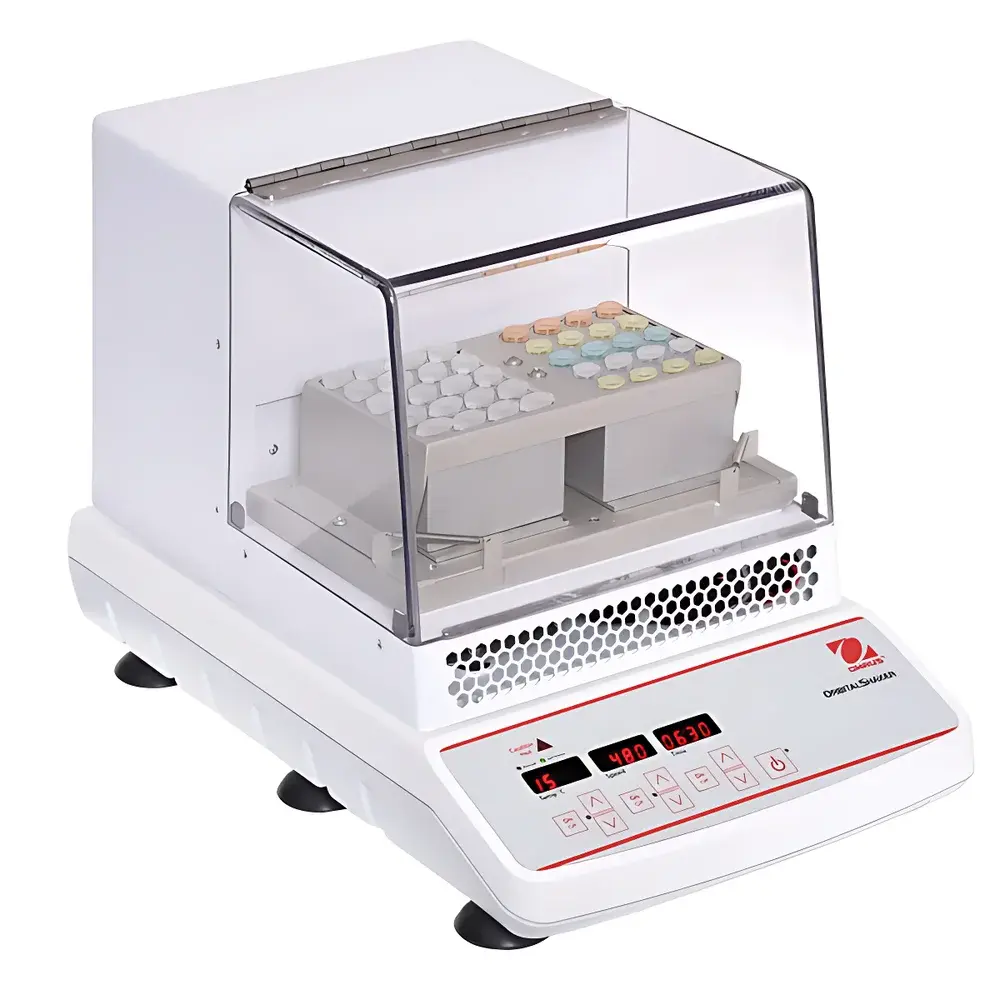
OHAUS ISICMBCDG Refrigerated Orbital Shaker
| Brand | OHAUS |
|---|---|
| Origin | USA |
| Manufacturer Type | Original Equipment Manufacturer (OEM) |
| Origin Category | Imported Instrument |
| Model | ISICMBCDG |
| Instrument Type | Refrigerated Orbital Incubator Shaker |
| Timer Range | 1 s to 160 h |
| Oscillation Speed | 100–1200 rpm |
| Orbit Diameter | 3 mm |
| Temperature Range | Ambient −10 °C to 65 °C |
| Number of Shaking Platforms | 2 |
Overview
The OHAUS ISICMBCDG Refrigerated Orbital Shaker is an engineered solution for precise, temperature-controlled orbital agitation in life science laboratories. Designed around a robust three-eccentric-shaft balanced drive system and a brushless DC motor, it delivers consistent, low-vibration motion essential for sensitive biological applications such as mammalian cell culture, bacterial suspension growth, hybridization assays, and enzyme kinetics studies. Its refrigeration capability—extending operation down to 10 °C below ambient—enables thermally demanding protocols without external cold rooms. The unit operates on the principle of orbital shaking with a fixed 3 mm diameter orbit, ensuring uniform mixing across microplates and modular sample carriers while minimizing shear stress on fragile cells or macromolecular complexes.
Key Features
- Microprocessor-based control architecture with non-volatile memory: retains last-used settings—including speed, temperature, and timer—even after power interruption, supporting GLP-compliant workflow continuity.
- PID temperature regulation with ±0.5 °C uniformity at 37 °C, adjustable in 1 °C increments; integrated temperature calibration mode allows traceable adjustment against NIST-traceable reference probes.
- Two independently usable orbital platforms (each accommodating one standard microplate or one modular carrier), enabling parallel experiments under identical or differentiated conditions.
- Intuitive touch-panel interface with dedicated LED displays for real-time monitoring of temperature, speed, elapsed time, and remaining timer duration—no menu navigation required for critical parameter verification.
- Programmable timer with dual functionality: counts down from user-defined duration (1 s to 160 h) and optionally triggers automatic shutdown upon completion; elapsed time display supports process validation and SOP adherence.
- Comprehensive safety suite: mechanical overload detection with audible/visual alert, soft-start acceleration to prevent splashing, high-temperature warning indicator (illuminates above 40 °C internal air temperature), spill-guidance channeling, and polycarbonate transparent lid that maintains thermal integrity while permitting visual sample inspection.
Sample Compatibility & Compliance
The ISICMBCDG accommodates standard 96-well and 384-well microplates, deep-well plates, and interchangeable OHAUS-compatible modules (e.g., tube racks, PCR strip holders). Its 3 mm orbit ensures compatibility with low-volume aqueous suspensions and viscous media up to ~20 cP without vortex formation or edge effects. The device complies with CE and TÜV safety directives (EN 61010-1:2010, EN 61326-1:2013) and meets electromagnetic compatibility requirements for laboratory environments. While not pre-certified for FDA 21 CFR Part 11, its audit-trail-capable logging (via optional OHAUS LoggerPro™ software integration) supports GxP-aligned data integrity practices when deployed in regulated QC/QA labs.
Software & Data Management
The shaker operates autonomously via front-panel controls but integrates seamlessly with OHAUS LoggerPro™ software (Windows-based, USB-connected) for remote configuration, real-time parameter logging, and export of timestamped CSV files. Logged parameters include setpoint vs. actual temperature (±0.1 °C resolution), speed (±1 rpm), timer status, and event flags (e.g., door open, overload trigger, calibration activation). Data exports are compatible with LIMS and ELN systems, and the software supports user-level access control—essential for environments adhering to ISO/IEC 17025 or CLIA standards.
Applications
- Cell culture maintenance: uniform suspension of adherent and suspension cell lines during subculturing or transfection protocols.
- Bacterial and yeast fermentation: optimized aeration and nutrient homogenization in shake flasks and deep-well plates.
- Molecular biology workflows: DNA/RNA hybridization, immunoassay plate washing, ELISA incubation, and restriction digestion reactions requiring stable thermal-agitation coupling.
- Protein biochemistry: gentle agitation during dialysis, refolding, or ligand-binding assays where temperature drift must remain within ±0.3 °C over extended durations.
- Quality control testing: stability studies per ICH Q5C guidelines, including accelerated degradation profiling under controlled thermal-mechanical stress.
FAQ
What is the minimum operating temperature relative to ambient?
The unit cools to 10 °C below ambient temperature, with performance dependent on ambient conditions (rated for 5–40 °C, ≤80% RH non-condensing).
Can both platforms operate at different speeds or temperatures simultaneously?
No—the ISICMBCDG maintains identical temperature and speed setpoints across both platforms; independent control is not supported.
Is the 3 mm orbit suitable for high-viscosity samples?
Yes, the 3 mm orbit minimizes radial shear while maintaining sufficient mixing energy for solutions up to ~20 mPa·s; for higher viscosities, lower speeds (<300 rpm) are recommended.
Does the unit support external temperature probe input for chamber calibration?
Yes—its built-in temperature calibration mode accepts user-entered offset values derived from external calibrated thermistors or RTDs.
What electrical specifications apply for international deployment?
The device is configured for 230 V, 50/60 Hz, 1 A operation; voltage-specific variants are available upon request for 100–120 V markets.





