
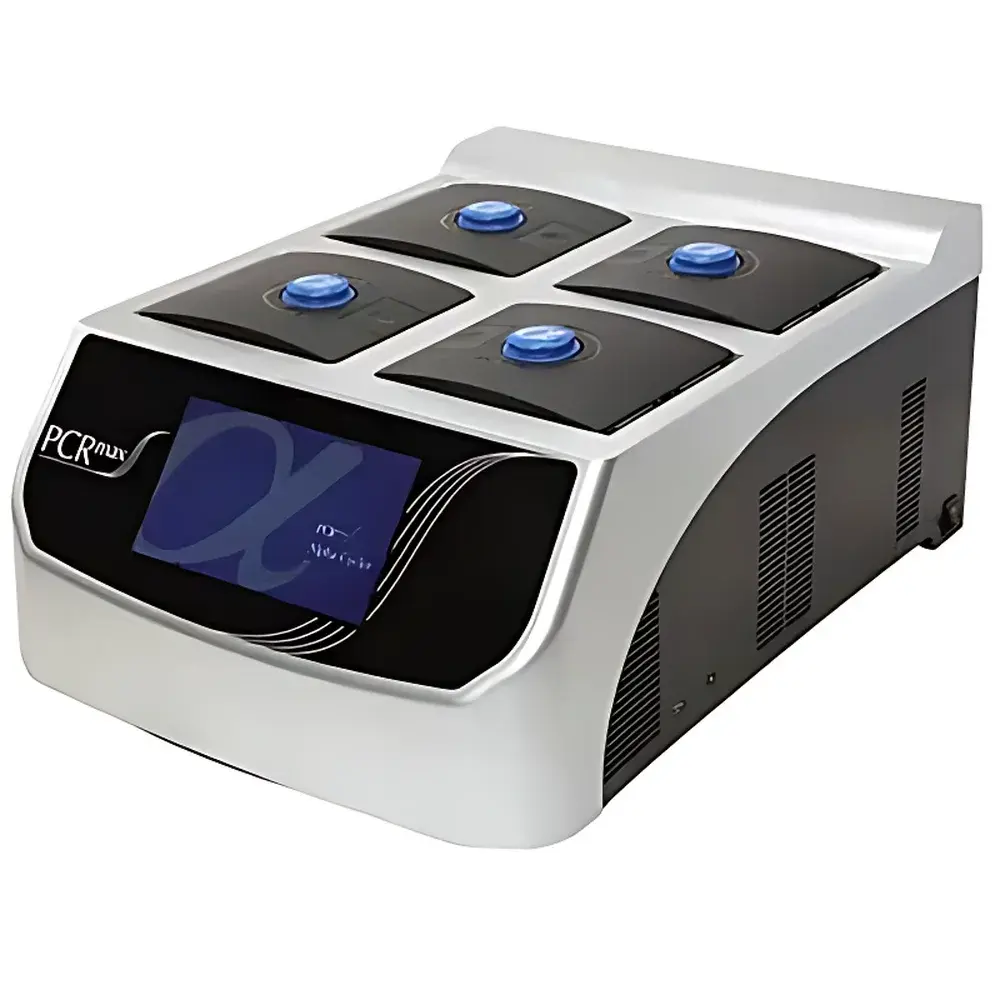
PCRmax AC-4 Four-Module Gradient PCR System
| Brand | PCRmax |
|---|---|
| Origin | United Kingdom |
| Model | AC-4 |
| Sample Capacity | 4 × 96-well or 4 × 384-well blocks (configurable combinations) |
| Max Heating Rate | 3.4°C/sec |
| Temperature Accuracy | ±0.1°C |
| Block Uniformity | ±0.3°C |
| Temperature Range | 4–100°C |
| Gradient Range | 10–100°C |
| Gradient Span | 1–29°C |
| Thermal Lid Temp | 35–115°C |
| Thermal Lid Uniformity | ±5°C |
| Thermal Lid Preheat Time | <2 min |
| Max Cycles per Program | 99 |
| Onboard Storage | ≥1,000 protocols |
| Display | 10" 1080P color LCD touchscreen |
| OS | Android-based embedded system |
| Power | 1600 W |
| Dimensions (W×D×H) | 700 × 535 × 335 mm |
| Noise Level | <50 dB (per module) |
Overview
The PCRmax AC-4 Four-Module Gradient PCR System is a high-throughput, modular thermal cycler engineered for laboratories requiring parallel amplification of diverse nucleic acid targets under independently optimized thermal conditions. Built upon PCRmax’s Alpha Cycler platform, the AC-4 employs Peltier-based semiconductor heating and cooling to deliver rapid, precise, and reproducible temperature transitions across four physically separate reaction blocks—each fully programmable and thermally isolated. Its core architecture supports simultaneous execution of up to four distinct PCR protocols—including standard, touchdown, gradient, and long-range amplifications—without inter-block thermal interference. Designed for compliance with GLP and ISO/IEC 17025 laboratory practices, the system integrates hardware-level traceability, user-access control, and audit-ready operation logs—making it suitable for regulated environments involved in clinical diagnostics development, quality control of biologics, and academic genomics research.
Key Features
- Four independent thermal blocks—each configurable as 96-well or 384-well format—with no shared thermal mass or electrical coupling, enabling true parallel experimentation.
- Dynamic gradient capability on all four modules: each block can generate a linear 12-point temperature gradient (spanning 1–29°C) with identical hold times across all positions—ideal for empirical optimization of annealing temperatures.
- Touchdown PCR functionality embedded at the firmware level: allows progressive reduction of annealing temperature over successive cycles within a single program, improving specificity without manual intervention.
- 10-inch 1080P capacitive touchscreen with intuitive Android-based UI; supports both graphical drag-and-drop protocol design and auto-programming based on amplicon length and primer Tm inputs.
- Thermal lid with manually adjustable pressure and wide operating range (35–115°C); preheats in under two minutes and maintains uniform contact across variable-height consumables (e.g., low-profile plates, tube strips).
- USB-based user authentication: login credentials and custom settings stored exclusively on removable USB media—no local account persistence, ensuring data sovereignty and instrument portability across shared lab spaces.
- Power-loss recovery with automatic resume: preserves cycle count and thermal state upon unexpected interruption, minimizing experimental attrition.
- Remote status monitoring via QR code scan using any smartphone camera—no proprietary app required; real-time operational feedback includes block temperature, remaining time, and error flags.
Sample Compatibility & Compliance
The AC-4 accommodates standard ANSI/SBS-compliant 96-well and 384-well plates, skirted or unskirted, as well as 0.2 mL and 0.1 mL tube strips. Its mechanical lid design applies consistent, user-adjustable pressure to ensure optimal thermal transfer regardless of plate warpage or manufacturer variance. From a regulatory standpoint, the system supports ALCOA+ data integrity principles: all protocol modifications, user logins, and run executions are timestamped and logged internally with immutable metadata. While not FDA 21 CFR Part 11-certified out-of-the-box, its audit trail structure—including exportable CSV logs and USB-based user isolation—facilitates validation against internal SOPs aligned with ISO 13485, CLIA, or GMP Annex 11 requirements.
Software & Data Management
The embedded Android OS hosts a dedicated thermal cycler application with dual programming modes: visual timeline editing and parameter-driven auto-generation. Protocols may be saved locally (≥1,000 programs retained in non-volatile memory) or exported/imported via USB-A interface. All user-defined profiles—including gradient matrices, touchdown slopes, and hold durations—are versioned and tagged with creator ID and date. No cloud connectivity is enabled by default; data residency remains entirely on-device or on user-controlled USB media. For integration into LIMS or ELN ecosystems, raw log exports include cycle-by-cycle temperature traces, ramp rates, and deviation alerts—formatted for parsing by third-party analytics tools compliant with MIAME or MAGE-TAB standards.
Applications
The AC-4 is routinely deployed in multiplex assay development, where differential primer melting temperatures necessitate side-by-side gradient testing. Its four-module independence enables concurrent validation of extraction methods (e.g., comparing column vs. magnetic bead yields), reference gene normalization panels, and NGS library amplification QC—all within a single instrument footprint. In translational research labs, it supports longitudinal studies requiring identical cycling parameters across multiple sample sets processed at staggered intervals, leveraging USB-based profile portability to eliminate inter-instrument calibration drift. Educational institutions utilize its graphical programming interface to demonstrate fundamental PCR kinetics, while QC units in IVD manufacturing rely on its ±0.1°C accuracy and <0.3°C uniformity to meet ISO 15189 verification criteria for amplification step consistency.
FAQ
Can the AC-4 run different plate formats simultaneously on separate modules?
Yes—each of the four modules supports independent configuration as either a full 96-well or full 384-well block, or mixed arrangements (e.g., one 96-well + three 384-well), with no hardware reconfiguration required.
Is gradient temperature control available on all modules during a single run?
Yes—each module executes its own 12-point gradient profile concurrently, with identical incubation duration per temperature step across all positions.
Does the system support electronic signature or 21 CFR Part 11 compliance?
It provides foundational elements (audit trail, user authentication, immutable logs), but formal Part 11 validation requires site-specific risk assessment and procedural controls—not built-in software certification.
How is thermal uniformity verified across the block surface?
PCRmax certifies block uniformity per ISO 15197 Annex D methodology: measurements taken at 9 standardized positions across each block at 60°C and 95°C, reporting maximum deviation as ±0.3°C.
What happens to running protocols during a power outage?
The system retains current cycle number and thermal state in battery-backed memory and resumes automatically upon power restoration—no manual restart or data loss occurs.




